







Question: There is a cost efficient firm with the cost function: TC(q) = 0.57. We will call this firm the dominant firm because it will NOT
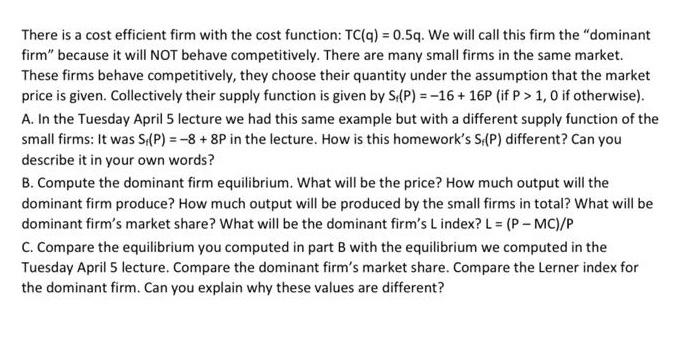
There is a cost efficient firm with the cost function: TC(q) = 0.57. We will call this firm the "dominant firm" because it will NOT behave competitively. There are many small firms in the same market. These firms behave competitively, they choose their quantity under the assumption that the market price is given. Collectively their supply function is given by Sc(P) = -16 + 16P (if P > 1, 0 if otherwise). A. In the Tuesday April 5 lecture we had this same example but with a different supply function of the small firms: It was S:(P) = -8 + 8P in the lecture. How is this homework's S/(P) different? Can you describe it in your own words? B. Compute the dominant firm equilibrium. What will be the price? How much output will the dominant firm produce? How much output will be produced by the small firms in total? What will be dominant firm's market share? What will be the dominant firm's Lindex? L = (P-MC)/P C. Compare the equilibrium you computed in part B with the equilibrium we computed in the Tuesday April 5 lecture. Compare the dominant firm's market share. Compare the Lerner index for the dominant firm. Can you explain why these values are different? There is a cost efficient firm with the cost function: TC(q) = 0.57. We will call this firm the "dominant firm" because it will NOT behave competitively. There are many small firms in the same market. These firms behave competitively, they choose their quantity under the assumption that the market price is given. Collectively their supply function is given by Sc(P) = -16 + 16P (if P > 1, 0 if otherwise). A. In the Tuesday April 5 lecture we had this same example but with a different supply function of the small firms: It was S:(P) = -8 + 8P in the lecture. How is this homework's S/(P) different? Can you describe it in your own words? B. Compute the dominant firm equilibrium. What will be the price? How much output will the dominant firm produce? How much output will be produced by the small firms in total? What will be dominant firm's market share? What will be the dominant firm's Lindex? L = (P-MC)/P C. Compare the equilibrium you computed in part B with the equilibrium we computed in the Tuesday April 5 lecture. Compare the dominant firm's market share. Compare the Lerner index for the dominant firm. Can you explain why these values are different
Step by Step Solution
There are 3 Steps involved in it

Get step-by-step solutions from verified subject matter experts
 Study Help