







Question: ~ There is a mass one of buyers with private values v F[0, 1] with density f, and a mass one of sellers with
![F[0, 1] with density f, and a mass one of sellers with](https://dsd5zvtm8ll6.cloudfront.net/si.experts.images/questions/2023/06/649561f4c5272_1687511540539.jpg)
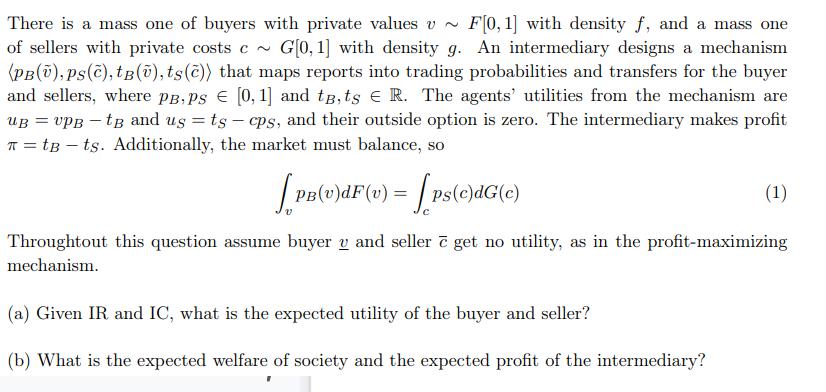
~ There is a mass one of buyers with private values v F[0, 1] with density f, and a mass one of sellers with private costs c~ G[0, 1] with density g. An intermediary designs a mechanism (PB(7), Ps(C), t(0), ts(c)) that maps reports into trading probabilities and transfers for the buyer and sellers, where PB, Ps [0, 1] and tp, ts R. The agents' utilities from the mechanism are uB = VPB - t and us=ts - cps, and their outside option is zero. The intermediary makes profit T=tBts. Additionally, the market must balance, so [ PB(v)dF (v) = [ ps(c)dG(c) Throughtout this question assume buyery and seller get no utility, as in the profit-maximizing mechanism. (a) Given IR and IC, what is the expected utility of the buyer and seller? (b) What is the expected welfare of society and the expected profit of the intermediary? (1) (c) What is the welfare maximizing allocation given the market must balance (1)? (d) Assume v, c~ U[0, 1]. What is expected welfare and expected profit under the welfare maxi- mizing allocation? 1-F(v) f(v) (e) Assume that MR(v) = v - is increasing in v and MC(c) = c + G is increasing in c. g(c) What is the profit maximizing allocation given the market must balance (1)? (f) Assume v, c~ U[0, 1]. What is expected welfare and expected profit under the profit maximizing allocation?
Step by Step Solution
3.45 Rating (145 Votes )
There are 3 Steps involved in it
a The expected utility of the buyer and seller can be calculated as follows For the buyer the expect... View full answer

Get step-by-step solutions from verified subject matter experts
 Study Help