







Question: THERE IS ENOUGH INFORMATION PROVIDED: Solenoid S whose cross - section is shown in Fig. 3 is wrapped with n turns of wire per its
THERE IS ENOUGH INFORMATION PROVIDED:
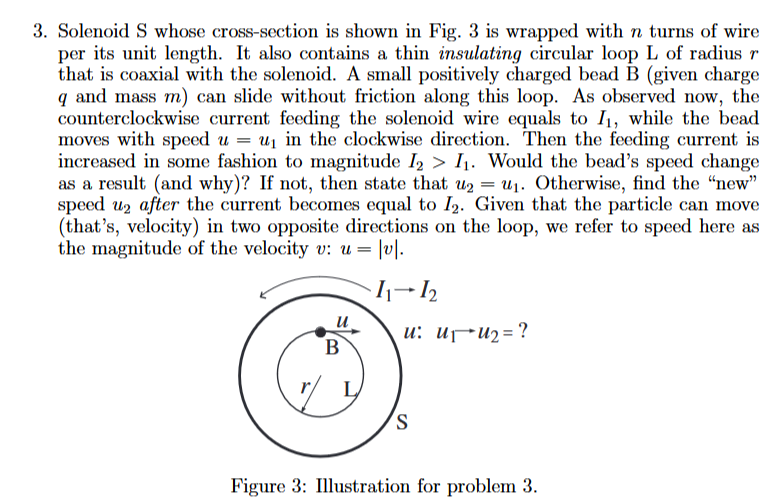
Solenoid S whose crosssection is shown in Fig. is wrapped with n turns of wire per its unit length. It also contains a thin insulating circular loop L of radius r that is coaxial with the solenoid. A small positively charged bead B given charge q and mass m can slide without friction along this loop. As observed now, the counterclockwise current feeding the solenoid wire equals to I while the bead moves with speed u u in the clockwise direction. Then the feeding current is increased in some fashion to magnitude Solenoid S whose crosssection is shown in Fig. is wrapped with n turns of wire per its unit length. It also contains a thin insulating circular loop L of radius r that is coaxial with the solenoid. A small positively charged bead B given charge q and mass m can slide without friction along this loop. As observed now, the counterclockwise current feeding the solenoid wire equals to I while the bead moves with speed uu in the clockwise direction. Then the feeding current is increased in some fashion to magnitude I I Would the bead's speed change
as a result and why If not, then state that uu Otherwise, find the "new" speed u after the current becomes equal to I Given that the particle can move
thats velocity in two opposite directions on the loop, we refer to speed here as the magnitude of the velocity v:uv
Figure : Illustration for problem
Step by Step Solution
There are 3 Steps involved in it
1 Expert Approved Answer
Step: 1 Unlock

Question Has Been Solved by an Expert!
Get step-by-step solutions from verified subject matter experts
Step: 2 Unlock
Step: 3 Unlock
 Study Help