







Question: There is no more information. what the assignment requires basically is to create sub-questions, possible answers to the sub-questions and finally data sources need that
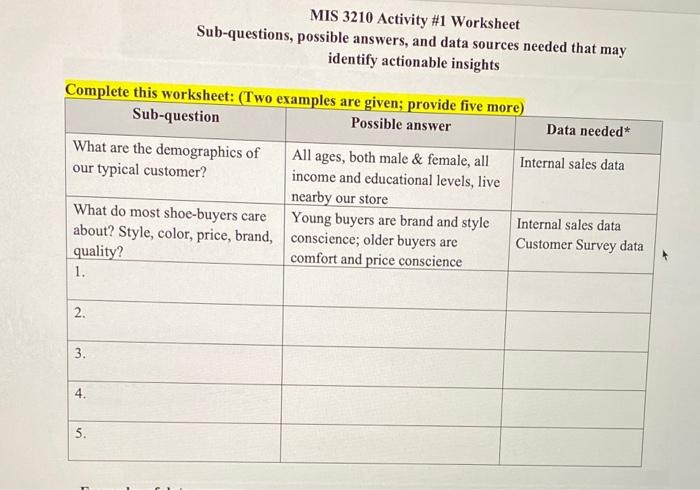
There is no more information. what the assignment requires basically is to create sub-questions, possible answers to the sub-questions and finally data sources need that may identify actionable insights in relation to the scenario above.
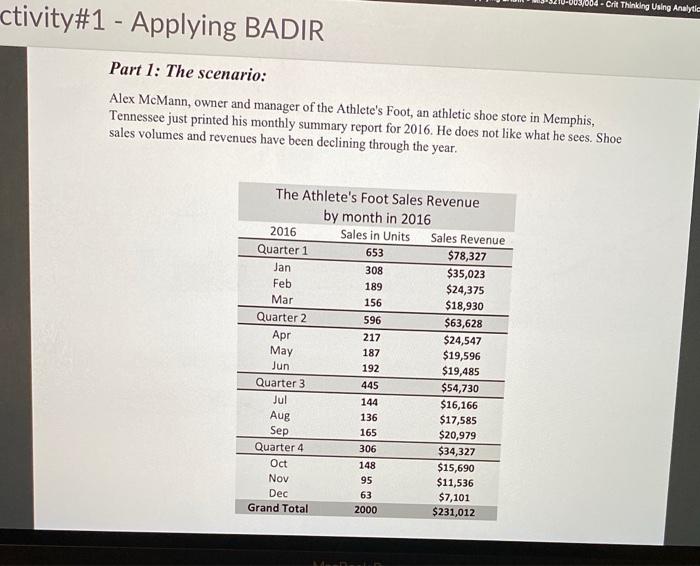
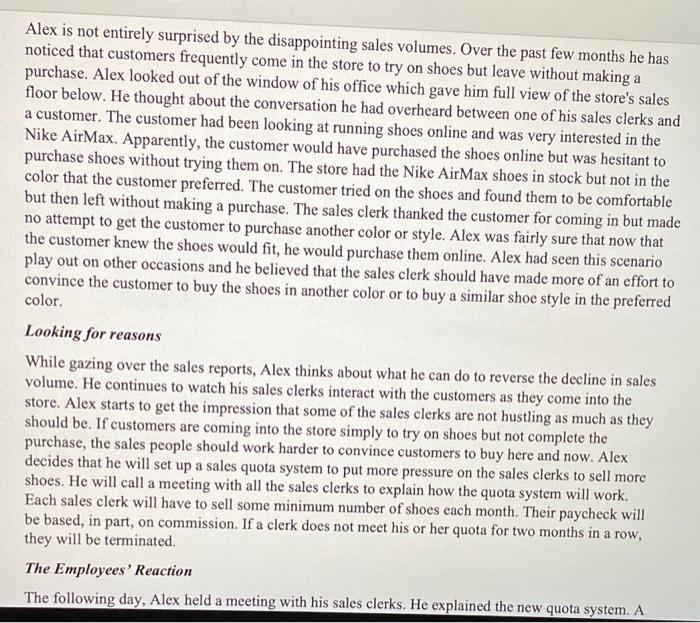
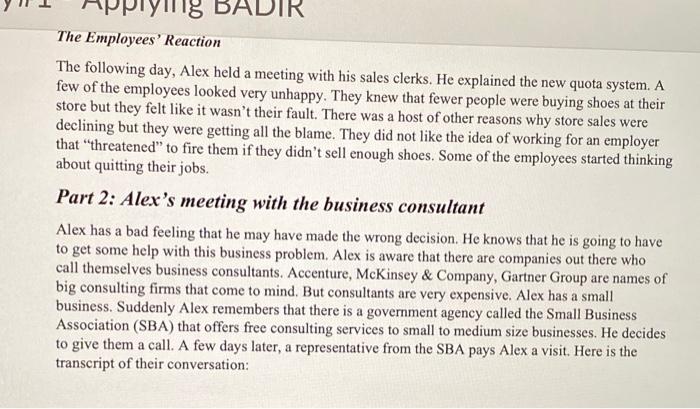
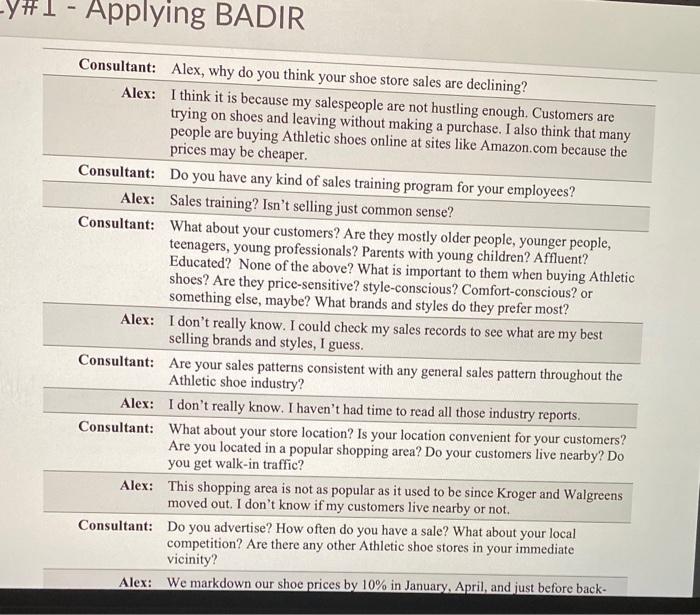
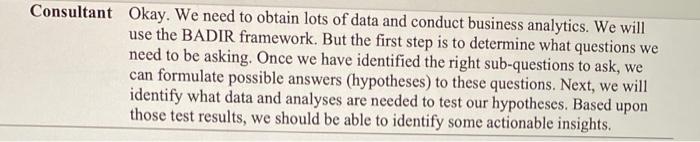
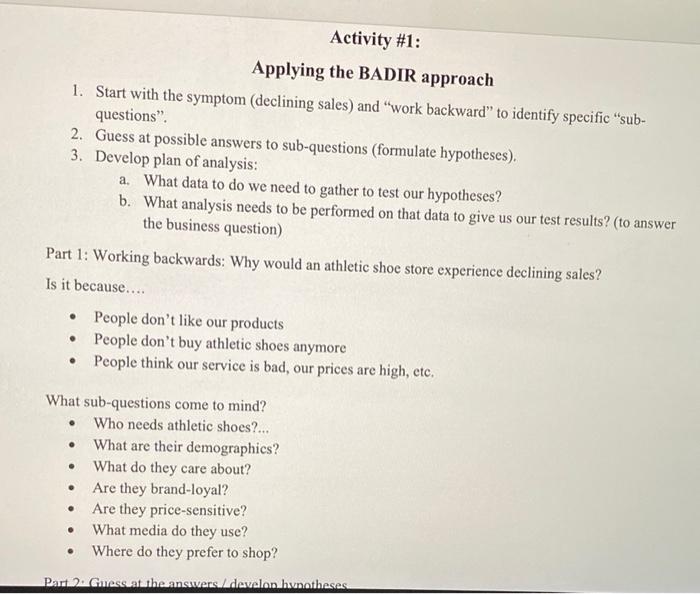
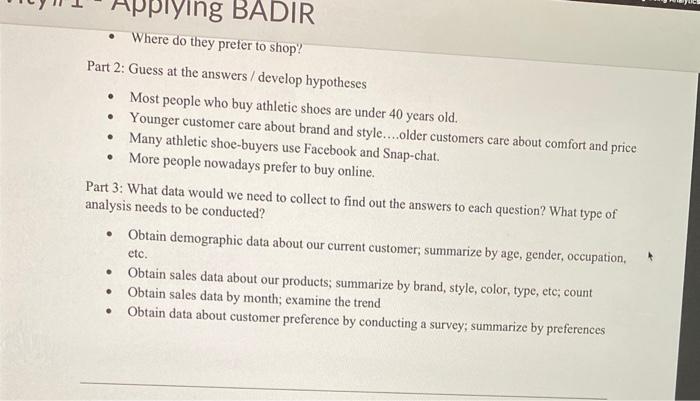
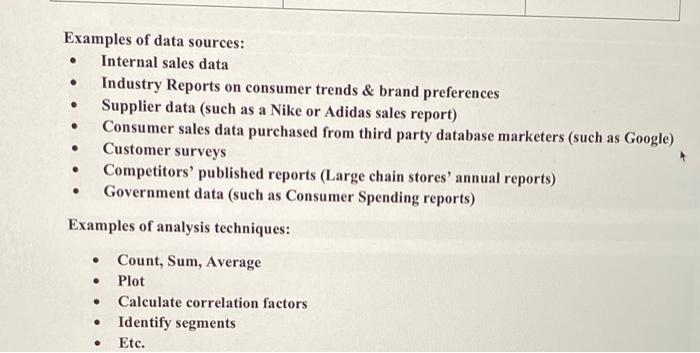
-Crite Thinking Using Analytic ctivity#1 - Applying BADIR Part 1: The scenario: Alex McMann, owner and manager of the Athlete's Foot, an athletic shoe store in Memphis, Tennessee just printed his monthly summary report for 2016. He does not like what he sees. Shoe sales volumes and revenues have been declining through the year. The Athlete's Foot Sales Revenue by month in 2016 2016 Sales in Units Sales Revenue Quarter 1 653 $78,327 Jan 308 $35,023 Feb 189 $24,375 Mar 156 $18,930 Quarter 2 596 $63,628 Apr 217 $24,547 May 187 $19,596 Jun 192 $19,485 Quarter 3 445 $54,730 Jul 144 $16,166 Aug 136 $17,585 Sep 165 $20,979 Quarter 4 306 $34,327 Oct 148 $15,690 Nov 95 $11,536 Dec 63 $7,101 Grand Total 2000 $231,012 Alex is not entirely surprised by the disappointing sales volumes. Over the past few months he has noticed that customers frequently come in the store to try on shoes but leave without making a purchase. Alex looked out of the window of his office which gave him full view of the store's sales floor below. He thought about the conversation he had overheard between one of his sales clerks and a customer. The customer had been looking at running shoes online and was very interested in the Nike AirMax. Apparently, the customer would have purchased the shoes online but was hesitant to purchase shoes without trying them on. The store had the Nike Air Max shoes in stock but not in the color that the customer preferred. The customer tried on the shoes and found them to be comfortable but then left without making a purchase. The sales clerk thanked the customer for coming in but made no attempt to get the customer to purchase another color or style. Alex was fairly sure that now that the customer knew the shoes would fit, he would purchase them online. Alex had seen this scenario play out on other occasions and he believed that the sales clerk should have made more of an effort to convince the customer to buy the shoes in another color or to buy a similar shoe style in the preferred color. Looking for reasons While gazing over the sales reports, Alex thinks about what he can do to reverse the decline in sales volume. He continues to watch his sales clerks interact with the customers as they come into the store. Alex starts to get the impression that some of the sales clerks are not hustling as much as they should be. If customers are coming into the store simply to try on shoes but not complete the purchase, the sales people should work harder to convince customers to buy here and now. Alex decides that he will set up a sales quota system to put more pressure on the sales clerks to sell more shoes. He will call a meeting with all the sales clerks to explain how the quota system will work. Each sales clerk will have to sell some minimum number of shoes each month. Their paycheck will be based, in part, on commission. If a clerk does not meet his or her quota for two months in a row, they will be terminated. The Employees' Reaction The following day, Alex held a meeting with his sales clerks. He explained the new quota system. A Plying BADIR The Employees' Reaction The following day, Alex held a meeting with his sales clerks. He explained the new quota system. A few of the employees looked very unhappy. They knew that fewer people were buying shoes at their store but they felt like it wasn't their fault. There was a host of other reasons why store sales were declining but they were getting all the blame. They did not like the idea of working for an employer that "threatened" to fire them if they didn't sell enough shoes. Some of the employees started thinking about quitting their jobs. Part 2: Alex's meeting with the business consultant Alex has a bad feeling that he may have made the wrong decision. He knows that he is going to have to get some help with this business problem. Alex is aware that there are companies out there who call themselves business consultants. Accenture, McKinsey & Company, Gartner Group are names of big consulting firms that come to mind. But consultants are very expensive. Alex has a small business. Suddenly Alex remembers that there is a government agency called the Small Business Association (SBA) that offers free consulting services to small to medium size businesses. He decides to give them a call. A few days later, a representative from the SBA pays Alex a visit. Here is the transcript of their conversation: -YHI - Applying BADIR Consultant: Alex, why do you think your shoe store sales are declining? Alex: I think it is because my salespeople are not hustling enough. Customers are trying on shoes and leaving without making a purchase. I also think that many people are buying Athletic shoes online at sites like Amazon.com because the prices may be cheaper. Consultant: Do you have any kind of sales training program for your employees? Alex: Sales training? Isn't selling just common sense? Consultant: What about your customers? Are they mostly older people, younger people, teenagers, young professionals? Parents with young children? Affluent? Educated? None of the above? What is important to them when buying Athletic shoes? Are they price-sensitive? style-conscious? Comfort-conscious? or something else, maybe? What brands and styles do they prefer most? Alex: I don't really know. I could check my sales records to see what are my best selling brands and styles, I guess. Consultant: Are your sales patterns consistent with any general sales pattern throughout the Athletic shoe industry? Alex: I don't really know. I haven't had time to read all those industry reports. Consultant: What about your store location? Is your location convenient for your customers? Are you located in a popular shopping area? Do your customers live nearby? Do you get walk-in traffic? Alex: This shopping area is not as popular as it used to be since Kroger and Walgreens moved out. I don't know if my customers live nearby or not. Consultant: Do you advertise? How often do you have a sale? What about your local competition? Are there any other Athletic shoe stores in your immediate vicinity? Alex: We markdown our shoe prices by 10% in January, April, and just before back- Consultant Okay. We need to obtain lots of data and conduct business analytics. We will use the BADIR framework. But the first step is to determine what questions we need to be asking. Once we have identified the right sub-questions to ask, we can formulate possible answers (hypotheses) to these questions. Next, we will identify what data and analyses are needed to test our hypotheses. Based upon those test results, we should be able to identify some actionable insights. Activity #1: Applying the BADIR approach 1. Start with the symptom (declining sales) and "work backward to identify specific sub- questions". 2. Guess at possible answers to sub-questions (formulate hypotheses). 3. Develop plan of analysis: a. What data to do we need to gather to test our hypotheses? b. What analysis needs to be performed on that data to give us our test results? (to answer the business question) Part 1: Working backwards: Why would an athletic shoe store experience declining sales? Is it because.... People don't like our products People don't buy athletic shoes anymore People think our service is bad, our prices are high, etc. . . What sub-questions come to mind? Who needs athletic shoes?... What are their demographics? What do they care about? Are they brand-loyal? Are they price-sensitive? What media do they use? Where do they prefer to shop? . . . . Part 2 Gescutathe answers davalan hintheses . Applying BADIR Where do they prefer to shop? Part 2: Guess at the answers / develop hypotheses Most people who buy athletic shoes are under 40 years old. Younger customer care about brand and style....older customers care about comfort and price Many athletic shoe-buyers use Facebook and Snap-chat. More people nowadays prefer to buy online. Part 3: What data would we need to collect to find out the answers to each question? What type of analysis needs to be conducted? Obtain demographic data about our current customer, summarize by age, gender, occupation, . . . etc. . . Obtain sales data about our products; summarize by brand, style, color, type, etc; count Obtain sales data by month; examine the trend Obtain data about customer preference by conducting a survey, summarize by preferences . MIS 3210 Activity #1 Worksheet Sub-questions, possible answers, and data sources needed that may identify actionable insights Complete this worksheet: (Two examples are given; provide five more) Sub-question Possible answer Data needed What are the demographics of All ages, both male & female, all Internal sales data our typical customer? income and educational levels, live nearby our store What do most shoe-buyers care Young buyers are brand and style Internal sales data about? Style, color, price, brand, conscience; older buyers are Customer Survey data quality? comfort and price conscience 1. 2. 3. 4. 5. . Examples of data sources: Internal sales data Industry Reports on consumer trends & brand preferences Supplier data (such as a Nike or Adidas sales report) Consumer sales data purchased from third party database marketers (such as Google) Customer surveys Competitors' published reports (Large chain stores' annual reports) Government data (such as Consumer Spending reports) . . Examples of analysis techniques: . Count, Sum, Average Plot Calculate correlation factors Identify segments Etc Step by Step Solution
There are 3 Steps involved in it
1 Expert Approved Answer
Step: 1 Unlock

Question Has Been Solved by an Expert!
Get step-by-step solutions from verified subject matter experts
Step: 2 Unlock
Step: 3 Unlock
 Study Help