







Question: There is no solution to PE 19 in chapter 13 of C++(7th), I have been asked to post the book title and problem number once,
There is no solution to PE 19 in chapter 13 of C++(7th), I have been asked to post the book title and problem number once, but was then asked to post again because that wasn't enough so here is the full problem, could I please get a working solution?
(Stock Market) Write a program to help a local stock trading company automate its systems. the company invests only in the stock market. At the end of each trading day, the company would like to generate and post the listing of its stocks so that investors can see how their holdings performed that day. We assume that the company invests in, say, 10 different stocks. The desired output is to produce two listings, one is sorted by stock symbol and another sorted by percent gain from highest to lowest.
The input data is provided in a file in the following format:
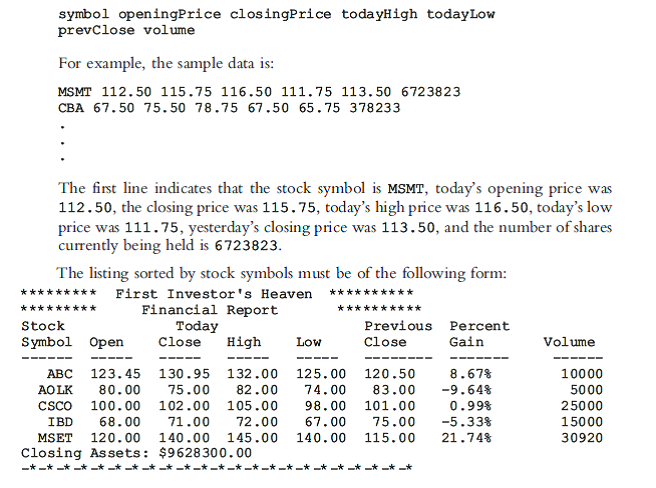
Develop this program exercise in two steps. In the first step(part a), design and implement a stock object. In the second step (part b), design and implement an object to maintain a list of stocks.
a.(Stock Object) Design and implement the stock object. Call the class that captures the various characteristics of a stock object stockType. The main components of a stock are the stock symbol, stock price, and the number of shares. Moreover, we need to output the opening price, closing price, high price, low price, previous price, and the percent gain/loss for the day. These are also all the characteristics of a stock. Therefore, the stock object should store all of this information.
Perform the following operations on each stock object:
1. Set the stock information
2. Print the stock information
3. show the different prices
4. Calculate and print the percent gain/loss
5. Show the number of shares
a.1. The natural ordering of the stock list is by stock symbol. Overload the relational operators to compare two stock objects by their symbols.
a.2. Overload the insertion operator,
a.3. Because the data is stored in a file, overload the stream extraction operator, >>, for easy input.
b. Now that you have designed and implemented the class stockType to implement a stock object in a program, it is time to create a list of stock objects.
Let us call the class to implement a list of stock objects stockListType.
The class stockListType must be derived from class listType, which youy designed and implemented in the previous exercise. However, the class stockListType is a very specific class, designed to create a list of stock objects. Therefore, the class stockListType is no longer a template.
Add and/or overwrite the operations of the class listType to implement the necessary operations on a stock list.
The following statement derives the class stockListType from class listType.
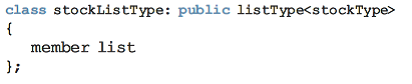
The member variables to hold the list elements, the length of the list, and the max listSize were declared as protected in the class listType. Therefore, these members can be directly accessed in the class stockListType.
Because the company also requires you to produce the list ordered by the percent gain/loss, you need to sort the stock list by this component. However, you are not to physically sort the list by the component percent gain/loss. Instead, you will provide a logical ordering with the respect to this component.
To do so, add a member variable, an array, to hold the indices of the stock list ordered by the component percent gain/loss, use the array sortIndecesGainLoss to print the list. The elements of the array sortIndecesGainLoss will tell which component of the stock list to print next.
c. Write a program that uses these two classes to automate the companies analysis of stock data.
symbol openingPrice closingPrice todayHigh todayLow prevClose vol ume For example, the sample data is: MSMT 112.50 115.75 116.50 111.75 113.50 6723823 CBA 67.50 75.50 78.75 67.50 65.75 378233 The first line indicates that the stock symbol is MSMT, today's opening price was 112.50, the closing price was 1 price was 111.75, yesterday's closing price was 113.50, and the number of shares currently being held is 6723823 15.75, today's high price was 116.50, today's low The listing sorted by stock symbols must be of the following form: Financial Report Stock Symbol Open Close High Low Today Previous Percent Close Gain Volume 867% AOLK 80.00 75.00 82.00 74.00 83.00-9.64% 0.99% IBD 68.00 71.00 72.00 67.00 75.00-5.33% MSET 120.00 140.00 145.00 140.00 115.00 21 .74% 10000 5000 25000 15000 30920 ABC 123.45 130.95 132.00 125.00 120.50 CSCO 100.00 102.00 105.00 98.00 101.00 Closing Assets $9628300.00 symbol openingPrice closingPrice todayHigh todayLow prevClose vol ume For example, the sample data is: MSMT 112.50 115.75 116.50 111.75 113.50 6723823 CBA 67.50 75.50 78.75 67.50 65.75 378233 The first line indicates that the stock symbol is MSMT, today's opening price was 112.50, the closing price was 1 price was 111.75, yesterday's closing price was 113.50, and the number of shares currently being held is 6723823 15.75, today's high price was 116.50, today's low The listing sorted by stock symbols must be of the following form: Financial Report Stock Symbol Open Close High Low Today Previous Percent Close Gain Volume 867% AOLK 80.00 75.00 82.00 74.00 83.00-9.64% 0.99% IBD 68.00 71.00 72.00 67.00 75.00-5.33% MSET 120.00 140.00 145.00 140.00 115.00 21 .74% 10000 5000 25000 15000 30920 ABC 123.45 130.95 132.00 125.00 120.50 CSCO 100.00 102.00 105.00 98.00 101.00 Closing Assets $9628300.00
Step by Step Solution
There are 3 Steps involved in it

Get step-by-step solutions from verified subject matter experts
 Study Help