



Question: There is one principal and two agents. Agent 1 chooses effort e, to perform task 1 while Agent 2 chooses effort ez to perform task
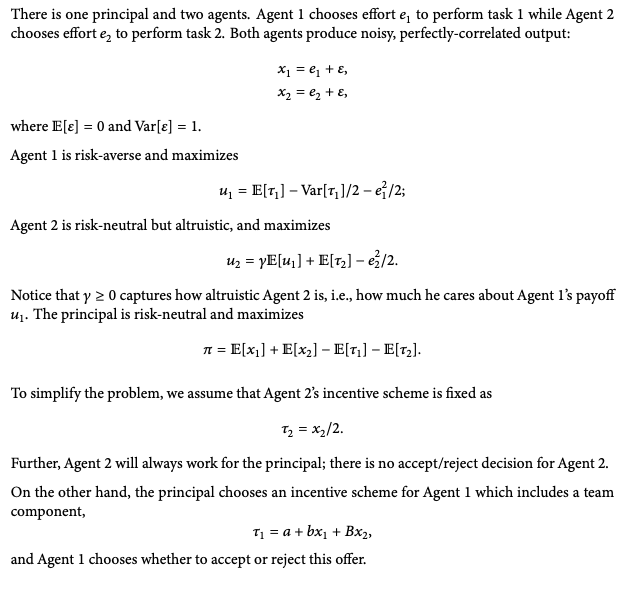
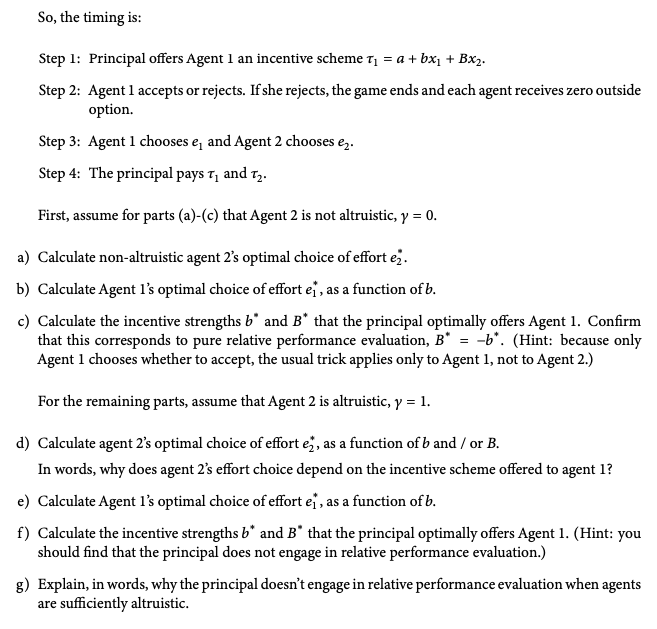
There is one principal and two agents. Agent 1 chooses effort e, to perform task 1 while Agent 2 chooses effort ez to perform task 2. Both agents produce noisy, perfectly-correlated output: * = e + e, *2 = ez + 6, where E[=] = 0 and Var[=] = 1. Agent 1 is risk-averse and maximizes 41 = - Var[T, 1/2 - e1/2; Agent 2 is risk-neutral but altruistic, and maximizes 12 = PE[u] ] + E[T2] - e2/2. Notice that y 2 0 captures how altruistic Agent 2 is, i.e., how much he cares about Agent I's payoff #1. The principal is risk-neutral and maximizes 7 = [[x]] + E[x2] - ] - E[T2]. To simplify the problem, we assume that Agent 2's incentive scheme is fixed as T2 = *2/2. Further, Agent 2 will always work for the principal; there is no accept/reject decision for Agent 2. On the other hand, the principal chooses an incentive scheme for Agent 1 which includes a team component, T1 = a+ bx] + BX2, and Agent 1 chooses whether to accept or reject this offer.So, the timing is: Step 1: Principal offers Agent 1 an incentive scheme 71 = a + bx] + Bx2. Step 2: Agent 1 accepts or rejects. If she rejects, the game ends and each agent receives zero outside option. Step 3: Agent 1 chooses e, and Agent 2 chooses ez. Step 4: The principal pays 71 and T2. First, assume for parts (a)-(c) that Agent 2 is not altruistic, y = 0. a) Calculate non-altruistic agent 2's optimal choice of effort ez. b) Calculate Agent I's optimal choice of effort el , as a function of b. c) Calculate the incentive strengths b" and B* that the principal optimally offers Agent 1. Confirm that this corresponds to pure relative performance evaluation, B" = -b. (Hint: because only Agent 1 chooses whether to accept, the usual trick applies only to Agent 1, not to Agent 2.) For the remaining parts, assume that Agent 2 is altruistic, y = 1. d) Calculate agent 2's optimal choice of effort ez, as a function of b and / or B. In words, why does agent 2's effort choice depend on the incentive scheme offered to agent 1? e) Calculate Agent I's optimal choice of effort el, as a function of b. f) Calculate the incentive strengths b" and B" that the principal optimally offers Agent 1. (Hint: you should find that the principal does not engage in relative performance evaluation.) g) Explain, in words, why the principal doesn't engage in relative performance evaluation when agents are sufficiently altruistic
Step by Step Solution
There are 3 Steps involved in it

Get step-by-step solutions from verified subject matter experts