


Question: There is sufficient raw material for all Type A parts and Type B parts. Machine I produces Type A parts taking an average time of
There is sufficient raw material for all Type A
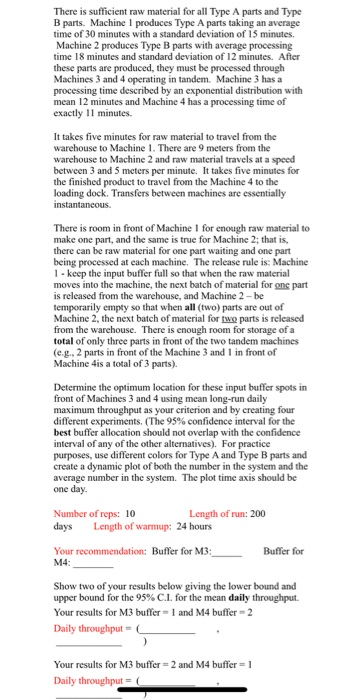
There is sufficient raw material for all Type A parts and Type B parts. Machine I produces Type A parts taking an average time of 30 minutes with a standard deviation of 15 minutes. Machine 2 produces Type B parts with average processing time 18 minutes and standard deviation of 12 minutes. After these parts are produced, they must be processed through Machines 3 and 4 operating in tandem. Machine 3 has a processing time described by an exponential distribution with mean 12 minutes and Machine 4 has a processing time of exactly 11 minutes. It takes five minutes for raw material to travel from the warehouse to Machine 1. There are 9 meters from the warehouse to Machine 2 and raw material travels at a speed between 3 and 5 meters per minute. It takes five minutes for the finished product to travel from the Machine 4 to the loading dock. Transfers between machines are essentially instantaneous There is room in front of Machine 1 for enough raw material to make one part, and the same is true for Machine 2; that is, there can be raw material for one part waiting and one part being processed at each machine. The release rule is: Machine 1 - keep the input buffer full so that when the raw material moves into the machine, the next batch of material for one part is released from the warehouse, and Machine 2 - be temporarily empty so that when all (two) parts are out of Machine 2, the next batch of material for two parts is released from the warehouse. There is enough room for storage of a total of only three parts in front of the two tandem machines (e.g., 2 parts in front of the Machine 3 and 1 in front of Machine 4is a total of 3 parts). Determine the optimum location for these input buffer spots in front of Machines 3 and 4 using mean long-run daily maximum throughput as your criterion and by creating four different experiments. The 95% confidence interval for the best buffer allocation should not overlap with the confidence interval of any of the other alternatives). For practice purposes, use different colors for Type A and Type B parts and create a dynamic plot of both the number in the system and the average number in the system. The plot time axis should be one day. Number of reps: 10 Length of run: 200 days Length of warmup: 24 hours Your recommendation: Buffer for M3:_ Buffer for M4: Show two of your results below giving the lower bound and upper bound for the 95% C.I. for the mean daily throughput. Your results for M3 buffer = 1 and M4 buffer = 2 Daily throughput = Your results for M3 buffer= 2 and M4 buffer = 1 Daily throughput =( There is sufficient raw material for all Type A parts and Type B parts. Machine I produces Type A parts taking an average time of 30 minutes with a standard deviation of 15 minutes. Machine 2 produces Type B parts with average processing time 18 minutes and standard deviation of 12 minutes. After these parts are produced, they must be processed through Machines 3 and 4 operating in tandem. Machine 3 has a processing time described by an exponential distribution with mean 12 minutes and Machine 4 has a processing time of exactly 11 minutes. It takes five minutes for raw material to travel from the warehouse to Machine 1. There are 9 meters from the warehouse to Machine 2 and raw material travels at a speed between 3 and 5 meters per minute. It takes five minutes for the finished product to travel from the Machine 4 to the loading dock. Transfers between machines are essentially instantaneous There is room in front of Machine 1 for enough raw material to make one part, and the same is true for Machine 2; that is, there can be raw material for one part waiting and one part being processed at each machine. The release rule is: Machine 1 - keep the input buffer full so that when the raw material moves into the machine, the next batch of material for one part is released from the warehouse, and Machine 2 - be temporarily empty so that when all (two) parts are out of Machine 2, the next batch of material for two parts is released from the warehouse. There is enough room for storage of a total of only three parts in front of the two tandem machines (e.g., 2 parts in front of the Machine 3 and 1 in front of Machine 4is a total of 3 parts). Determine the optimum location for these input buffer spots in front of Machines 3 and 4 using mean long-run daily maximum throughput as your criterion and by creating four different experiments. The 95% confidence interval for the best buffer allocation should not overlap with the confidence interval of any of the other alternatives). For practice purposes, use different colors for Type A and Type B parts and create a dynamic plot of both the number in the system and the average number in the system. The plot time axis should be one day. Number of reps: 10 Length of run: 200 days Length of warmup: 24 hours Your recommendation: Buffer for M3:_ Buffer for M4: Show two of your results below giving the lower bound and upper bound for the 95% C.I. for the mean daily throughput. Your results for M3 buffer = 1 and M4 buffer = 2 Daily throughput = Your results for M3 buffer= 2 and M4 buffer = 1 Daily throughput =(

Step by Step Solution

There are 3 Steps involved in it

1 Expert Approved Answer
Step: 1 Unlock blur-text-image

Question Has Been Solved by an Expert!

Get step-by-step solutions from verified subject matter experts

Step: 2 Unlock
Step: 3 Unlock

Students Have Also Explored These Related General Management Questions!