







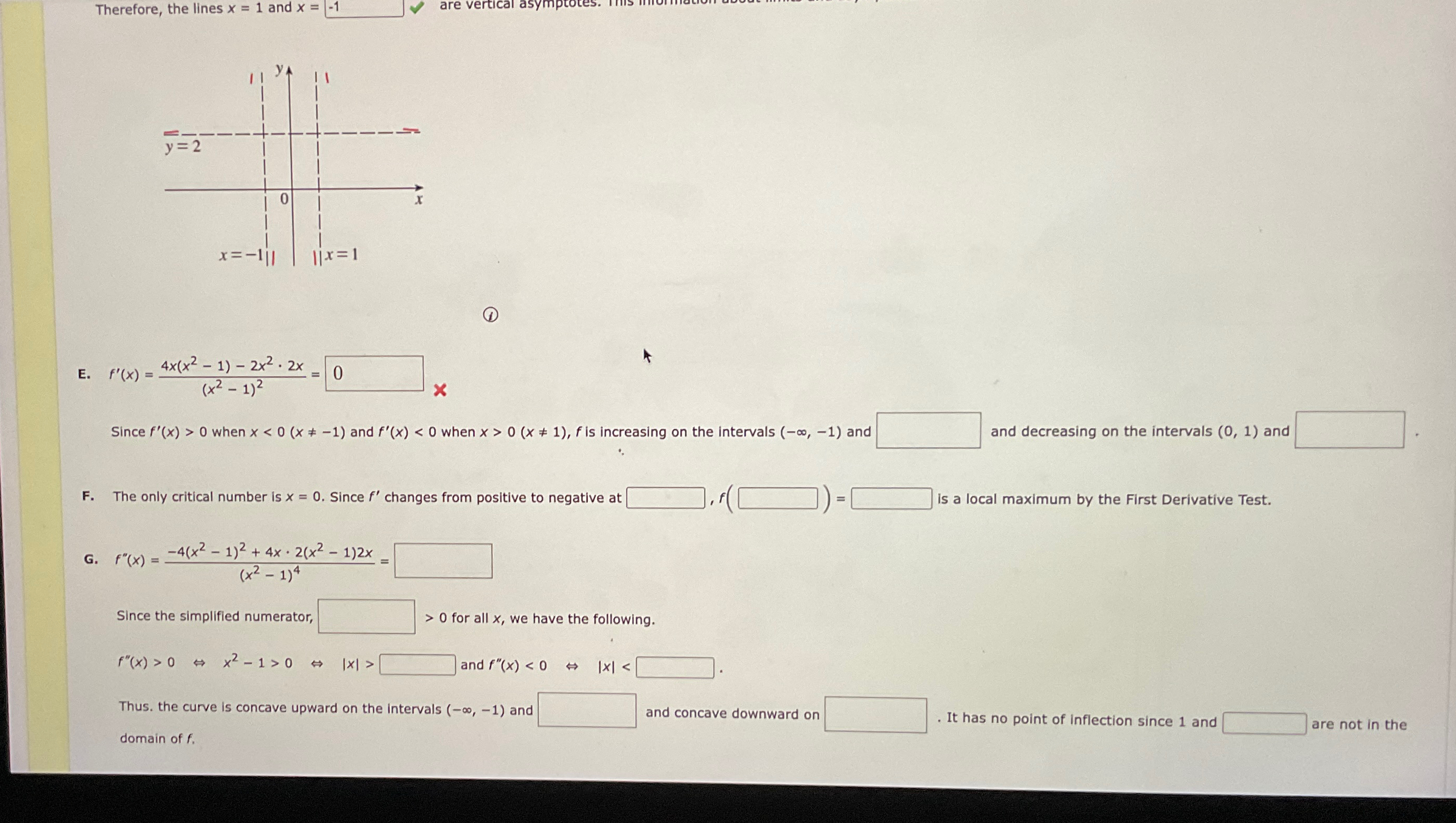
Question: Therefore, the lines x = 1 and x = - 1 ( 1 ) E . f ' ( x ) = 4 x (
Therefore, the lines and
E
Since when and when is increasing on the intervals and and decreasing on the intervals and
F The only critical number is Since changes from positive to negative at is a local maximum by the First Derivative Test.
G
Since the simplified numerator, for all we have the following.
and
Thus. the curve is concave upward on the intervals and and concave downward on It has no point of inflection since and are not in the domain of
Step by Step Solution
There are 3 Steps involved in it
1 Expert Approved Answer
Step: 1 Unlock

Question Has Been Solved by an Expert!
Get step-by-step solutions from verified subject matter experts
Step: 2 Unlock
Step: 3 Unlock
 Study Help