



Question: these are the 6 in the module 8. Provide a customer service related example for each of the six roadblocks to listening presented in the

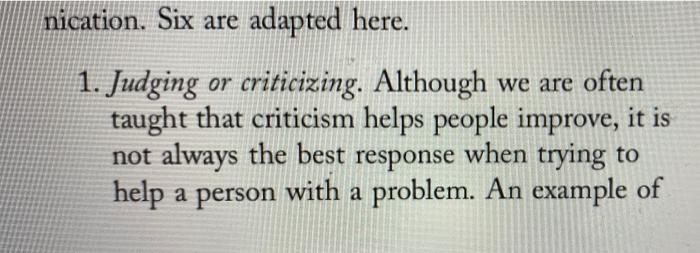
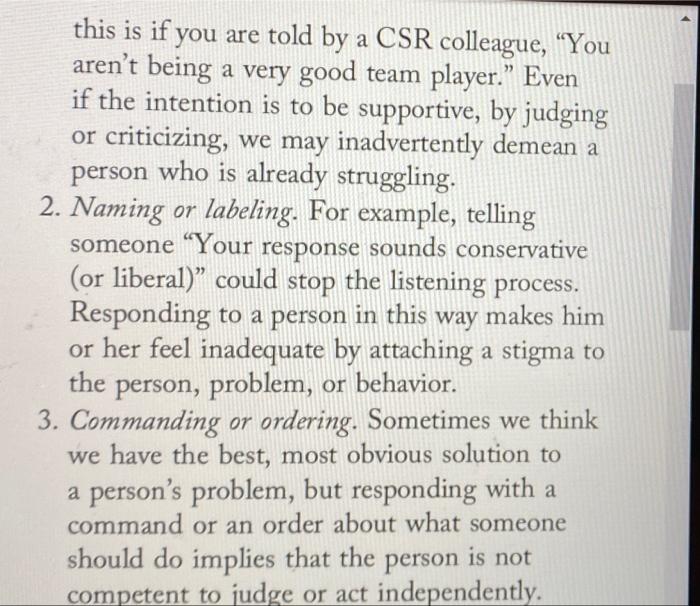
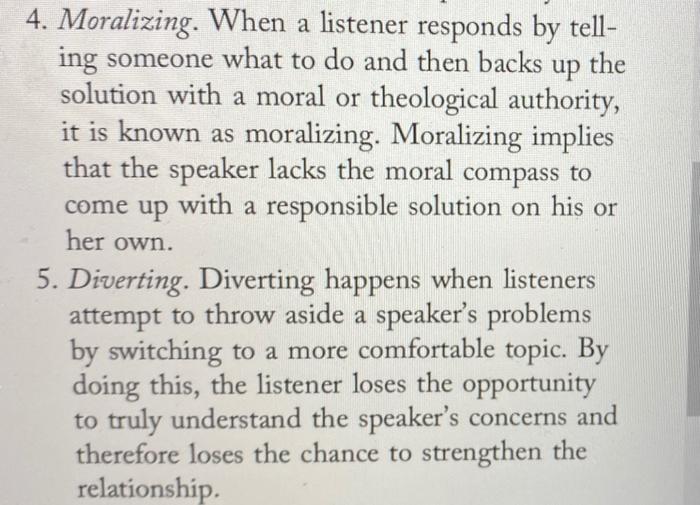
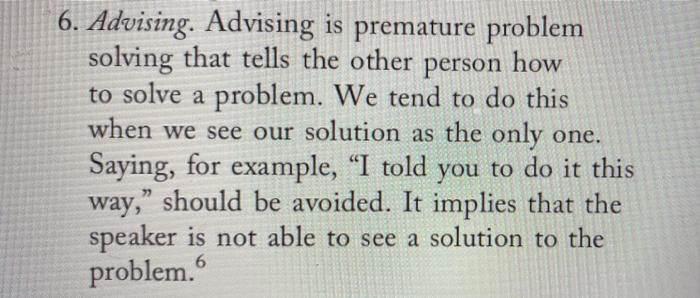
8. Provide a customer service related example for each of the six roadblocks to listening presented in the module. nication. Six are adapted here. 1. Judging or criticizing. Although we are often taught that criticism helps people improve, it is not always the best response when trying to help a person with a problem. An example of a this is if you are told by a CSR colleague, You aren't being a very good team player. Even if the intention is to be supportive, by judging or criticizing, we may inadvertently demean a person who is already struggling, 2. Naming or labeling. For example, telling someone Your response sounds conservative (or liberal) could stop the listening process. Responding to a person in this way makes him or her feel inadequate by attaching a stigma to the person, problem, or behavior. 3. Commanding or ordering. Sometimes we think we have the best, most obvious solution to a person's problem, but responding with a command or an order about what someone should do implies that the person is not competent to judge or act independently. a 4. Moralizing. When a listener responds by tell- ing someone what to do and then backs up the solution with a moral or theological authority, it is known as moralizing. Moralizing implies that the speaker lacks the moral compass to come up with a responsible solution on his or her own. 5. Diverting. Diverting happens when listeners attempt to throw aside a speaker's problems by switching to a more comfortable topic. By doing this, the listener loses the opportunity to truly understand the speaker's concerns and therefore loses the chance to strengthen the relationship 6. Advising. Advising is premature problem solving that tells the other person how to solve a problem. We tend to do this when we see our solution as the only one. Saying, for example, I told you to do it this way, should be avoided. It implies that the speaker is not able to see a solution to the problem. 6 8. Provide a customer service related example for each of the six roadblocks to listening presented in the module. nication. Six are adapted here. 1. Judging or criticizing. Although we are often taught that criticism helps people improve, it is not always the best response when trying to help a person with a problem. An example of a this is if you are told by a CSR colleague, You aren't being a very good team player. Even if the intention is to be supportive, by judging or criticizing, we may inadvertently demean a person who is already struggling, 2. Naming or labeling. For example, telling someone Your response sounds conservative (or liberal) could stop the listening process. Responding to a person in this way makes him or her feel inadequate by attaching a stigma to the person, problem, or behavior. 3. Commanding or ordering. Sometimes we think we have the best, most obvious solution to a person's problem, but responding with a command or an order about what someone should do implies that the person is not competent to judge or act independently. a 4. Moralizing. When a listener responds by tell- ing someone what to do and then backs up the solution with a moral or theological authority, it is known as moralizing. Moralizing implies that the speaker lacks the moral compass to come up with a responsible solution on his or her own. 5. Diverting. Diverting happens when listeners attempt to throw aside a speaker's problems by switching to a more comfortable topic. By doing this, the listener loses the opportunity to truly understand the speaker's concerns and therefore loses the chance to strengthen the relationship 6. Advising. Advising is premature problem solving that tells the other person how to solve a problem. We tend to do this when we see our solution as the only one. Saying, for example, I told you to do it this way, should be avoided. It implies that the speaker is not able to see a solution to the problem. 6
Step by Step Solution
There are 3 Steps involved in it

Get step-by-step solutions from verified subject matter experts