Question: these are the instructions This is example 1.1 This is example 6.5 Exercise 8.17 Consider the equipment rental process described in Example 1.1 (page 3)
these are the instructions
This is example 1.1
This is example 6.5
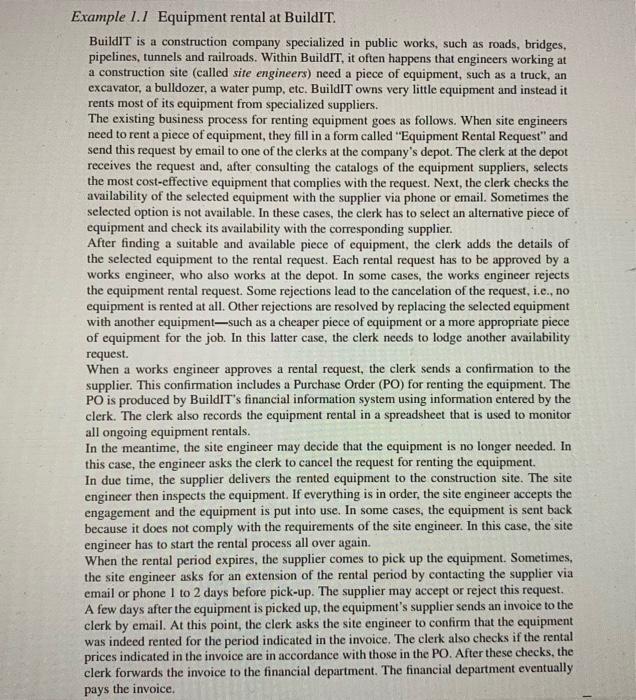
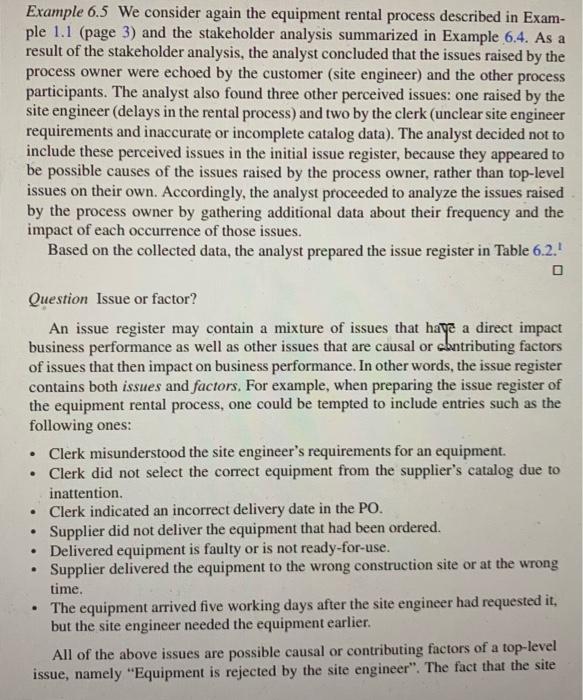
Exercise 8.17 Consider the equipment rental process described in Example 1.1 (page 3) and the corresponding issues documented in Example 6,5 (page 230). a Apply the redesign heuristics from Appendix A in order to address the issues documented in Example 6.5. b Capture the resulting to-be model in BPMN. c Explain the impact of the changes you propose in terms of the performance dimensions of the Devil's Quadrangle. Do the textbook exercise 8.17. You do not need to apply all heuristics, but for every heuristic you apply, you should describe where and how you apply it to the process, why you apply it, and what are the benefits and drawbacks of applying this heuristic (think in terms of the "Devil's quadrangle"). You may therefore combine parts (a) and (c) of this question in one discussion. Example 1.1 Equipment rental at BuildIT. BuildIt is a construction company specialized in public works, such as roads, bridges, pipelines, tunnels and railroads. Within Buildir, it often happens that engineers working at a construction site (called site engineers) need a piece of equipment, such as a truck, an excavator, a bulldozer, a water pump, etc. BuildIT owns very little equipment and instead it rents most of its equipment from specialized suppliers. The existing business process for renting equipment goes as follows. When site engineers need to rent a piece of equipment, they fill in a form called "Equipment Rental Request" and send this request by email to one of the clerks at the company's depot. The clerk at the depot receives the request and, after consulting the catalogs of the equipment suppliers, selects the most cost-effective equipment that complies with the request. Next, the clerk checks the availability of the selected equipment with the supplier via phone or email. Sometimes the selected option is not available. In these cases, the clerk has to select an alternative piece of equipment and check its availability with the corresponding supplier. After finding a suitable and available piece of equipment, the clerk adds the details of the selected equipment to the rental request. Each rental request has to be approved by a works engineer, who also works at the depot. In some cases, the works engineer rejects the equipment rental request. Some rejections lead to the cancelation of the request, i.e., no equipment is rented at all. Other rejections are resolved by replacing the selected equipment with another equipment-such as a cheaper piece of equipment or a more appropriate piece of equipment for the job. In this latter case, the clerk needs to lodge another availability request. When a works engineer approves a rental request, the clerk sends a confirmation to the supplier. This confirmation includes a Purchase Order (PO) for renting the equipment. The PO is produced by BuildIt's financial information system using information entered by the clerk. The clerk also records the equipment rental in a spreadsheet that is used to monitor all ongoing equipment rentals. In the meantime, the site engineer may decide that the equipment is no longer needed. In this case, the engineer asks the clerk to cancel the request for renting the equipment. In due time, the supplier delivers the rented equipment to the construction site. The site engineer then inspects the equipment. If everything is in order, the site engineer accepts the engagement and the equipment is put into use. In some cases, the equipment is sent back because it does not comply with the requirements of the site engineer. In this case, the site engineer has to start the rental process all over again. When the rental period expires, the supplier comes to pick up the equipment. Sometimes, the site engineer asks for an extension of the rental period by contacting the supplier via email or phone 1 to 2 days before pick-up. The supplier may accept or reject this request. A few days after the equipment is picked up, the equipment's supplier sends an invoice to the clerk by email. At this point, the clerk asks the site engineer to confirm that the equipment was indeed rented for the period indicated in the invoice. The clerk also checks if the rental prices indicated in the invoice are in accordance with those in the PO. After these checks, the clerk forwards the invoice to the financial department. The financial department eventually pays the invoice. Example 6.5 We consider again the equipment rental process described in Exam- ple 1.1 (page 3) and the stakeholder analysis summarized in Example 6.4. As a result of the stakeholder analysis, the analyst concluded that the issues raised by the process owner were echoed by the customer (site engineer) and the other process participants. The analyst also found three other perceived issues: one raised by the site engineer (delays in the rental process) and two by the clerk (unclear site engineer requirements and inaccurate or incomplete catalog data). The analyst decided not to include these perceived issues in the initial issue register, because they appeared to be possible causes of the issues raised by the process owner, rather than top-level issues on their own. Accordingly, the analyst proceeded to analyze the issues raised by the process owner by gathering additional data about their frequency and the impact of each occurrence of those issues. Based on the collected data, the analyst prepared the issue register in Table 6.2.! Question Issue or factor? An issue register may contain a mixture of issues that have a direct impact business performance as well as other issues that are causal or contributing factors of issues that then impact on business performance. In other words, the issue register contains both issues and factors. For example, when preparing the issue register of the equipment rental process, one could be tempted to include entries such as the following ones: Clerk misunderstood the site engineer's requirements for an equipment. Clerk did not select the correct equipment from the supplier's catalog due to inattention. Clerk indicated an incorrect delivery date in the PO. Supplier did not deliver the equipment that had been ordered. Delivered equipment is faulty or is not ready-for-use. Supplier delivered the equipment to the wrong construction site or at the wrong time. The equipment arrived five working days after the site engineer had requested it, but the site engineer needed the equipment earlier. All of the above issues are possible causal or contributing factors of a top-level issue, namely "Equipment is rejected by the site engineer". The fact that the site . Exercise 8.17 Consider the equipment rental process described in Example 1.1 (page 3) and the corresponding issues documented in Example 6,5 (page 230). a Apply the redesign heuristics from Appendix A in order to address the issues documented in Example 6.5. b Capture the resulting to-be model in BPMN. c Explain the impact of the changes you propose in terms of the performance dimensions of the Devil's Quadrangle. Do the textbook exercise 8.17. You do not need to apply all heuristics, but for every heuristic you apply, you should describe where and how you apply it to the process, why you apply it, and what are the benefits and drawbacks of applying this heuristic (think in terms of the "Devil's quadrangle"). You may therefore combine parts (a) and (c) of this question in one discussion. Example 1.1 Equipment rental at BuildIT. BuildIt is a construction company specialized in public works, such as roads, bridges, pipelines, tunnels and railroads. Within Buildir, it often happens that engineers working at a construction site (called site engineers) need a piece of equipment, such as a truck, an excavator, a bulldozer, a water pump, etc. BuildIT owns very little equipment and instead it rents most of its equipment from specialized suppliers. The existing business process for renting equipment goes as follows. When site engineers need to rent a piece of equipment, they fill in a form called "Equipment Rental Request" and send this request by email to one of the clerks at the company's depot. The clerk at the depot receives the request and, after consulting the catalogs of the equipment suppliers, selects the most cost-effective equipment that complies with the request. Next, the clerk checks the availability of the selected equipment with the supplier via phone or email. Sometimes the selected option is not available. In these cases, the clerk has to select an alternative piece of equipment and check its availability with the corresponding supplier. After finding a suitable and available piece of equipment, the clerk adds the details of the selected equipment to the rental request. Each rental request has to be approved by a works engineer, who also works at the depot. In some cases, the works engineer rejects the equipment rental request. Some rejections lead to the cancelation of the request, i.e., no equipment is rented at all. Other rejections are resolved by replacing the selected equipment with another equipment-such as a cheaper piece of equipment or a more appropriate piece of equipment for the job. In this latter case, the clerk needs to lodge another availability request. When a works engineer approves a rental request, the clerk sends a confirmation to the supplier. This confirmation includes a Purchase Order (PO) for renting the equipment. The PO is produced by BuildIt's financial information system using information entered by the clerk. The clerk also records the equipment rental in a spreadsheet that is used to monitor all ongoing equipment rentals. In the meantime, the site engineer may decide that the equipment is no longer needed. In this case, the engineer asks the clerk to cancel the request for renting the equipment. In due time, the supplier delivers the rented equipment to the construction site. The site engineer then inspects the equipment. If everything is in order, the site engineer accepts the engagement and the equipment is put into use. In some cases, the equipment is sent back because it does not comply with the requirements of the site engineer. In this case, the site engineer has to start the rental process all over again. When the rental period expires, the supplier comes to pick up the equipment. Sometimes, the site engineer asks for an extension of the rental period by contacting the supplier via email or phone 1 to 2 days before pick-up. The supplier may accept or reject this request. A few days after the equipment is picked up, the equipment's supplier sends an invoice to the clerk by email. At this point, the clerk asks the site engineer to confirm that the equipment was indeed rented for the period indicated in the invoice. The clerk also checks if the rental prices indicated in the invoice are in accordance with those in the PO. After these checks, the clerk forwards the invoice to the financial department. The financial department eventually pays the invoice. Example 6.5 We consider again the equipment rental process described in Exam- ple 1.1 (page 3) and the stakeholder analysis summarized in Example 6.4. As a result of the stakeholder analysis, the analyst concluded that the issues raised by the process owner were echoed by the customer (site engineer) and the other process participants. The analyst also found three other perceived issues: one raised by the site engineer (delays in the rental process) and two by the clerk (unclear site engineer requirements and inaccurate or incomplete catalog data). The analyst decided not to include these perceived issues in the initial issue register, because they appeared to be possible causes of the issues raised by the process owner, rather than top-level issues on their own. Accordingly, the analyst proceeded to analyze the issues raised by the process owner by gathering additional data about their frequency and the impact of each occurrence of those issues. Based on the collected data, the analyst prepared the issue register in Table 6.2.! Question Issue or factor? An issue register may contain a mixture of issues that have a direct impact business performance as well as other issues that are causal or contributing factors of issues that then impact on business performance. In other words, the issue register contains both issues and factors. For example, when preparing the issue register of the equipment rental process, one could be tempted to include entries such as the following ones: Clerk misunderstood the site engineer's requirements for an equipment. Clerk did not select the correct equipment from the supplier's catalog due to inattention. Clerk indicated an incorrect delivery date in the PO. Supplier did not deliver the equipment that had been ordered. Delivered equipment is faulty or is not ready-for-use. Supplier delivered the equipment to the wrong construction site or at the wrong time. The equipment arrived five working days after the site engineer had requested it, but the site engineer needed the equipment earlier. All of the above issues are possible causal or contributing factors of a top-level issue, namely "Equipment is rejected by the site engineer". The fact that the site










 Study Help