



Question: These first two questions are theoretical - they are not associated with any data. If 49% of the total variability in Y is accounted for
These first two questions are theoretical - they are not associated with any data.
- If 49% of the total variability inYis accounted for (explained) byX, then what is the correlation betweenXandY (r, Pearson's correlation coefficient)?
- If you find that your (simplified) regression equation for a given dataset is, what are your values foraandb?
Not sure how to figure this one out? Here are two hints/approaches you can take (depending on your preferred method):
a)Consider what the equation above means (if X is 1, what is ??). Also consider what the "normal" equation for a linear regression is, and thus what values a and bmust have for the two expressions to be equivalent.
b)Invent any two simple values of X and find their corresponding ?. You can now imagine drawing a line that passes through these two points: what is its slope? What is its interception?
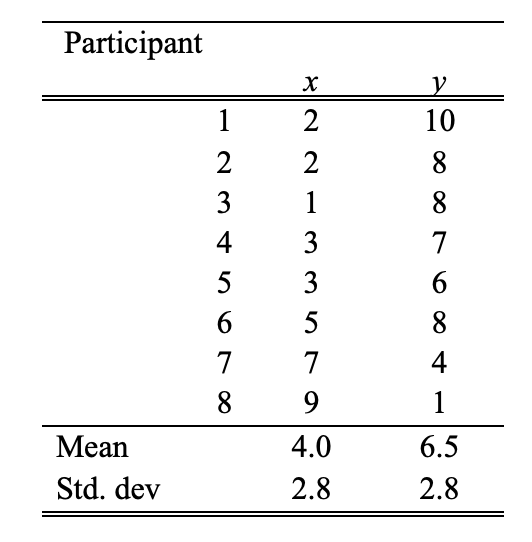
For the rest of this worksheet, base your answers on the following data.
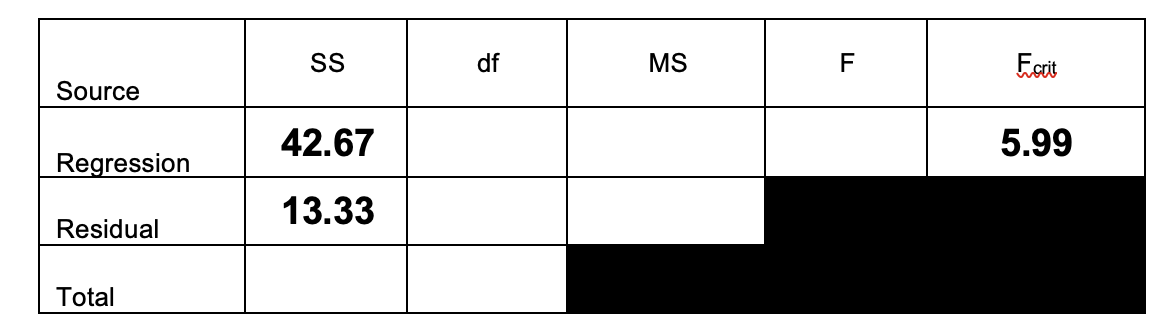
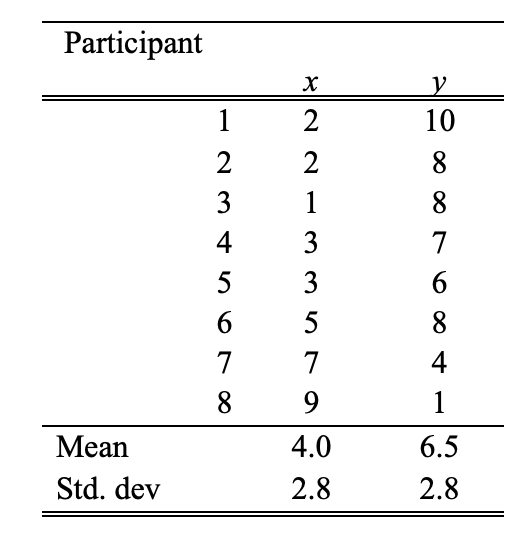
\fParticipant X 10 D JUWWINN DO Ja UAWNK Mean 4.0 6.5 Std. dev 2.8 2.8
Step by Step Solution
There are 3 Steps involved in it

Get step-by-step solutions from verified subject matter experts