







Question: These problems concern the two agent games with a, 2 0, a strictly concave and strictly increasing benefit function, B(.) that satisfies B(0) = 0,
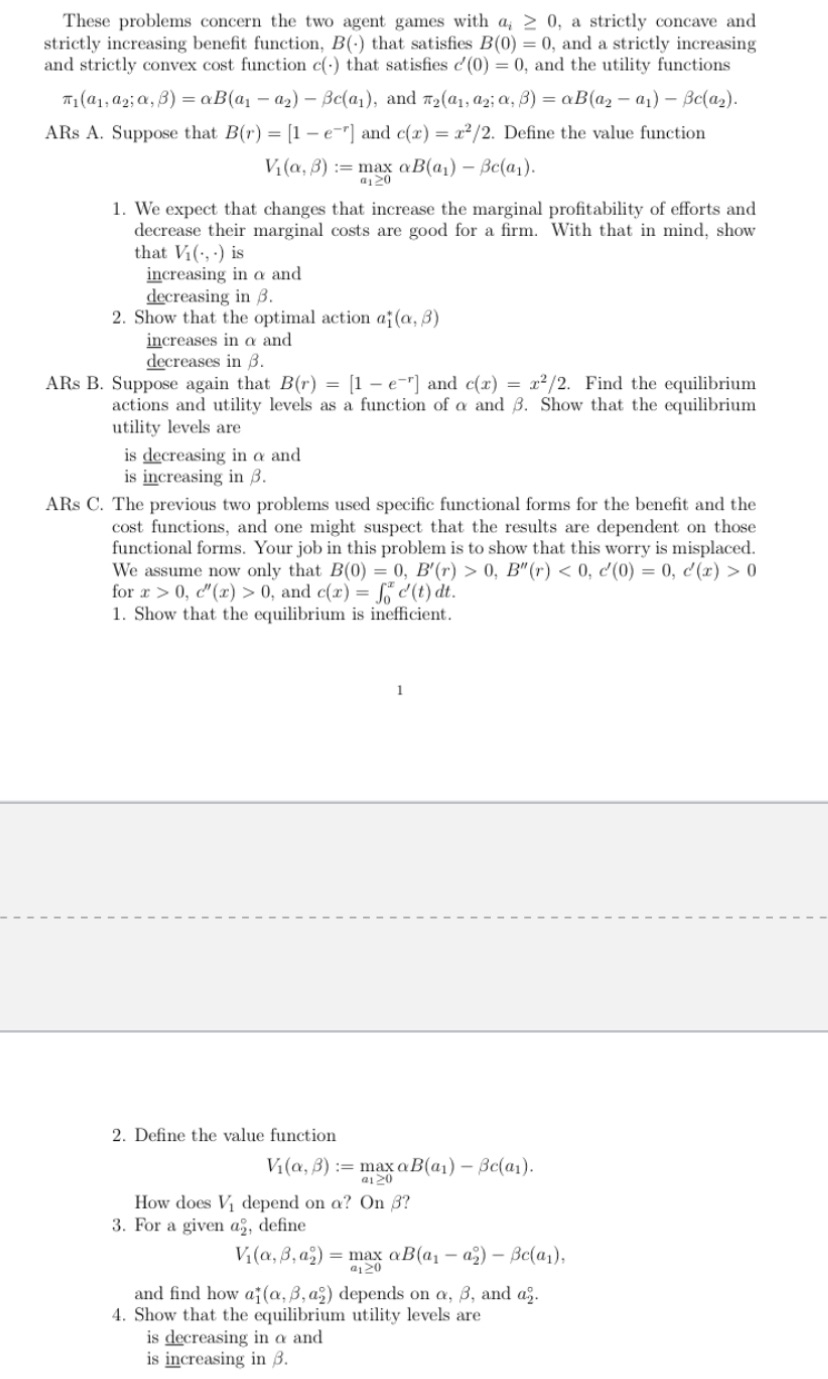
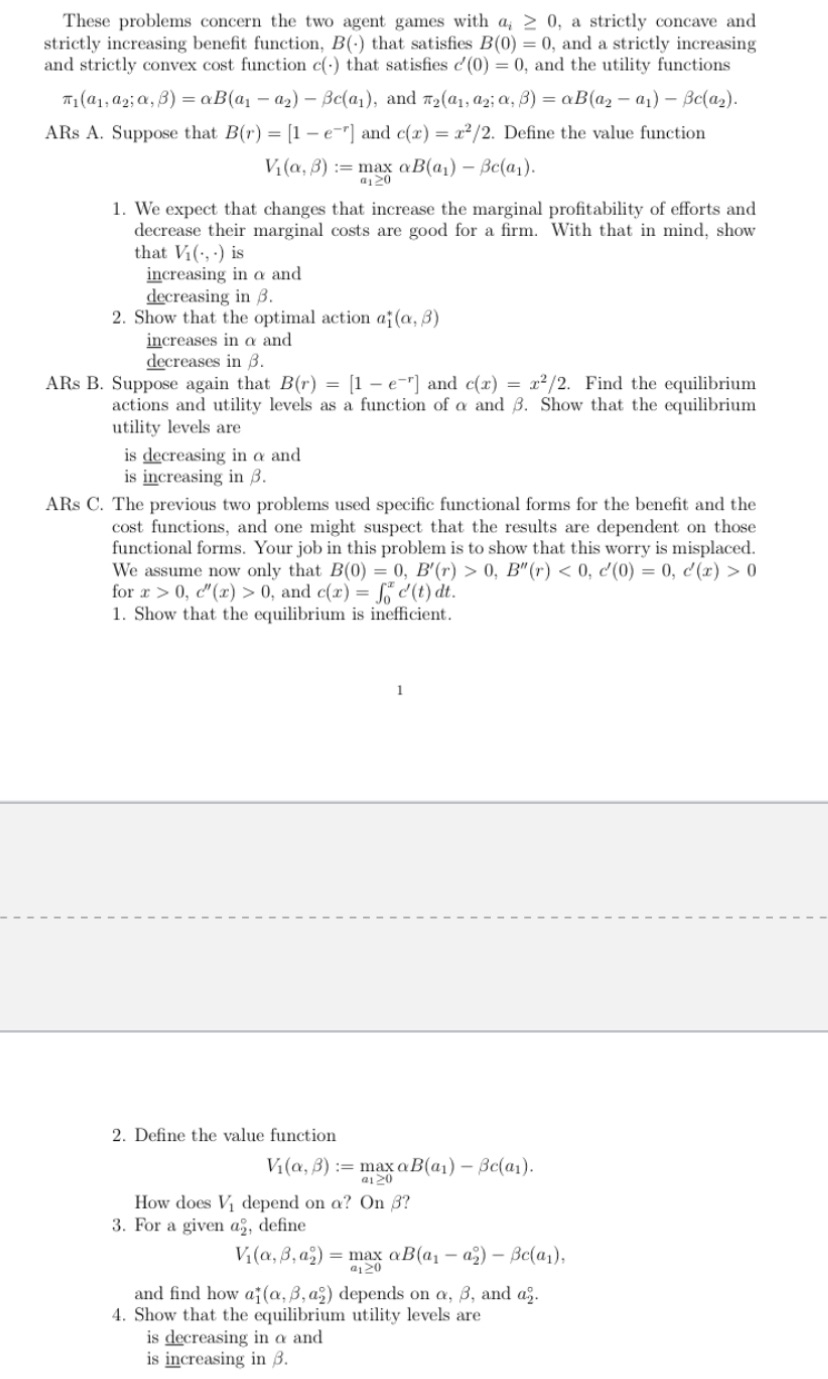
These problems concern the two agent games with a, 2 0, a strictly concave and strictly increasing benefit function, B(.) that satisfies B(0) = 0, and a strictly increasing and strictly convex cost function c(.) that satisfies c(0) = 0, and the utility functions "1(a1, a2; a, B) = QB(a1 - 42) - Bc(a,), and #2(a1, a2; 0, B) = QB(a2 - a;) - Bc(az). ARs A. Suppose that B(r) = [1 - e-"] and c(x) = 12/2. Define the value function 4120 Vi(a, B) := max aB(a,) - Bc(a,). 1. We expect that changes that increase the marginal profitability of efforts and decrease their marginal costs are good for a firm. With that in mind, show that Vi(., . ) is increasing in a and decreasing in B. 2. Show that the optimal action a; (a, B) increases in o and decreases in B. ARs B. Suppose again that B(r) = [1 - e-"] and c(x) = x2/2. Find the equilibrium actions and utility levels as a function of a and B. Show that the equilibrium utility levels are is decreasing in or and is increasing in B. ARs C. The previous two problems used specific functional forms for the benefit and the cost functions, and one might suspect that the results are dependent on those functional forms. Your job in this problem is to show that this worry is misplaced. We assume now only that B(0) = 0, B'(r) > 0, B"(r) 0 for r > 0, c'(x) > 0, and c(x) = fo d(t) dt. 1. Show that the equilibrium is inefficient. 2. Define the value function Vi(a, B) := max a B(a1) - Bc(a1). a1 20 How does Vi depend on a? On B? 3. For a given a?, define Vi(a, B, a;) = max aB(a1 - a2) - Bc(a1), 4120 and find how a; (a, B, a;) depends on a, B, and a? 4. Show that the equilibrium utility levels are is decreasing in a and is increasing in B
Step by Step Solution
There are 3 Steps involved in it

Get step-by-step solutions from verified subject matter experts
 Study Help