







Question: These question are throwing me off. Could someon help? 12. [16] On what basis may the appellate court properly reverse the judgment in favor of
These question are throwing me off. Could someon help? 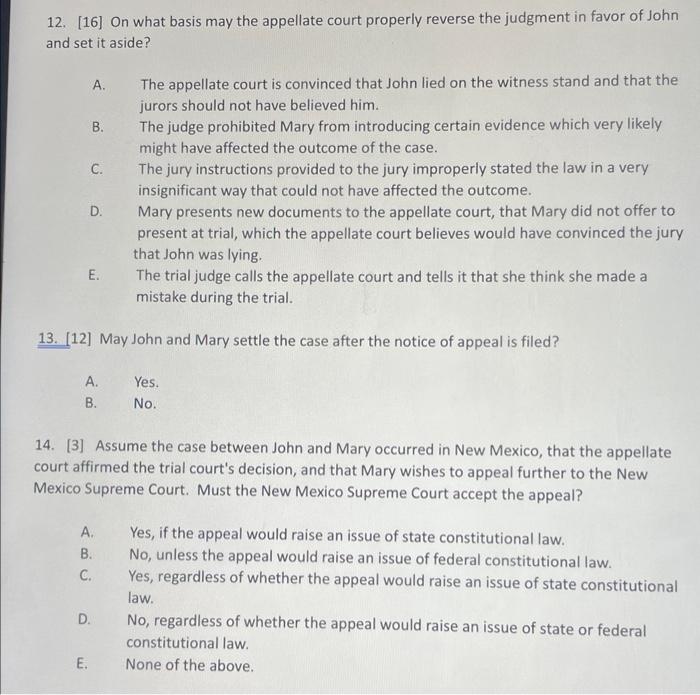
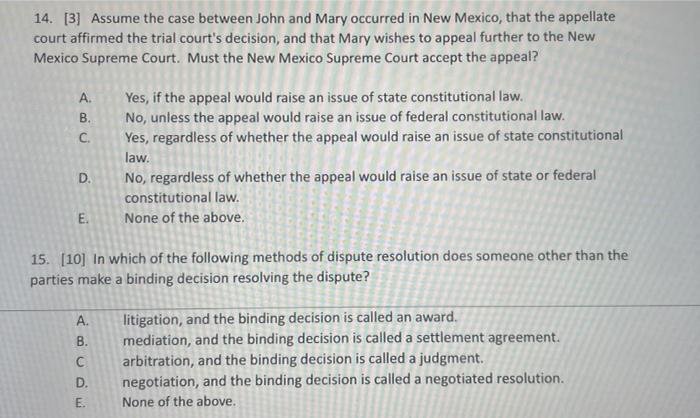
12. [16] On what basis may the appellate court properly reverse the judgment in favor of John and set it aside? A. The appellate court is convinced that John lied on the witness stand and that the jurors should not have believed him. B. The judge prohibited Mary from introducing certain evidence which very likely might have affected the outcome of the case. C. The jury instructions provided to the jury improperly stated the law in a very insignificant way that could not have affected the outcome. D. Mary presents new documents to the appellate court, that Mary did not offer to present at trial, which the appellate court believes would have convinced the jury that John was lying. E. The trial judge calls the appellate court and tells it that she think she made a mistake during the trial. 13. [12] May John and Mary settle the case after the notice of appeal is filed? A. Yes. B. No. 14. [3] Assume the case between John and Mary occurred in New Mexico, that the appellate court affirmed the trial court's decision, and that Mary wishes to appeal further to the New Mexico Supreme Court. Must the New Mexico Supreme Court accept the appeal? A. Yes, if the appeal would raise an issue of state constitutional law. B. No, unless the appeal would raise an issue of federal constitutional law. C. Yes, regardless of whether the appeal would raise an issue of state constitutional law. D. No, regardless of whether the appeal would raise an issue of state or federal constitutional law. E. None of the above. 14. [3] Assume the case between John and Mary occurred in New Mexico, that the appellate court affirmed the trial court's decision, and that Mary wishes to appeal further to the New Mexico Supreme Court. Must the New Mexico Supreme Court accept the appeal? A. Yes, if the appeal would raise an issue of state constitutional law. B. No, unless the appeal would raise an issue of federal constitutional law. C. Yes, regardless of whether the appeal would raise an issue of state constitutional law. D. No, regardless of whether the appeal would raise an issue of state or federal constitutional law. E. None of the above. 15. [10] In which of the following methods of dispute resolution does someone other than the parties make a binding decision resolving the dispute? A. litigation, and the binding decision is called an award. B. mediation, and the binding decision is called a settlement agreement. C arbitration, and the binding decision is called a judgment. D. negotiation, and the binding decision is called a negotiated resolution. E. None of the above
Step by Step Solution
There are 3 Steps involved in it
1 Expert Approved Answer
Step: 1 Unlock

Question Has Been Solved by an Expert!
Get step-by-step solutions from verified subject matter experts
Step: 2 Unlock
Step: 3 Unlock
 Study Help