



Question: Thinking on the Millennium Dome, do you feel that all the risks were assessed and planned for in advance? What could have been done differently?
Thinking on the Millennium Dome, do you feel that all the risks were assessed and planned for in advance? What could have been done differently? Use at least 34 sentences in your response.
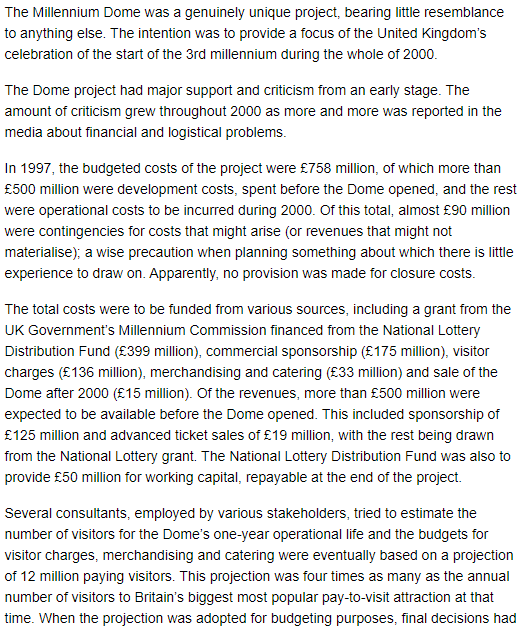
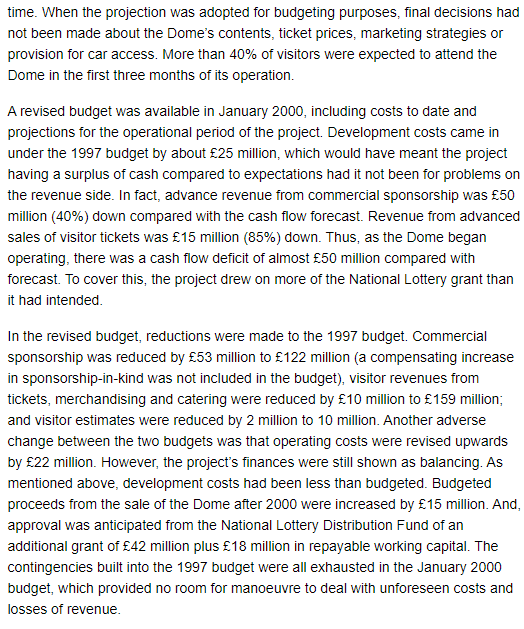
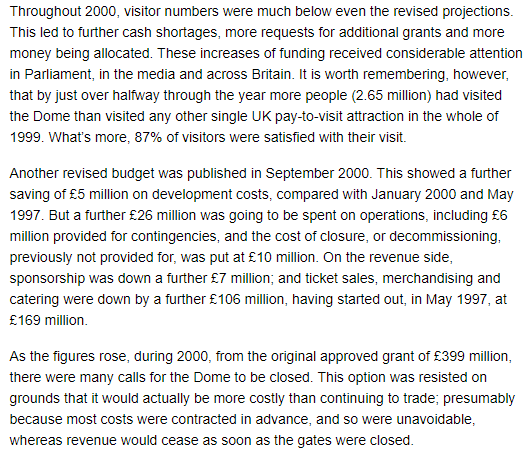
The Millennium Dome was a genuinely unique project, bearing little resemblance to anything else. The intention was to provide a focus of the United Kingdom's celebration of the start of the 3rd millennium during the whole of 2000. The Dome project had major support and criticism from an early stage. The amount of criticism grew throughout 2000 as more and more was reported in the media about financial and logistical problems. In 1997, the budgeted costs of the project were 758 million, of which more than 500 million were development costs, spent before the Dome opened, and the rest were operational costs to be incurred during 2000. Of this total, almost 90 million were contingencies for costs that might arise (or revenues that might not materialise); a wise precaution when planning something about which there is little experience to draw on. Apparently, no provision was made for closure costs. The total costs were to be funded from various sources, including a grant from the UK Government's Millennium Commission financed from the National Lottery Distribution Fund (399 million), commercial sponsorship (175 million), visitor charges (136 million), merchandising and catering (33 million) and sale of the Dome after 2000 (15 million). Of the revenues, more than 500 million were expected to be available before the Dome opened. This included sponsorship of 125 million and advanced ticket sales of 19 million, with the rest being drawn from the National Lottery grant. The National Lottery Distribution Fund was also to provide 50 million for working capital, repayable at the end of the project. Several consultants, employed by various stakeholders, tried to estimate the number of visitors for the Dome's one-year operational life and the budgets for visitor charges, merchandising and catering were eventually based on a projection of 12 million paying visitors. This projection was four times as many as the annual number of visitors to Britain's biggest most popular pay-to-visit attraction at that time. When the projection was adopted for budgeting purposes, final decisions had time. When the projection was adopted for budgeting purposes, final decisions had not been made about the Dome's contents, ticket prices, marketing strategies or provision for car access. More than 40% of visitors were expected to attend the Dome in the first three months of its operation. A revised budget was available in January 2000, including costs to date and projections for the operational period of the project. Development costs came in under the 1997 budget by about 25 million, which would have meant the project having a surplus of cash compared to expectations had it not been for problems on the revenue side. In fact, advance revenue from commercial sponsorship was 50 million (40%) down compared with the cash flow forecast. Revenue from advanced sales of visitor tickets was 15 million (85%) down. Thus, as the Dome began operating, there was a cash flow deficit of almost 50 million compared with forecast. To cover this, the project drew on more of the National Lottery grant than it had intended. In the revised budget, reductions were made to the 1997 budget. Commercial sponsorship was reduced by 53 million to 122 million (a compensating increase in sponsorship-in-kind was not included in the budget), visitor revenues from tickets, merchandising and catering were reduced by 10 million to 159 million; and visitor estimates were reduced by 2 million to 10 million. Another adverse change between the two budgets was that operating costs were revised upwards by 22 million. However, the project's finances were still shown as balancing. As mentioned above, development costs had been less than budgeted. Budgeted proceeds from the sale of the Dome after 2000 were increased by 15 million. And, approval was anticipated from the National Lottery Distribution Fund of an additional grant of 42 million plus 18 million in repayable working capital. The contingencies built into the 1997 budget were all exhausted in the January 2000 budget, which provided no room for manoeuvre to deal with unforeseen costs and losses of revenue. Throughout 2000, visitor numbers were much below even the revised projections. This led to further cash shortages, more requests for additional grants and more money being allocated. These increases of funding received considerable attention in Parliament, in the media and across Britain. It is worth remembering, however, that by just over halfway through the year more people (2.65 million) had visited the Dome than visited any other single UK pay-to-visit attraction in the whole of 1999. What's more, 87% of visitors were satisfied with their visit. Another revised budget was published in September 2000. This showed a further saving of 5 million on development costs, compared with January 2000 and May 1997. But a further 26 million was going to be spent on operations, including 6 million provided for contingencies, and the cost of closure, or decommissioning, previously not provided for, was put at 10 million. On the revenue side, sponsorship was down a further 7 million; and ticket sales, merchandising and catering were down by a further 106 million, having started out, in May 1997, at 169 million. As the figures rose, during 2000, from the original approved grant of 399 million, there were many calls for the Dome to be closed. This option was resisted on grounds that it would actually be more costly than continuing to trade; presumably because most costs were contracted in advance, and so were unavoidable, whereas revenue would cease as soon as the gates were closedStep by Step Solution
There are 3 Steps involved in it
1 Expert Approved Answer
Step: 1 Unlock

Question Has Been Solved by an Expert!
Get step-by-step solutions from verified subject matter experts
Step: 2 Unlock
Step: 3 Unlock