







Question: This activity of the Economic Principles Exercise (EPE) is mostly a written analysis using logical argumentation. There is a 'graphical' component to this assessment where
This activity of the Economic Principles Exercise (EPE) is mostly a written analysis using logical argumentation. There is a 'graphical' component to this assessment where you are to simply hand-draw (pen/pencil, paper, and then electronically scan/snap) the particulars of the relevant economics diagram. These answers need to be typed, but diagrams must be hand-drawn and inserted into the Word document. o The organisation of the text is crucial and requires planning. Sentences and paragraphs should be well connected using logical argumentation. Your answer should read as a continuous, threaded flow of ideas from beginning to end.o Be analytical and use your own critical thinking; do not be overly descriptive? What do you mean by 'technical detail' (esp. re Q1) and using 'hypothetical values'? o Where possible, integrate some points of data from the article in question (or with extra research if you wanted to) to make it a little more accurate to convey the concept. ? Therealityisyouwillnotbeabletouseactualvaluesforeverypointonthecurves etc. It is just not possible. o Making up figures (i.e. being hypothetical) is fine and a good practice for all questions (when no data to draw upon). For example, it is hard to get actual quantity figures for the x-axis. To be on the safe side, just state to the reader that you are using hypothetical values?that way you are informing the reader/marker exactly what you're doing. ? For example on Q1, you may find more info on prices and profit to some extent (but not necessarily work out a complete MC and isoprofit curves per se). Obviously, you won't have an entire D-curve of prices, but you can draw upon some research to get an approximation.? You should calculate a price elasticity of demand (PED) in Q1b, based on the hypothetical figures that you have used in your drawing.? Regarding Q2, there is no need to calculate per se the price elasticity of supply (PES), but you may wish to discuss (and illustrate) PES determinants for students who want to work on a high-standard extended answer.o You should not need to do an exact copy/snapshot of a diagram from the unit materials - - as this is an applied activity -- a diagram may closely resemble something from the materials, but it is unlikely to be an exact match.ONLY NEED QUESTION 2 As shown in pic
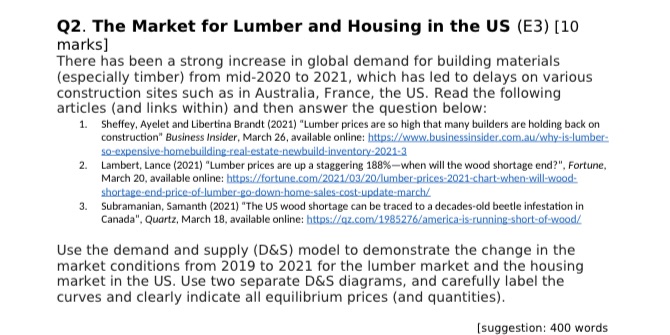
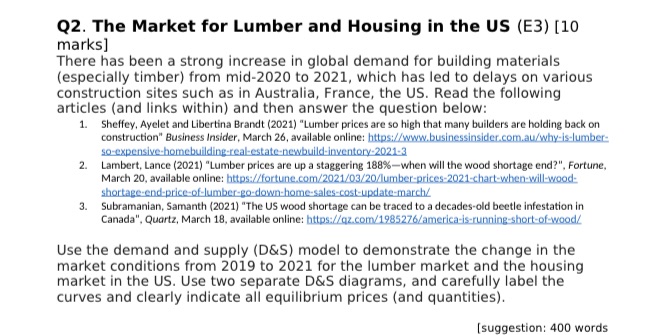
Q2. The Market for Lumber and Housing in the US (E3) [10 marks] There has been a strong increase in global demand for building materials (especially timber) from mid-2020 to 2021, which has led to delays on various construction sites such as in Australia, France, the US. Read the following articles (and links within) and then answer the question below: 1. Sheffey, Ayelet and Libertina Brandt (2021) "Lumber prices are so high that many builders are holding back on construction" Business Insider, March 26, available online: https://www.businessinsider.com.aw/why-is-lumber- so expensive-homebuilding-real-estate-newbuild-inventory-2021-3 2. Lambert, Lance (2021) "Lumber prices are up a staggering 188%-when will the wood shortage end?", Fortune. March 20, available online: https://fortune.com/2021/03/20/lumber-prices-2021-chart-when-will-wood- shortage-end-price-of-lumber-go-down-home-sales-cost-update-march/ 3. Subramanian, Samantha021) "The US wood shortage can be traced to a decades-old beetle infestation in Canada", Quartz, March 18, available online: https://qz.com/1985276/america-is-running-short-of-wood/ Use the demand and supply (D&S) model to demonstrate the change in the market conditions from 2019 to 2021 for the lumber market and the housing market in the US. Use two separate D&S diagrams, and carefully label the curves and clearly indicate all equilibrium prices (and quantities). [ suggestion: 400 words
Step by Step Solution
There are 3 Steps involved in it

Get step-by-step solutions from verified subject matter experts
 Study Help