Question: This article is about product design. Do you think this is applicable to systems design? Justify your answer by citing their similarities and differences and
- This article is about product design. Do you think this is applicable to systems design? Justify your answer by citing their similarities and differences and Prepare a reflection paper on this article by relating it to the topics under "The Systems Design Process".
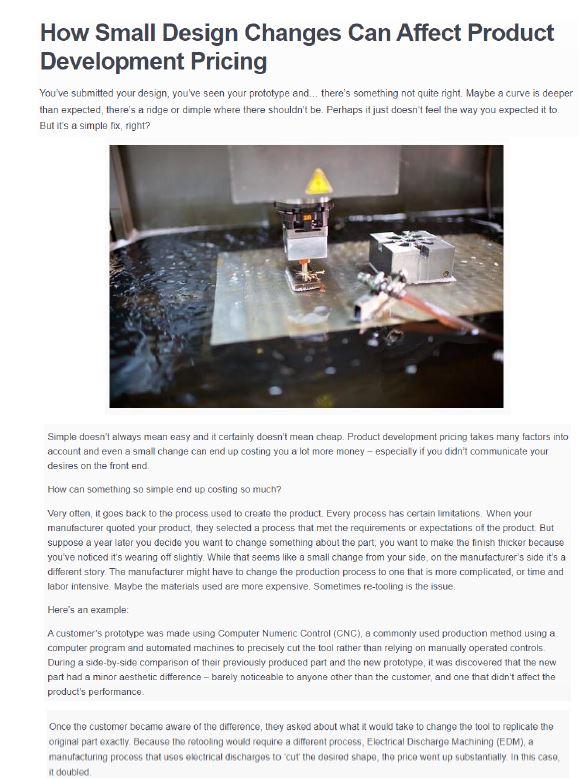
How Small Design Changes Can Affect Product Development Pricing You've submitted your design, you've seen your prototype and there's something not quite right. Maybe a curve is deeper than expected, there's a ridge or dimple where there shouldn't be. Perhaps it just doesn't feel the way you expected it to But it's a simple nix, right? Simple doesn't always mean easy and it certainly doesn't mean Product development pricing takes many factors into account and even a small change can end up costing you a lot more money - especially if you didn't communicate your desires on the front end How can something so simple end up costing so much? Very otton, it goes back to the process used to create the product. Every process has certain limitations when your manufacturer quoted your product, they selected a process that met the requirements or expectations of the product But suppose a year later you decide you want to change something about the part, you want to make the finish thicker because you've noticed its wearing off slightly. While that seems like a small change from your side on the manufacturer's side it's a different story. The manufacturer might have to change the production process to one that is more complicated, or time and labor intensive. Maybe the materials used are more expensive. Sometimes re-tooling is the issue. Here's an example: A customer's prototype was made using Computer Numenc Control (CNC), a commonly used production method using a computer program and automated machines to precisely cut the tool rather than relying on manually operated controls During a side-by-side comparison of their previously produced part and the new prototype, it was discovered that the new part had a minor aesthetic difference - barely noticeable to anyone other than the customer and one that didn't affect the product's performance Once the customer became aware of the difference, they asked about what it would take to change the tool to replicate the original part exactly Because the retooling would require a different process, Electrical Discharge Machining (EDM), a manufacturing process that uses electrical dischargos to cut the desired shape, the price went up substantially in this case il doubled FIRST QUESTION: How does such a situation happen? Isn't that something that should have been settied before prototyping? The answer is that this can happen any number of ways. Sometimes details aren't specified, either in preliminary discussions or in drawings or CAD models Sometimes there's simply a "failure to communicate." SECOND QUESTION: Who bears the cost? That depends on the situation. I asked one of our engineers who told me that if a customer made a mistake and the only solution is to remake the tool, they usually Price end up paying for the new tool. All tools have a life expectancy, for example 100,000 shots Tool life is affected by a number of things including the material from which it's made, the cutting speed and the load it's expected to bear Let's say a tool runs its course, but the customer is still making orders. A new tool must be made, but some contract manufacturers won't charge to make that new tool because of the relationship with the customer. If the customer wanted to make some changes, the contract manufacturer would probably work with their customer on any fees, sometimes absorbing the cost of retooling. It depends on the relationship between parties, and the magnitude of the changes. Another thing to consider if a design change results in a material change, you could be looking at higher costs - especially if materials for the previous design were already ordered. It can also causo higher unit costs, scrapping fees and delays









 Study Help