







Question: This assignment addresses very interesting and helpful model developed by well-known psychologist V. Vroom together with Yetton, and then Jago. It deals with defining the
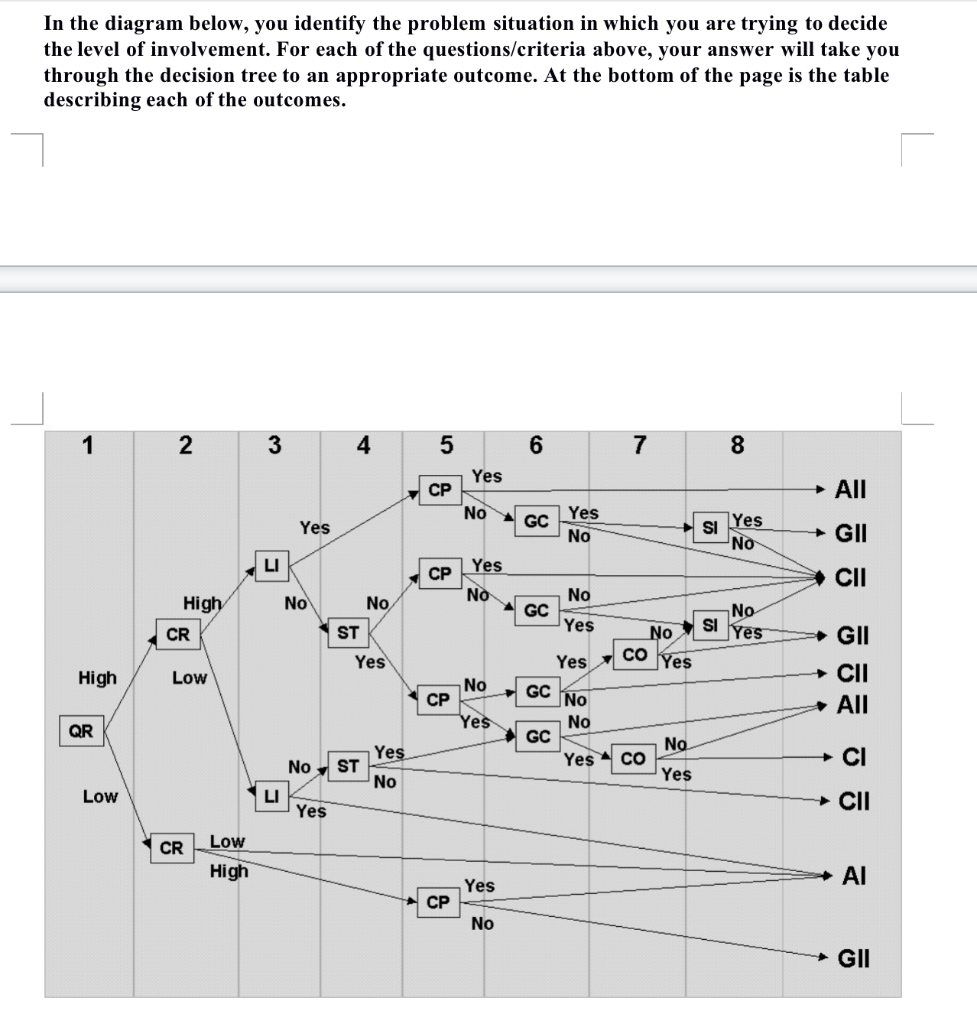
This assignment addresses very interesting and helpful model developed by well-known psychologist V. Vroom together with Yetton, and then Jago. It deals with defining the optimal level (out of 5) of participation of subordinates in a particular decision. This is Contingency model, the main idea is that there is no one best way in managing people, here - in the level participation of employees. Besides explanation in the textbook, there is a useful description and schema of the model presented in this module. Tip: do not get scared of this decision tree (initialatural knee-jerk reaction), you will need to use just one path.
Describe shortly the problem that you or your manager faced in the past. Basing on the model of Vroom/Yetton/Jago, define and explain what is the optimal level of subordinates' participation in making this decision. Compare this with actual level of participation used by a manager - was the actual level the same as normative one? If not, what were the consequences? Use the materials on the model in this module.
Another tip: do not make logical leaps, go step-by-step in the model.
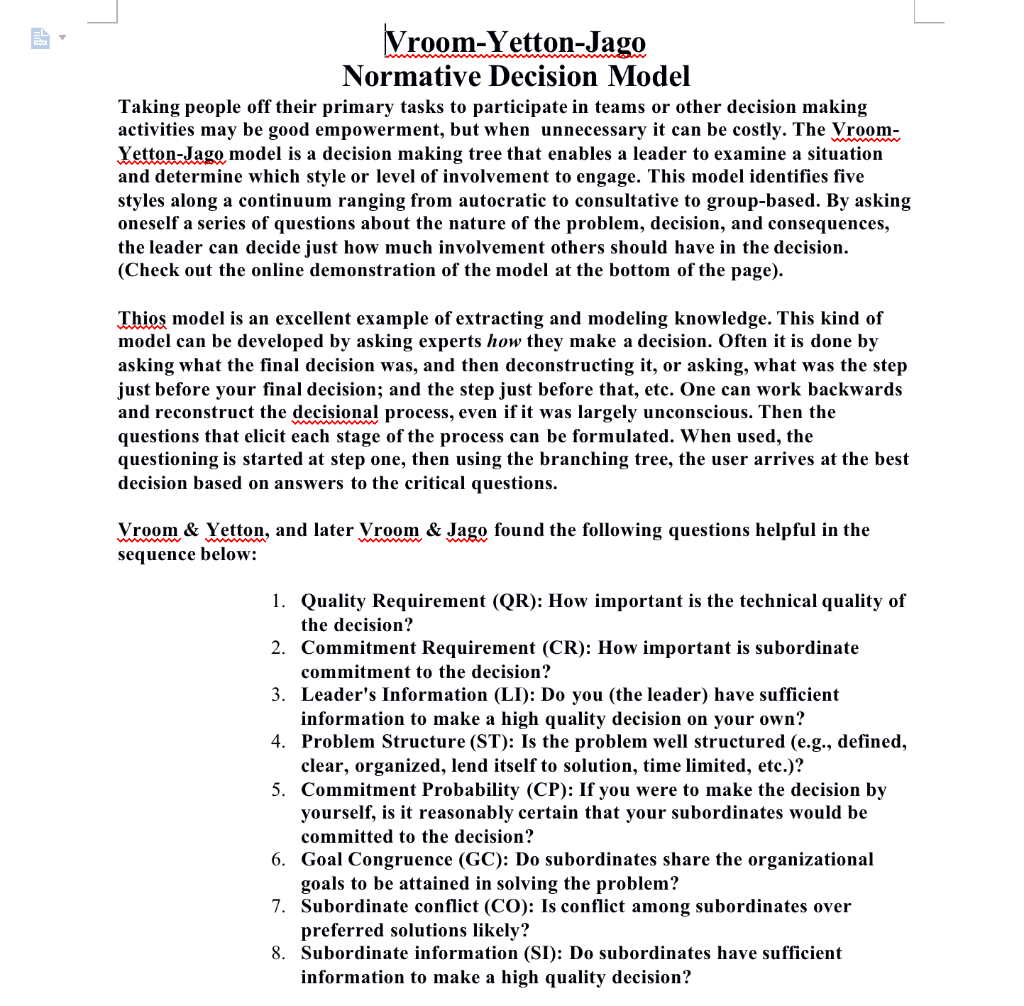
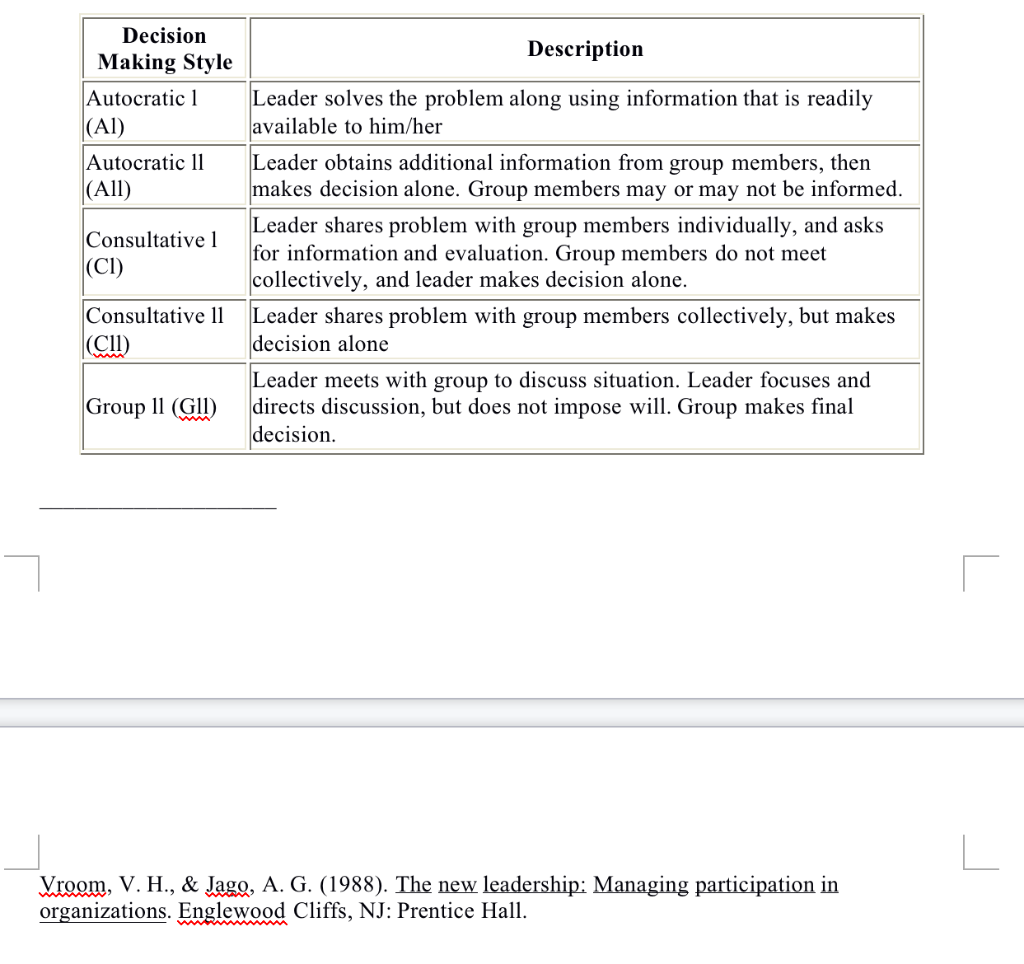
Vroom-Yetton-Jago Normative Decision Model Taking people off their primary tasks to participate in teams or other decision making activities may be good empowerment, but when unnecessary it can be costly. The VroomYetton-Jago model is a decision making tree that enables a leader to examine a situation and determine which style or level of involvement to engage. This model identifies five styles along a continuum ranging from autocratic to consultative to group-based. By asking oneself a series of questions about the nature of the problem, decision, and consequences, the leader can decide just how much involvement others should have in the decision. (Check out the online demonstration of the model at the bottom of the page). Thios model is an excellent example of extracting and modeling knowledge. This kind of model can be developed by asking experts how they make a decision. Often it is done by asking what the final decision was, and then deconstructing it, or asking, what was the step just before your final decision; and the step just before that, etc. One can work backwards and reconstruct the decisional process, even if it was largely unconscious. Then the questions that elicit each stage of the process can be formulated. When used, the questioning is started at step one, then using the branching tree, the user arrives at the best decision based on answers to the critical questions. Vroom \& Yetton, and later Vroom \& Jago found the following questions helpful in the sequence below: 1. Quality Requirement (QR): How important is the technical quality of the decision? 2. Commitment Requirement (CR): How important is subordinate commitment to the decision? 3. Leader's Information (LI): Do you (the leader) have sufficient information to make a high quality decision on your own? 4. Problem Structure (ST): Is the problem well structured (e.g., defined, clear, organized, lend itself to solution, time limited, etc.)? 5. Commitment Probability (CP): If you were to make the decision by yourself, is it reasonably certain that your subordinates would be committed to the decision? 6. Goal Congruence (GC): Do subordinates share the organizational goals to be attained in solving the problem? 7. Subordinate conflict (CO): Is conflict among subordinates over preferred solutions likely? 8. Subordinate information (SI): Do subordinates have sufficient information to make a high quality decision? In the diagram below, you identify the problem situation in which you are trying to decide the level of involvement. For each of the questions/criteria above, your answer will take you through the decision tree to an appropriate outcome. At the bottom of the page is the table describing each of the outcomes. Vroom, V. H., \& Jago, A. G. (1988). The new leadership: Managing participation in organizations. Englewood Cliffs, NJ: Prentice Hall
Step by Step Solution
There are 3 Steps involved in it

Get step-by-step solutions from verified subject matter experts
 Study Help