





Question: This assignment corresponds with Exercise 42 (p. 606 in Negotiation: Readings, Exercises, and Cases ). Obtain nos from 10 different people from whom you make

  1. This assignment corresponds with Exercise 42 (p. 606 in Negotiation: Readings, Exercises, and Cases).
  2. Obtain "nos" from 10 different people from whom you make 10 separate and different requests.
    1. Requests must be legal and must be possible for them to do.
    2. Requests must be something to give you (i.e., a favor or a specific object.). Requests cannot simply be answers to questions.
    3. Request may not be made to your instructor.
    4. Requests must be separate and different.
    5. "Yeses" need not be recorded.
      1. For all ten "nos", record the following:
        1. Whom you asked
        2. What was the subject of your request
        3. What was the response to your request
        4. What was your reaction to their response
      2. For one of the above requests:
        1. Return to the person who responded "no."
        2. Make the same request again.
        3. If they continue to respond "no," ask them a third time.
        4. Record their response each time.
        5. If they changed their response to "yes," explain why you think they changed their response.
        6. If their answer remained "no," explain why you think they did not change their response.
      3. For another one of the requests:
        1. Ask "what would it take to get you to say 'yes?'"
        2. Record their response.
        3. Record your response to their answer.
      4. What was your most surprising no? Why was it surprising? Why do you think they said no?
      5. What was your most surprising yes? Why was it surprising? Why do you think they said yes?
  3. Document your responses in a single document. Be sure each of the subparts is in a separate section and clearly marked.
This assignment corresponds with Exercise 42 (p.

This assignment corresponds with Exercise 42 (p.

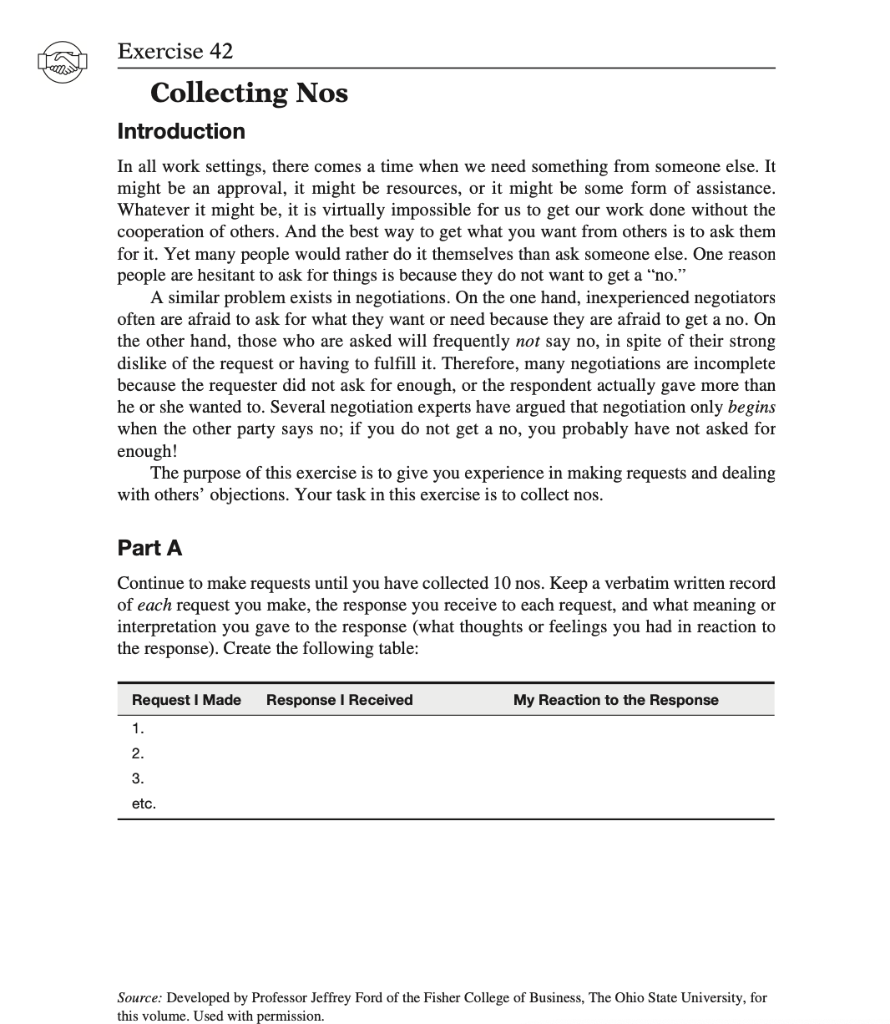
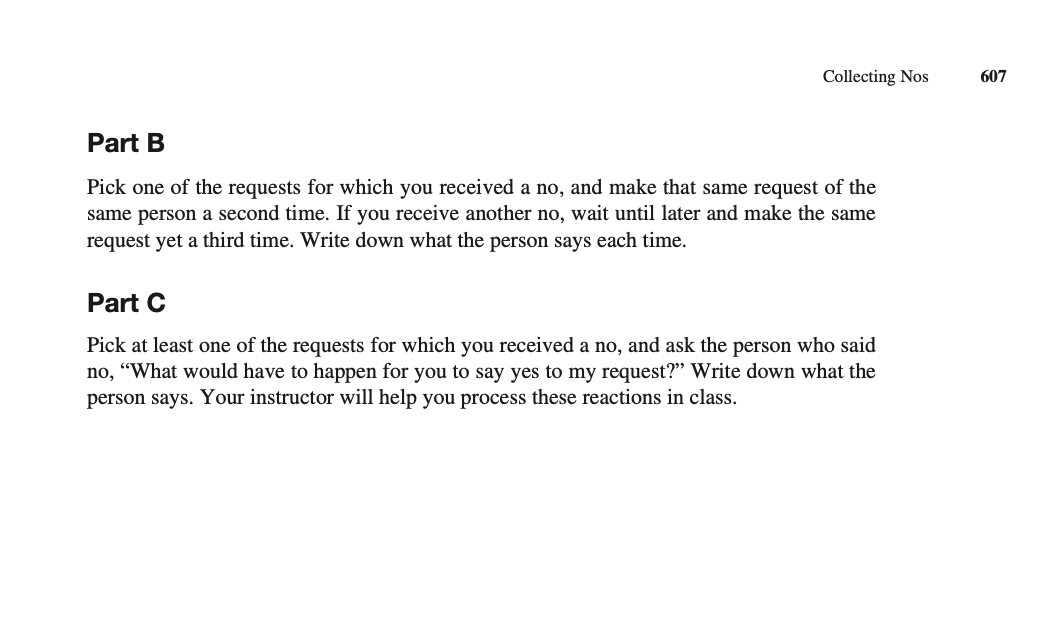
LA Exercise 42 Collecting Nos Introduction In all work settings, there comes a time when we need something from someone else. It might be an approval, it might be resources, or it might be some form of assistance. Whatever it might be, it is virtually impossible for us to get our work done without the cooperation of others. And the best way to get what you want from others is to ask them for it. Yet many people would rather do it themselves than ask someone else. One reason people are hesitant to ask for things is because they do not want to get a no." A similar problem exists in negotiations. On the one hand, inexperienced negotiators often are afraid to ask for what they want or need because they are afraid to get a no. On the other hand, those who are asked will frequently not say no, in spite of their strong dislike of the request or having to fulfill it. Therefore, many negotiations are incomplete because the requester did not ask for enough, or the respondent actually gave more than he or she wanted to. Several negotiation experts have argued that negotiation only begins when the other party says no; if you do not get a no, you probably have not asked for enough! The purpose of this exercise is to give you experience in making requests and dealing with others' objections. Your task in this exercise is to collect nos. Part A Continue to make requests until you have collected 10 nos. Keep a verbatim written record of each request you make, the response you receive to each request, and what meaning or interpretation you gave to the response (what thoughts or feelings you had in reaction to the response). Create the following table: Response | Received My Reaction to the Response Request | Made 1 2. 3. etc. Source: Developed by Professor Jeffrey Ford of the Fisher College of Business, The Ohio State University, for this volume. Used with permission. Collecting Nos 607 Part B Pick one of the requests for which you received a no, and make that same request of the same person a second time. If you receive another no, wait until later and make the same request yet a third time. Write down what the person says each time. Part C Pick at least one of the requests for which you received a no, and ask the person who said no, "What would have to happen for you to say yes to my request? Write down what the person says. Your instructor will help you process these reactions in class

Step by Step Solution

There are 3 Steps involved in it

1 Expert Approved Answer
Step: 1 Unlock blur-text-image

Question Has Been Solved by an Expert!

Get step-by-step solutions from verified subject matter experts

Step: 2 Unlock
Step: 3 Unlock

Students Have Also Explored These Related General Management Questions!