







Question: This assignment covers methods and classes, which are discussed in lectures. This homework also assumes understanding of the concepts that are covered from the
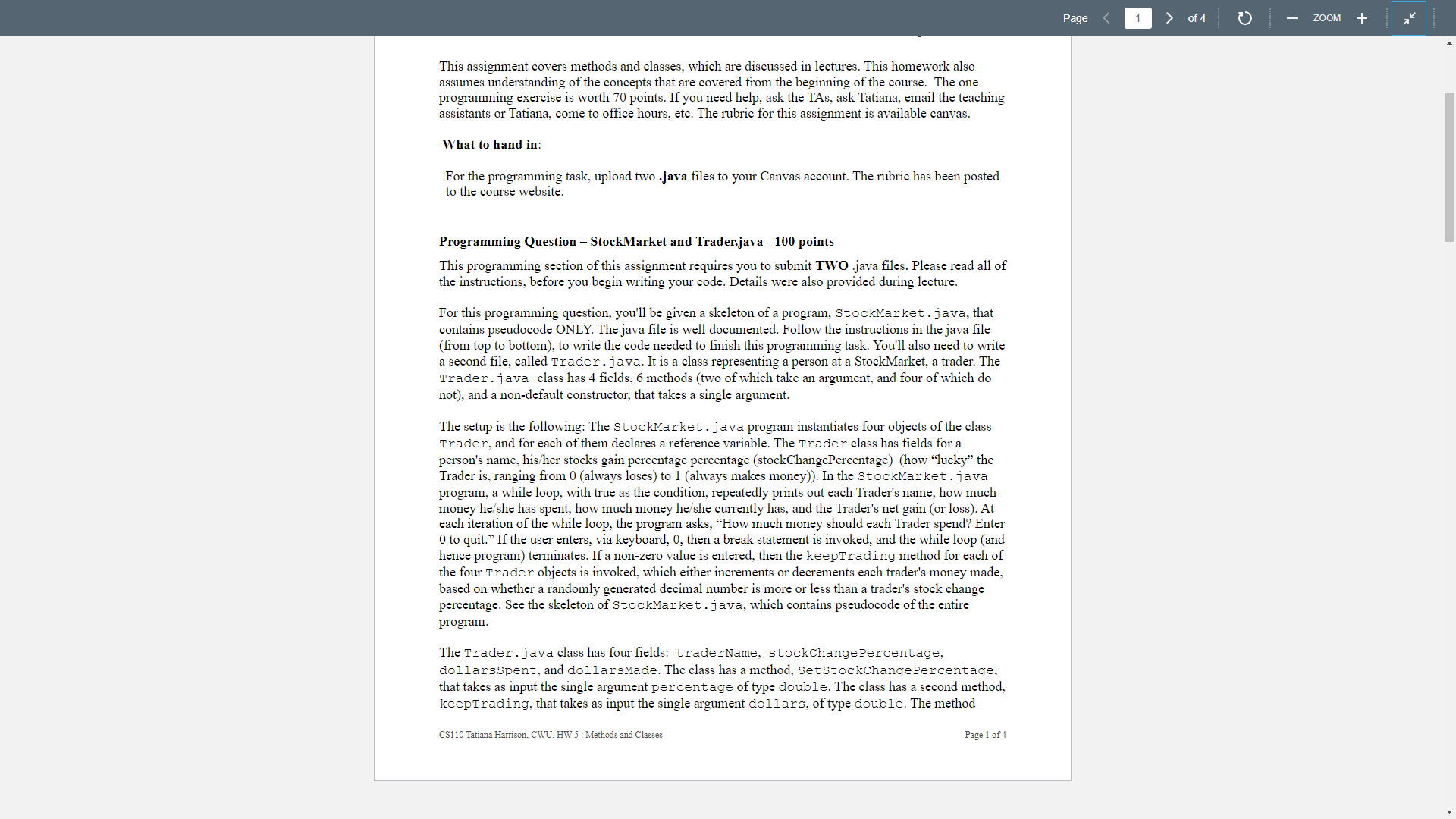
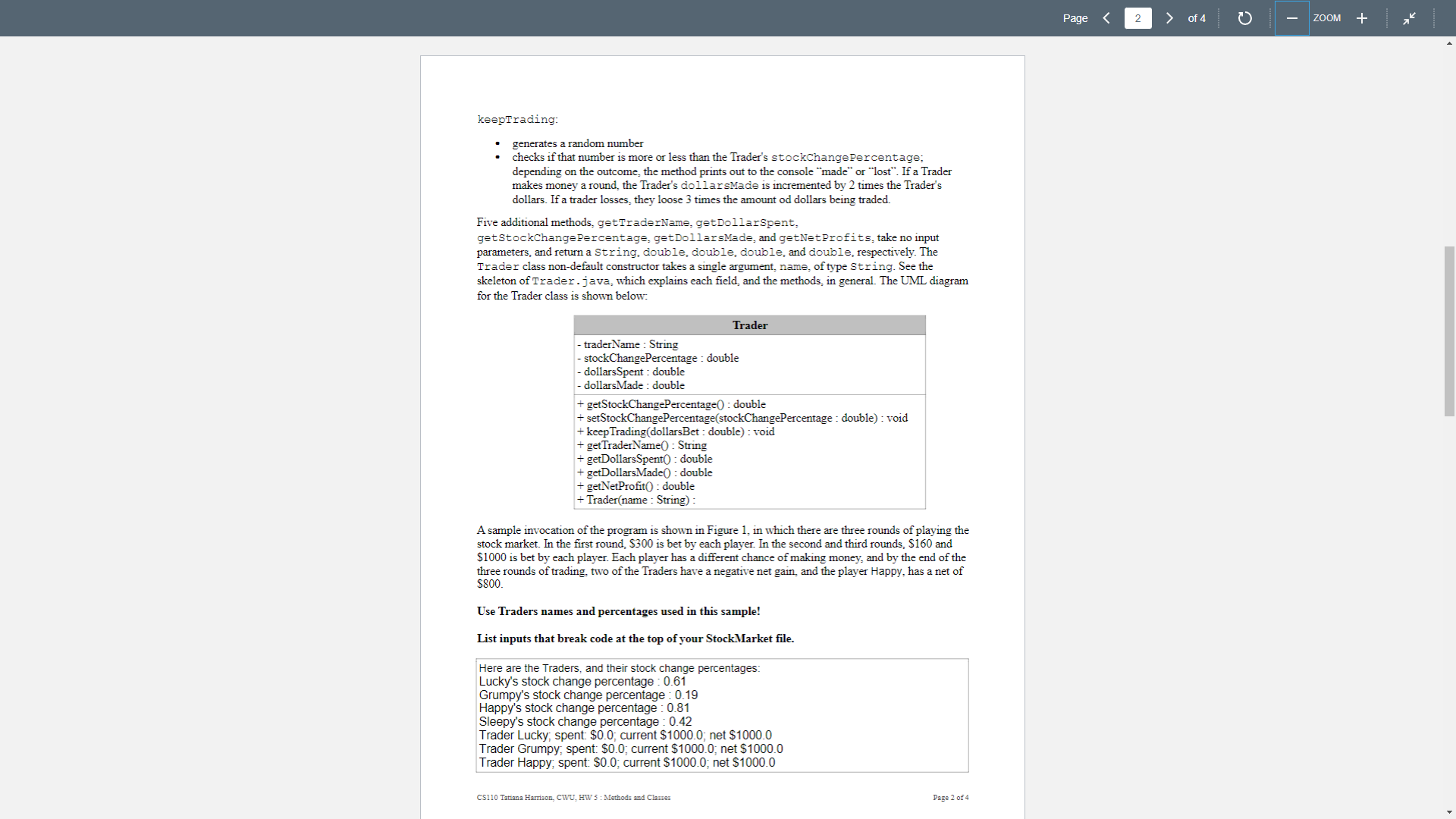
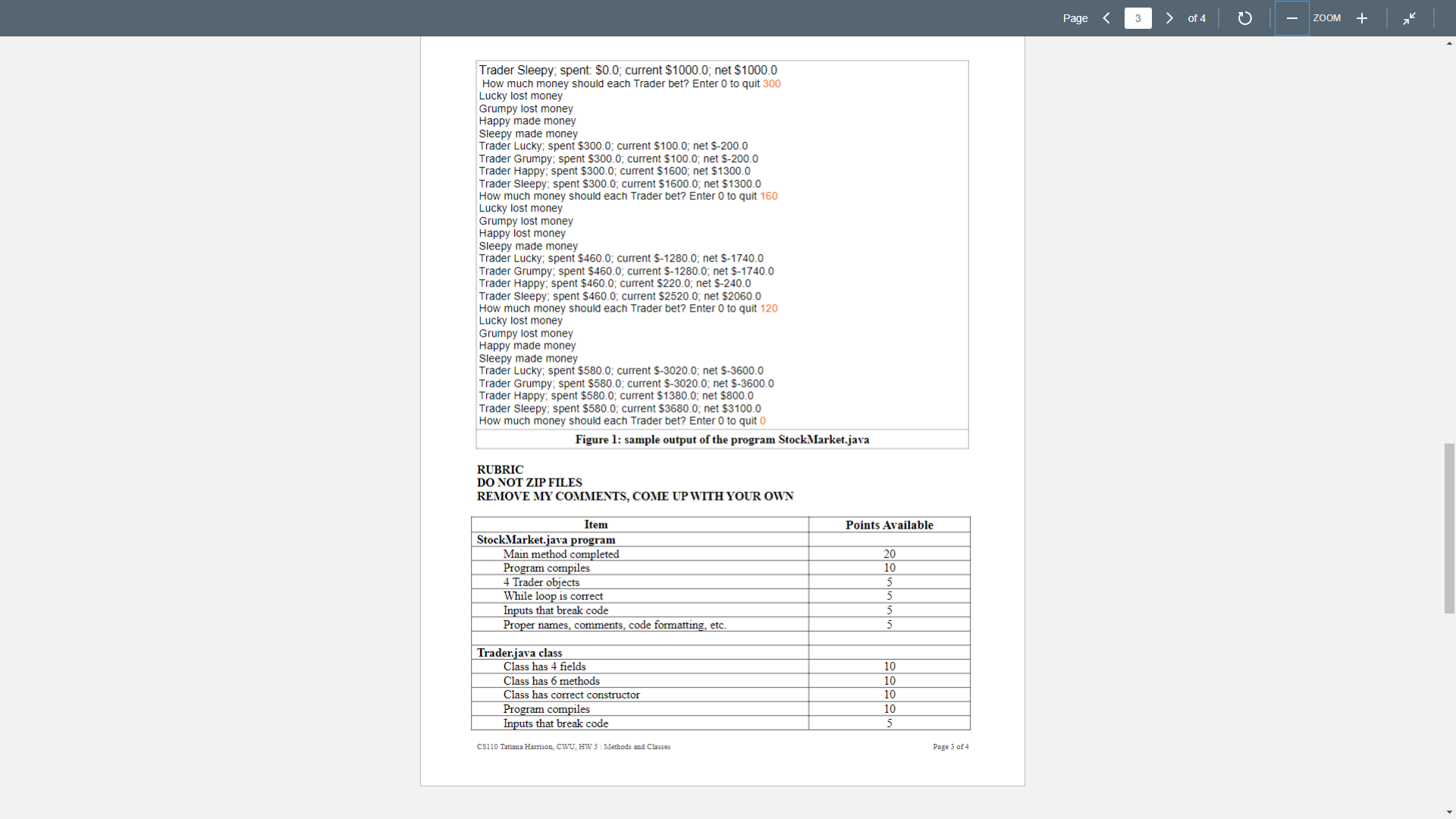
This assignment covers methods and classes, which are discussed in lectures. This homework also assumes understanding of the concepts that are covered from the beginning of the course. The one programming exercise is worth 70 points. If you need help, ask the TAs, ask Tatiana, email the teaching assistants or Tatiana, come to office hours, etc. The rubric for this assignment is available canvas. What to hand in: For the programming task, upload two .java files to your Canvas account. The rubric has been posted to the course website. Programming Question - StockMarket and Trader.java - 100 points This programming section of this assignment requires you to submit TWO .java files. Please read all of the instructions, before you begin writing your code. Details were also provided during lecture. For this programming question, you'll be given a skeleton of a program, StockMarket.java, that contains pseudocode ONLY. The java file is well documented. Follow the instructions in the java file (from top to bottom), to write the code needed to finish this programming task. You'll also need to write a second file, called Trader.java. It is a class representing a person at a StockMarket, a trader. The Trader.java class has 4 fields, 6 methods (two of which take an argument, and four of which do not), and a non-default constructor, that takes a single argument. The setup is the following: The StockMarket.java program instantiates four objects of the class Trader, and for each of them declares a reference variable. The Trader class has fields for a person's name, his/her stocks gain percentage percentage (stockChangePercentage) (how "lucky" the Trader is, ranging from 0 (always loses) to 1 (always makes money)). In the StockMarket.java program, a while loop, with true as the condition, repeatedly prints out each Trader's name, how much money he/she has spent, how much money he/she currently has, and the Trader's net gain (or loss). At each iteration of the while loop, the program asks, "How much money should each Trader spend? Enter 0 to quit." If the user enters, via keyboard, 0, then a break statement is invoked, and the while loop (and hence program) terminates. If a non-zero value is entered, then the keepTrading method for each of the four Trader objects is invoked, which either increments or decrements each trader's money made, based on whether a randomly generated decimal number is more or less than a trader's stock change percentage. See the skeleton of StockMarket.java, which contains pseudocode of the entire program. The Trader.java class has four fields: traderName, stockChange Percentage, dollarsSpent, and dollarsMade. The class has a method, SetStockChange Percentage, that takes as input the single argument percentage of type double. The class has a second method, keepTrading, that takes as input the single argument dollars, of type double. The method CS110 Tatiana Harrison, CWU, HW5: Methods and Classes Page 1 of 4 Page 1 > of 4 ZOOM + keepTrading: generates a random number checks if that number is more or less than the Trader's stockChange Percentage; depending on the outcome, the method prints out to the console "made" or "lost". If a Trader makes money a round, the Trader's dollarsMade is incremented by 2 times the Trader's dollars. If a trader losses, they loose 3 times the amount od dollars being traded. Five additional methods, getTraderName, getDollarSpent, getStockChange Percentage, getDollarsMade, and getNetProfits, take no input parameters, and return a String, double, double, double, and double, respectively. The Trader class non-default constructor takes a single argument, name, of type String. See the skeleton of Trader.java, which explains each field, and the methods, in general. The UML diagram for the Trader class is shown below: traderName: String stock-ChangePercentage: double dollarsSpent : double - dollarsMade: double + getStockChangePercentage(): double + setStockChangePercentage(stockChangePercentage: double): void + keep Trading (dollarsBet : double): void + getTraderName(): String + getDollarsSpent(): double + getDollarsMade(): double + getNetProfit(): double + Trader(name: String): Trader A sample invocation of the program is shown in Figure 1, in which there are three rounds of playing the stock market. In the first round, $300 is bet by each player. In the second and third rounds, $160 and $1000 is bet by each player. Each player has a different chance of making money, and by the end of the three rounds of trading, two of the Traders have a negative net gain, and the player Happy, has a net of $800. Use Traders names and percentages used in this sample! List inputs that break code at the top of your Stock Market file. Here are the Traders, and their stock change percentages: Lucky's stock change percentage: 0.61 Grumpy's stock change percentage: 0.19 Happy's stock change percentage: 0.81 Sleepy's stock change percentage: 0.42 Trader Lucky; spent: $0.0; current $1000.0; net $1000.0 Trader Grumpy; spent: $0.0; current $1000.0; net $1000.0 Trader Happy; spent: $0.0; current $1000.0; net $1000.0 CS110 Tatiana Harrison, CWU, HW 5: Methods and Classes Page 2 of 4 Page 2 > of 4 ZOOM + Trader Sleepy; spent: $0.0; current $1000.0; net $1000.0 How much money should each Trader bet? Enter 0 to quit 300 Lucky lost money Grumpy lost money Happy made money Sleepy made money Trader Lucky; spent $300.0; current $100.0; net $-200.0 Trader Grumpy; spent $300.0; current $100.0; net $-200.0 Trader Happy; spent $300.0; current $1600; net $1300.0 Trader Sleepy; spent $300.0; current $1600.0; net $1300.0 How much money should each Trader bet? Enter 0 to quit 160 Lucky lost money Grumpy lost money money Happy lost money Sleepy made money Trader Lucky; spent $460.0; current $-1280.0; net $-1740.0 L Trader Grumpy; spent $460.0; current $-1280.0; net $-1740.0 Trader Happy; spent $460.0; current $220.0; net $-240.0 Trader Sleepy; spent $460.0; current $2520.0; net $2060.0 How much money should each Trader bet? Enter 0 to quit 120 Lucky lost money Grumpy lost money Happy made money Sleepy made money Trader Lucky; spent $580.0; current $-3020.0; net $-3600.0 Trader Grumpy; spent $580.0; current $-3020.0; net $-3600.0 Trader Happy; spent $580.0; current $1380.0; net $800.0 Trader Sleepy; spent $580.0; current $3680.0; net $3100.0 How much money should each Trader bet? Enter 0 to quit 0 Figure 1: sample output of the program StockMarket.java RUBRIC DO NOT ZIP FILES REMOVE MY COMMENTS, COME UP WITH YOUR OWN Item Stock Market.java program Main method completed Program compiles 4 Trader objects While loop is correct Inputs that break code Proper names, comments, code formatting, etc. Trader.java class Class has 4 fields Class has 6 methods Class has correct constructor Program compiles Inputs that break code CS110 Tatiana Harrison, CWU, HW 5: Methods and Classes Points Available 20 10 5 5 5 5 10 10 10 10 5 Page 3 of 4 Page 3 > of 4 ZOOM +
Step by Step Solution
3.42 Rating (161 Votes )
There are 3 Steps involved in it
Lets break down the assignment requirements and the steps needed to complete it accurately StockMarketjava ... View full answer

Get step-by-step solutions from verified subject matter experts
 Study Help