







Question: This assignment involves designing the architecture and writing RTL for an elevator controller in a building with five floors ( a ground floor and four
This assignment involves designing the architecture and writing RTL for an elevator controller in
a building with five floors a ground floor and four upper floors
The elevator should manage multiple requests simultaneously by assigning priority. The elevator
should prioritize requests in its current direction of movement, servicing requests in the upward
direction while moving up and downward while moving down. If the elevator is idle not
moving priority is given to the first floor requested. If multiple requests are received at the
same time while the elevator is idle, priority is given to the highest floor among the requests.
The elevator includes a stop feature: a push button inside the elevator allows passengers to stop
it immediately. When pressed, the elevator halts and retains all input, output, and control
states. Pressing the button again releases the stop, allowing the elevator to resume from where
it left off, with all signals and states preserved for a seamless continuation.
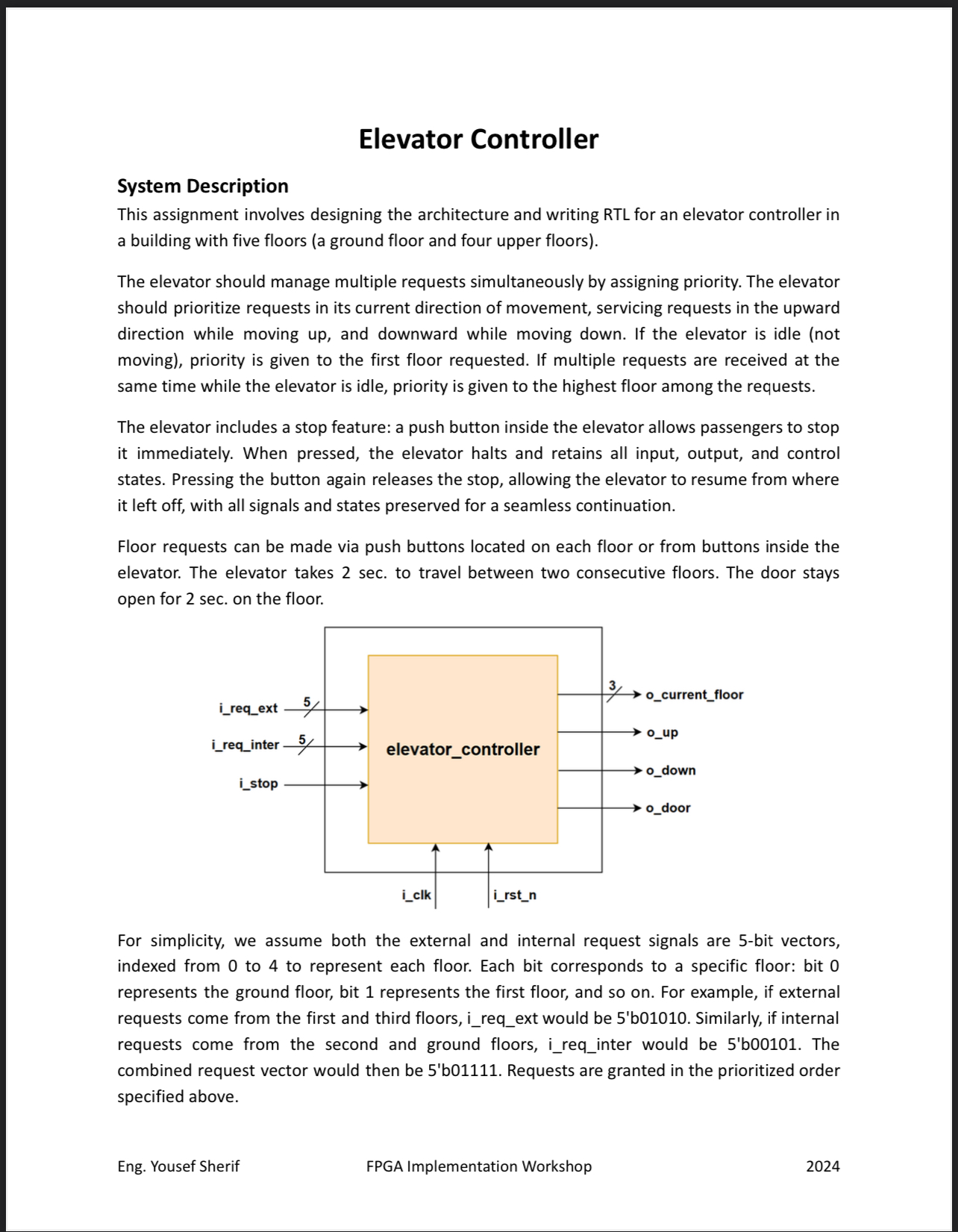
Floor requests can be made via push buttons located on each floor or from buttons inside the
elevator The elevator takes sec to travel between two consecutive floors. The door stays
open for sec on the floor Elevator Controller
System Description
This assignment involves designing the architecture and writing RTL for an elevator controller in a building with five floors a ground floor and four upper floors
The elevator should manage multiple requests simultaneously by assigning priority. The elevator should prioritize requests in its current direction of movement, servicing requests in the upward direction while moving up and downward while moving down. If the elevator is idle not moving priority is given to the first floor requested. If multiple requests are received at the same time while the elevator is idle, priority is given to the highest floor among the requests.
The elevator includes a stop feature: a push button inside the elevator allows passengers to stop it immediately. When pressed, the elevator halts and retains all input, output, and control states. Pressing the button again releases the stop, allowing the elevator to resume from where it left off, with all signals and states preserved for a seamless continuation.
Floor requests can be made via push buttons located on each floor or from buttons inside the elevator. The elevator takes sec to travel between two consecutive floors. The door stays open for sec on the floor.
For simplicity, we assume both the external and internal request signals are bit vectors, indexed from to to represent each floor. Each bit corresponds to a specific floor: bit represents the ground floor, bit represents the first floor, and so on For example, if external requests come from the first and third floors, ireqext would be b Similarly, if internal requests come from the second and ground floors, ireqinter would be b The combined request vector would then be b Requests are granted in the prioritized order specified above. Signals
Table
begintabularcccl
hline Signal & Width & Direction & multicolumnc Description
hline iclk & & Input & Positive edge system clock MHz
hline irstn & & Input & Negative edge asynchronous system reset
hline ireqext & & Input & begintabularl
External input requests where each bit represents the
push button outside the elevator for its corresponding
floor. When a bit is set to it indicates a request from
that floor.
endtabular
hline istop & & Input & begintabularl
Internal elevator requests where each bit represents a
push button inside the elevator for a specific floor.
When a bit is set to it indicates a request for that
floor.
endtabular
hline ocurrentfloo & & output & begintabularl
A stop button inside the elevator allows People to
immediately halt the elevator.
endtabular
hline oup & & begintabularl
An output indicating the current floor number. For
example, if the elevator is on the third floor,
ocurrentfloor will be set to d
endtabular
hline output & begintabularl
: elevator is moving up
: elevator is moving down or not moving
endtabular
hline odoor & & output & begintabularl
: elevator is moving down
: elevator is moving up or not moving
endtabular
hline output & begintabularl
: elevator door opens
: elevator door closed
endtabular
hline
endtabular
Deliverables
You have to submit a pdf or zip file that contains:
A PDF file that contains:
Architecture of the design which includes how subblocks communicate with each other.
Description of the operation between blocks and any existing FSM
Simulation waveform that shows the module is working correctly.
Project folder contains zip file or google drive link:
RTL codes of the system.
Testbench code of the system.
Eng. Yousef
Step by Step Solution
There are 3 Steps involved in it
1 Expert Approved Answer
Step: 1 Unlock

Question Has Been Solved by an Expert!
Get step-by-step solutions from verified subject matter experts
Step: 2 Unlock
Step: 3 Unlock
 Study Help