







Question: This assignment is an individual assignment. This assignment requires you to: provide a briefing paper for a new junior Minister in the Department of Finance
This assignment is an individual assignment.
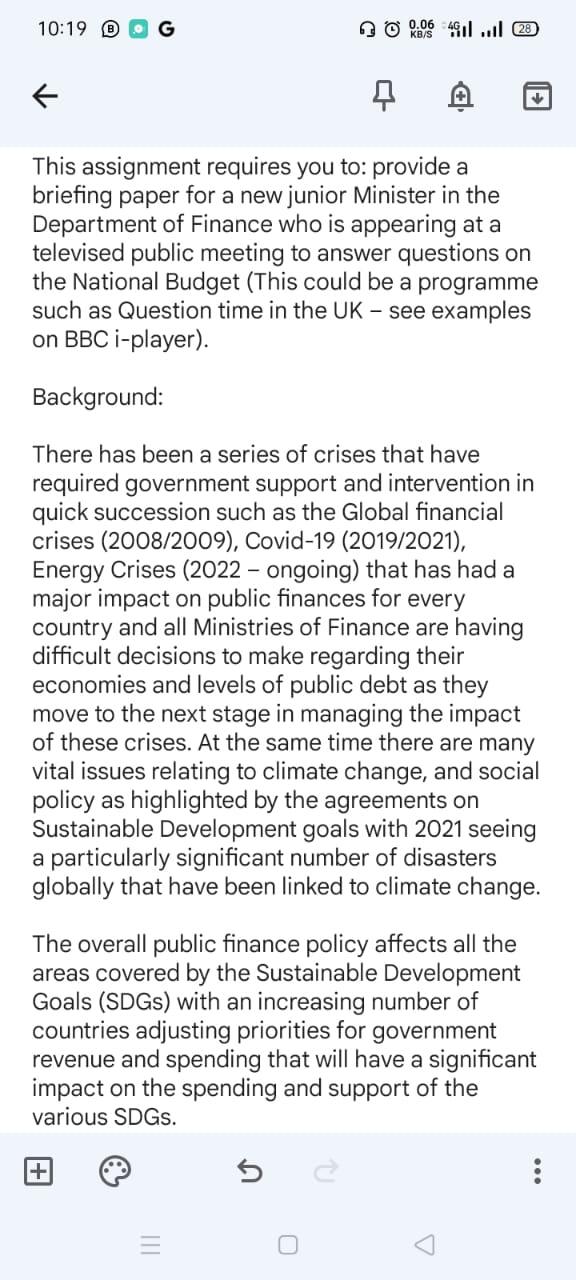
This assignment requires you to: provide a briefing paper for a new junior Minister in the Department of Finance who is appearing at a televised public meeting to answer questions on the National Budget (This could be a programme such as Question time in the UK see examples on BBC i-player).
Background:
There has been a series of crises that have required government support and intervention in quick succession such as the Global financial crises (2008/2009), Covid-19 (2019/2021), Energy Crises (2022 ongoing) that has had a major impact on public finances for every country and all Ministries of Finance are having difficult decisions to make regarding their economies and levels of public debt as they move to the next stage in managing the impact of these crises. At the same time there are many vital issues relating to climate change, and social policy as highlighted by the agreements on Sustainable Development goals with 2021 seeing a particularly significant number of disasters globally that have been linked to climate change.
The overall public finance policy affects all the areas covered by the Sustainable Development Goals (SDGs) with an increasing number of countries adjusting priorities for government revenue and spending that will have a significant impact on the spending and support of the various SDGs.
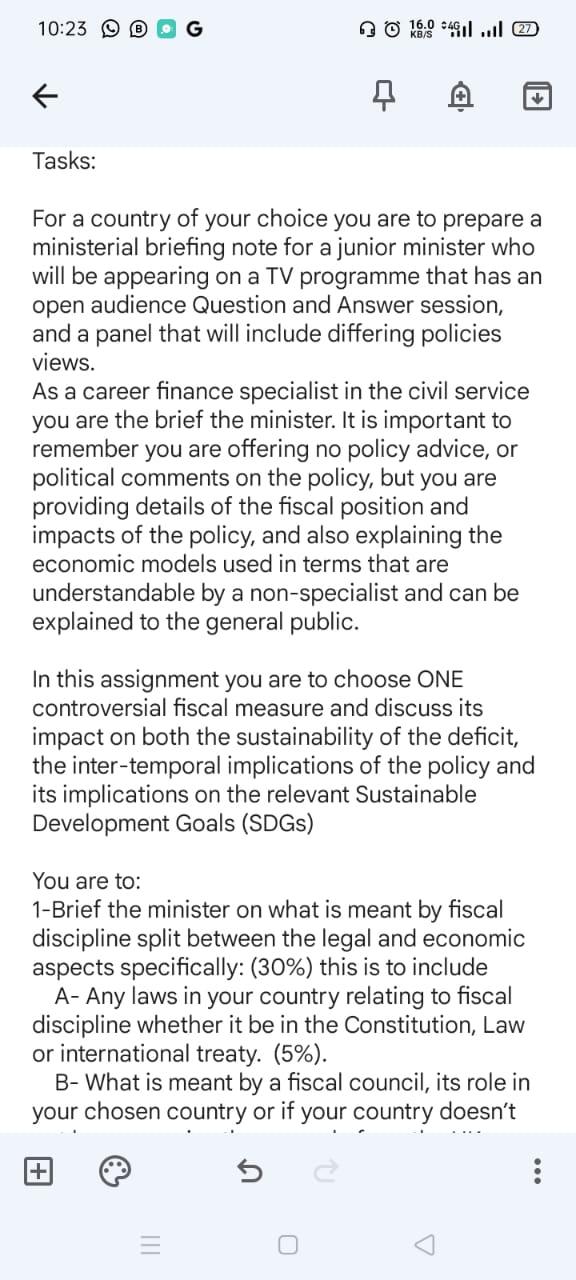
Tasks:
For a country of your choice you are to prepare a ministerial briefing note for a junior minister who will be appearing on a TV programme that has an open audience Question and Answer session, and a panel that will include differing policies views.
As a career finance specialist in the civil service you are the brief the minister. It is important to remember you are offering no policy advice, or political comments on the policy, but you are providing details of the fiscal position and impacts of the policy, and also explaining the economic models used in terms that are understandable by a non-specialist and can be explained to the general public.
In this assignment you are to choose ONE controversial fiscal measure and discuss its impact on both the sustainability of the deficit, the inter-temporal implications of the policy and its implications on the relevant Sustainable Development Goals (SDGs)
You are to:
Brief the minister on what is meant by fiscal discipline split between the legal and economic aspects specifically: (30%) this is to include
Any laws in your country relating to fiscal discipline whether it be in the Constitution, Law or international treaty. (5%).
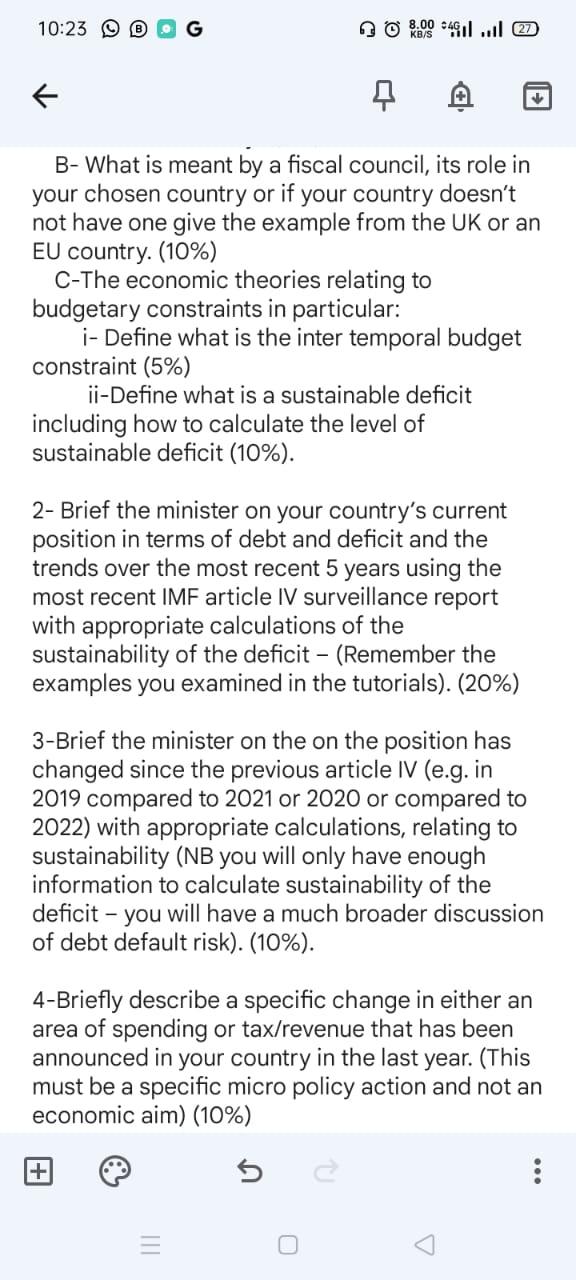
What is meant by a fiscal council, its role in your chosen country or if your country doesnt not have one give the example from the UK or an EU country. (10%)
The economic theories relating to budgetary constraints in particular:
Define what is the inter temporal budget constraint (5%)
Define what is a sustainable deficit including how to calculate the level of sustainable deficit (10%).
Brief the minister on your countrys current position in terms of debt and deficit and the trends over the most recent 5 years using the most recent IMF article IV surveillance report with appropriate calculations of the sustainability of the deficit (Remember the examples you examined in the tutorials). (20%)
Brief the minister on the on the position has changed since the previous article IV (e.g. in 2019 compared to 2021 or 2020 or compared to 2022) with appropriate calculations, relating to sustainability (NB you will only have enough information to calculate sustainability of the deficit you will have a much broader discussion of debt default risk). (10%).
Briefly describe a specific change in either an area of spending or tax/revenue that has been announced in your country in the last year. (This must be a specific micro policy action and not an economic aim) (10%)
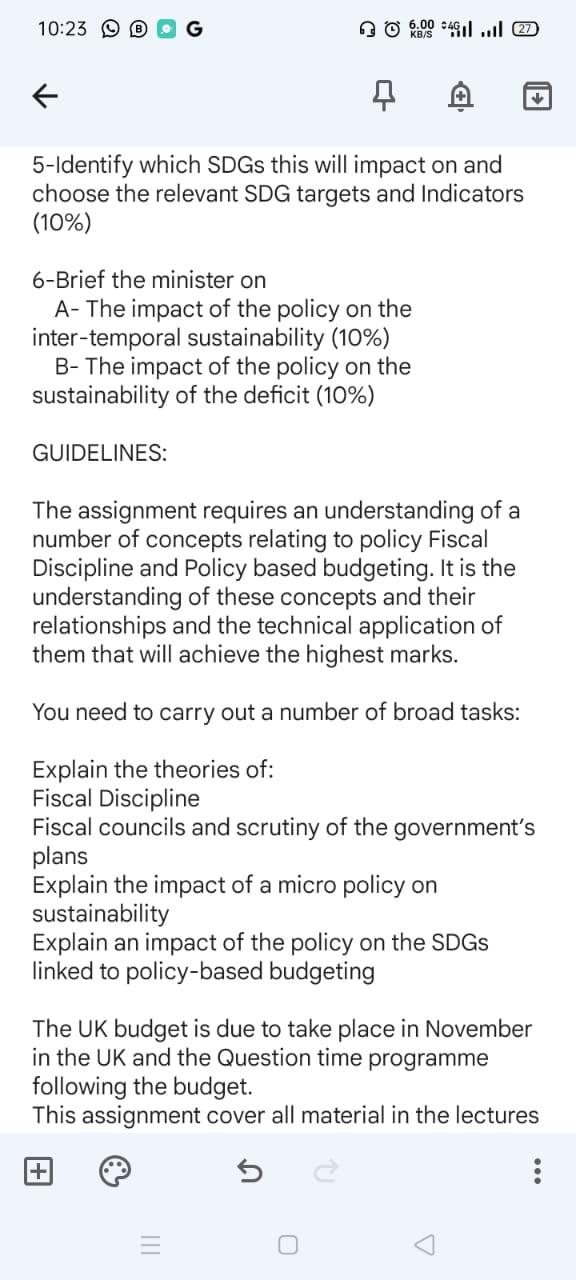
Identify which SDGs this will impact on and choose the relevant SDG targets and Indicators (10%)
Brief the minister on
The impact of the policy on the inter-temporal sustainability (10%)
The impact of the policy on the sustainability of the deficit (10%)
GUIDELINES:
The assignment requires an understanding of a number of concepts relating to policy Fiscal Discipline and Policy based budgeting. It is the understanding of these concepts and their relationships and the technical application of them that will achieve the highest marks.
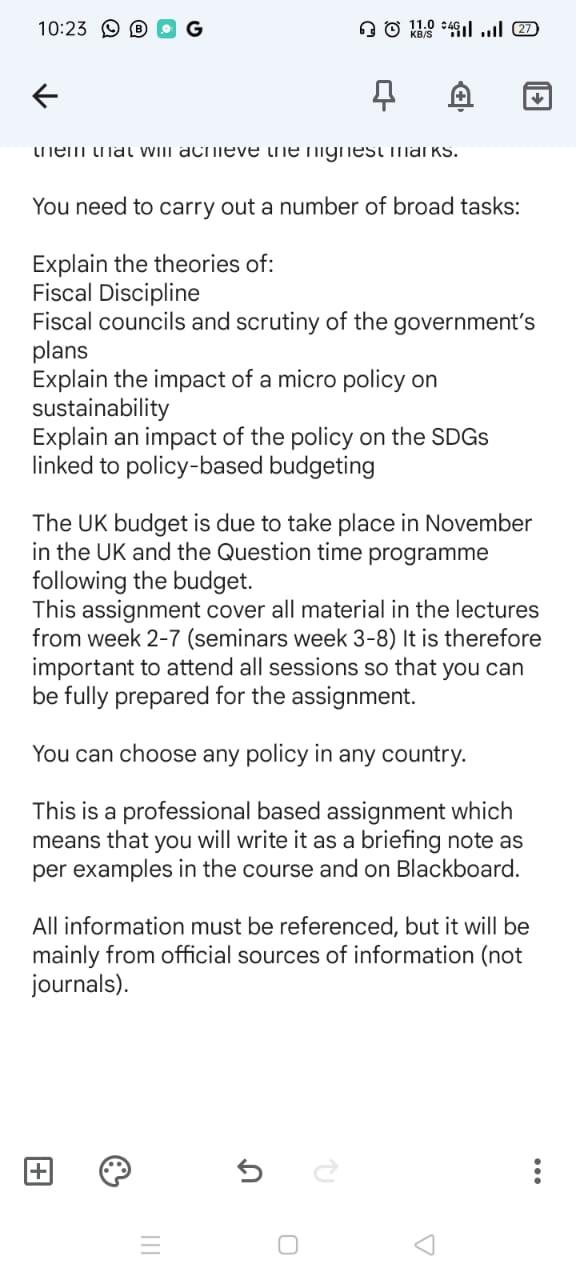
You need to carry out a number of broad tasks:
Explain the theories of:
Fiscal Discipline
Fiscal councils and scrutiny of the governments plans
Explain the impact of a micro policy on sustainability
Explain an impact of the policy on the SDGs linked to policy-based budgeting
The UK budget is due to take place in November in the UK and the Question time programme following the budget.
This assignment cover all material in the lectures from week 2-7 (seminars week 3-8) It is therefore important to attend all sessions so that you can be fully prepared for the assignment.
You can choose any policy in any country.
This is a professional based assignment which means that you will write it as a briefing note as per examples in the course and on Blackboard.
All information must be referenced, but it will be mainly from official sources of information (not journals).
briefing paper for a new junior Minister in the Department of Finance who is appearing at a televised public meeting to answer questions on the National Budget (This could be a programme such as Question time in the UK - see examples on BBC i-player). Background: There has been a series of crises that have required government support and intervention in quick succession such as the Global financial crises (2008/2009), Covid-19 (2019/2021), Energy Crises (2022 - ongoing) that has had a major impact on public finances for every country and all Ministries of Finance are having difficult decisions to make regarding their economies and levels of public debt as they move to the next stage in managing the impact of these crises. At the same time there are many vital issues relating to climate change, and social policy as highlighted by the agreements on Sustainable Development goals with 2021 seeing a particularly significant number of disasters globally that have been linked to climate change. The overall public finance policy affects all the areas covered by the Sustainable Development Goals (SDGs) with an increasing number of countries adjusting priorities for government revenue and spending that will have a significant impact on the spending and support of the various SDGs. For a country of your choice you are to prepare a ministerial briefing note for a junior minister who will be appearing on a TV programme that has an open audience Question and Answer session, and a panel that will include differing policies views. As a career finance specialist in the civil service you are the brief the minister. It is important to remember you are offering no policy advice, or political comments on the policy, but you are providing details of the fiscal position and impacts of the policy, and also explaining the economic models used in terms that are understandable by a non-specialist and can be explained to the general public. In this assignment you are to choose ONE controversial fiscal measure and discuss its impact on both the sustainability of the deficit, the inter-temporal implications of the policy and its implications on the relevant Sustainable Development Goals (SDGs) You are to: 1-Brief the minister on what is meant by fiscal discipline split between the legal and economic aspects specifically: (30%) this is to include A- Any laws in your country relating to fiscal discipline whether it be in the Constitution, Law or international treaty. (5\%). B- What is meant by a fiscal council, its role in your chosen country or if your country doesn't B- What is meant by a fiscal council, its role in your chosen country or if your country doesn't not have one give the example from the UK or an EU country. (10\%) C-The economic theories relating to budgetary constraints in particular: i- Define what is the inter temporal budget constraint (5\%) ii-Define what is a sustainable deficit including how to calculate the level of sustainable deficit (10\%). 2- Brief the minister on your country's current position in terms of debt and deficit and the trends over the most recent 5 years using the most recent IMF article IV surveillance report with appropriate calculations of the sustainability of the deficit - (Remember the examples you examined in the tutorials). (20\%) 3-Brief the minister on the on the position has changed since the previous article IV (e.g. in 2019 compared to 2021 or 2020 or compared to 2022) with appropriate calculations, relating to sustainability (NB you will only have enough information to calculate sustainability of the deficit - you will have a much broader discussion of debt default risk). (10\%). 4-Briefly describe a specific change in either an area of spending or tax/ revenue that has been announced in your country in the last year. (This must be a specific micro policy action and not an economic aim) (10\%) 5-Identity which SDGS this will Impact on and choose the relevant SDG targets and Indicators (10%) 6-Brief the minister on A-The impact of the policy on the inter-temporal sustainability (10%) B- The impact of the policy on the sustainability of the deficit (10%) GUIDELINES: The assignment requires an understanding of a number of concepts relating to policy Fiscal Discipline and Policy based budgeting. It is the understanding of these concepts and their relationships and the technical application of them that will achieve the highest marks. You need to carry out a number of broad tasks: Explain the theories of: Fiscal Discipline Fiscal councils and scrutiny of the government's plans Explain the impact of a micro policy on sustainability Explain an impact of the policy on the SDGs linked to policy-based budgeting The UK budget is due to take place in November in the UK and the Question time programme following the budget. This assignment cover all material in the lectures You need to carry out a number of broad tasks: Explain the theories of: Fiscal Discipline Fiscal councils and scrutiny of the government's plans Explain the impact of a micro policy on sustainability Explain an impact of the policy on the SDGs linked to policy-based budgeting The UK budget is due to take place in November in the UK and the Question time programme following the budget. This assignment cover all material in the lectures from week 2-7 (seminars week 3-8) It is therefore important to attend all sessions so that you can be fully prepared for the assignment. You can choose any policy in any country. This is a professional based assignment which means that you will write it as a briefing note as per examples in the course and on Blackboard. All information must be referenced, but it will be mainly from official sources of information (not journals). briefing paper for a new junior Minister in the Department of Finance who is appearing at a televised public meeting to answer questions on the National Budget (This could be a programme such as Question time in the UK - see examples on BBC i-player). Background: There has been a series of crises that have required government support and intervention in quick succession such as the Global financial crises (2008/2009), Covid-19 (2019/2021), Energy Crises (2022 - ongoing) that has had a major impact on public finances for every country and all Ministries of Finance are having difficult decisions to make regarding their economies and levels of public debt as they move to the next stage in managing the impact of these crises. At the same time there are many vital issues relating to climate change, and social policy as highlighted by the agreements on Sustainable Development goals with 2021 seeing a particularly significant number of disasters globally that have been linked to climate change. The overall public finance policy affects all the areas covered by the Sustainable Development Goals (SDGs) with an increasing number of countries adjusting priorities for government revenue and spending that will have a significant impact on the spending and support of the various SDGs. For a country of your choice you are to prepare a ministerial briefing note for a junior minister who will be appearing on a TV programme that has an open audience Question and Answer session, and a panel that will include differing policies views. As a career finance specialist in the civil service you are the brief the minister. It is important to remember you are offering no policy advice, or political comments on the policy, but you are providing details of the fiscal position and impacts of the policy, and also explaining the economic models used in terms that are understandable by a non-specialist and can be explained to the general public. In this assignment you are to choose ONE controversial fiscal measure and discuss its impact on both the sustainability of the deficit, the inter-temporal implications of the policy and its implications on the relevant Sustainable Development Goals (SDGs) You are to: 1-Brief the minister on what is meant by fiscal discipline split between the legal and economic aspects specifically: (30%) this is to include A- Any laws in your country relating to fiscal discipline whether it be in the Constitution, Law or international treaty. (5\%). B- What is meant by a fiscal council, its role in your chosen country or if your country doesn't B- What is meant by a fiscal council, its role in your chosen country or if your country doesn't not have one give the example from the UK or an EU country. (10\%) C-The economic theories relating to budgetary constraints in particular: i- Define what is the inter temporal budget constraint (5\%) ii-Define what is a sustainable deficit including how to calculate the level of sustainable deficit (10\%). 2- Brief the minister on your country's current position in terms of debt and deficit and the trends over the most recent 5 years using the most recent IMF article IV surveillance report with appropriate calculations of the sustainability of the deficit - (Remember the examples you examined in the tutorials). (20\%) 3-Brief the minister on the on the position has changed since the previous article IV (e.g. in 2019 compared to 2021 or 2020 or compared to 2022) with appropriate calculations, relating to sustainability (NB you will only have enough information to calculate sustainability of the deficit - you will have a much broader discussion of debt default risk). (10\%). 4-Briefly describe a specific change in either an area of spending or tax/ revenue that has been announced in your country in the last year. (This must be a specific micro policy action and not an economic aim) (10\%) 5-Identity which SDGS this will Impact on and choose the relevant SDG targets and Indicators (10%) 6-Brief the minister on A-The impact of the policy on the inter-temporal sustainability (10%) B- The impact of the policy on the sustainability of the deficit (10%) GUIDELINES: The assignment requires an understanding of a number of concepts relating to policy Fiscal Discipline and Policy based budgeting. It is the understanding of these concepts and their relationships and the technical application of them that will achieve the highest marks. You need to carry out a number of broad tasks: Explain the theories of: Fiscal Discipline Fiscal councils and scrutiny of the government's plans Explain the impact of a micro policy on sustainability Explain an impact of the policy on the SDGs linked to policy-based budgeting The UK budget is due to take place in November in the UK and the Question time programme following the budget. This assignment cover all material in the lectures You need to carry out a number of broad tasks: Explain the theories of: Fiscal Discipline Fiscal councils and scrutiny of the government's plans Explain the impact of a micro policy on sustainability Explain an impact of the policy on the SDGs linked to policy-based budgeting The UK budget is due to take place in November in the UK and the Question time programme following the budget. This assignment cover all material in the lectures from week 2-7 (seminars week 3-8) It is therefore important to attend all sessions so that you can be fully prepared for the assignment. You can choose any policy in any country. This is a professional based assignment which means that you will write it as a briefing note as per examples in the course and on Blackboard. All information must be referenced, but it will be mainly from official sources of information (not journals)
Step by Step Solution
There are 3 Steps involved in it

Get step-by-step solutions from verified subject matter experts
 Study Help