







Question: This assignment requires you to read an article on how to avoid group conflict, and make sure that all members contribute to the group assignment.
This assignment requires you to read an article on how to avoid group conflict, and make sure that all members contribute to the group assignment. While it is a group assignment, every member should read the article.
Read the following article:Coping with Hitchhikers and Couch Potatoes on Teams
Coping with Hitchhikers and Couch Potatoes on Teams? You will usually find your university teammates as interested in learning as you are. Occasionally, how- ever, you may encounter a person who creates difficul- ties. This handout is meant to give you practical advice for this type of situation. To begin with, let's imagine you have been as- signed to a combined homework and lab group this semester with three others: Mary, Henry, and Jack. Mary is okay?she's not good at solving problems, but she tries hard, and she willingly does things like get extra help from the professor. Henry is irritating. He's a nice guy, but he just doesn't put in the effort to good job. He'll sheepishly hand over partially worked home- work problems and confess to spending the weekend watching TV. Jack, on the other hand, has been noth- ing but a problem. Here are a few of the things Jack has done: ? When you tried to set up meetings at the begin- ning of the semester, Jack just couldn't meet, be- cause he was too busy. ? Jack infrequently turns in his part of the homework. When he does, it's almost always wrong?he ob- viously spent just enough time to scribble some- thing down that looks like work. ? Jack has never answered phone messages. When you confront him, he denies getting any messages. You e-mail him, but he's "too busy to answer." ? Jack misses every meeting?he always promises he'll be there, but never shows up. ? His writing skills are okay, but he can't seem to do anything right for lab reports. He loses the drafts, doesn't reread his work, leaves out tables, or does something sloppy like write equations by hand. You've stopped assigning him work because you don't want to miss your professor's strict deadlines. ? Jack constantly complains about his fifty-hour work weeks, heavy school load, bad textbooks, and ter- rible teachers. At first you felt sorry for him?but recently you've begun to wonder if Jack is using you. ? Jack speaks loudly and self-confidently when you try to discuss his problems-he thinks the problems are everyone else's fault. He is so self-assured that you can't help wondering sometimes if he's right. Your group finally was so upset they went to dis- cuss the situation with Professor Distracted. He in turn talked, along with the group, to Jack, who in sincere and convincing fashion said he hadn't really understood what everyone wanted him to do. Dr. Distracted said the problem must be the group was not communicating effectively. He noticed you, Mary, and Henry looked angry and agitated, while Jack simply looked bewil- dered, a little hurt, and not at all guilty. It was easy for Dr. Distracted to conclude this was a dysfunctional group, and everyone was at fault?probably Jack least of all. The bottom line: You and your teammates are left holding the bag. Jack is getting the same good grades as everyone else without doing any work. Oh yes?he managed to make you all look bad while he was at it. What this group did wrong: Absorbing This was an 'absorber' group. From the very be- ginning they absorbed the problem when Jack did some- thing wrong, and took pride in getting the job done whatever the cost. Hitchhikers count on you to act in a self-sacrificing manner. However, the nicer you are (or the nicer you think you are being), the more the hitch- hiker will be able to hitchhike their way through the university?and through life. By absorbing the hitchhiker's problems, you are inadvertently training the hitchhiker to become the kind of person who thinks it is all right to take credit for the work of others. What this group should have done: Mirroring It's important to reflect back the dysfunctional behavior of the hitchhiker, so the hitchhiker pays the ?This essay is a brief, adapted version from "It Takes Two to Tango: How 'Good' Students Enable Problematic Behavior in Teams," Barbara Oakley, Journal of Student Centered Learning, Volume 1, Issue 1, Fall, 2002, pp. 19-27. price?not you. Never accept accusations, blame, or criticism from a hitchhiker. Maintain your own sense of reality despite what the hitchhiker says, (easier said
Volume 2, No. 1, 2004 / 33 than done). Show you have a bottom line: there are limits to the behavior you will accept. Clearly com- municate these limits and act consistently on them. For example, here is what the group could have done: ? When Jack couldn't find time to meet in his busy schedule, even when alternatives were suggested, you needed to decide whether Jack was a hitch- hiker. Was Jack brusque, self-important, and in a hurry to get away? Those are suspicious signs. Someone needed to tell Jack up front to either find time to meet, or talk to the professor. ? If Jack turns nothing in, his name does not go on the finished work. (Note: if you know your team- mate is generally a contributor, it is appropriate to help if something unexpected arises.) Many pro- fessors allow a team to fire a student, so the would- be freeloader has to the rest of the se- mester. Discuss this option with your instructor if the student has not contributed over the course of an assignment or two. ? If Jack turns in poorly prepared homework or lab reports, you must tell him he has not contributed meaningfully, so his name will not go on the sub- mitted work. No matter what Jack says, stick to your guns! If Jack gets abusive, show the professor his work. the first time the junk is submit- ted, before Jack has taken much advantage?not after a month, when you are really getting frustrated. ? Set your limits early and high, because hitchhikers have an uncanny ability to detect just how much they can get away with. ? If Jack doesn't respond to e-mails, answer phone messages, or show up for meetings, don't waste more time trying to contact him. (It can be helpful, particularly in industry, to use e-mail for contact- ing purposes, because then a written record is avail- able about the contact attempt. Copying the e-mail to Jack's supervisor or other important people can often produce surprisingly effective results.) ? Keep in mind the only one who can handle Jack's problems is Jack. You can't change him?you can only change your own attitude so he no longer takes advantage of you. Only Jack can change Jack? and he will have no incentive to change if you do all his work for him. People like Jack can be skilled manipulators. By the time you find out his problems are never-end- ing, and he himself is their cause, the semester has ended and he is off to repeat his manipulations on a new, un- suspecting group. Stop allowing these dysfunctional patterns early in the game?before the hitchhiker takes advantage of you and the rest of your team! Henry, the Couch Potato But we haven't discussed Henry yet. Although Henry stood up with the rest of the group to try to battle against Jack's irrational behavior, he hasn't really been pulling his weight. (If you think of yourself as tired and bored and really more interested in watching TV than working on your homework?everyone has had times like these?you begin to get a picture of the couch potato.) You will find the best way to deal with a couch potato like Henry is the way you deal with a hitchhiker: set firm, explicit expectations?then stick to your guns. Although couch potatoes are not as manipulative as hitchhikers, they will definitely test your limits. If your limits are weak, you then share the blame if you have Henry's work to s well as your own. But I've Never Liked Telling People What to Do! If you are a nice person who has always avoided confrontation, working with a couch potato or a hitch- hiker can help you grow as a person and learn the im- portant character trait of firmness. Just be patient with yourself as you learn. The first few times you try to be firm, you may find yourself thinking?'but now he/she won't like me?it's not worth the pain!' But many people just like you have had exactly the same troubled reaction the first few (or even many) times they tried to be firm. Just keep trying?and stick to your guns! Some- day it will seem more natural and you won't feel so guilty about having reasonable expectations for others. In the meantime, you will find you have more time to spend with your family, friends, or schoolwork, because you aren't doing someone else's job along with your own.
Volume 2, No. 1, 2004 / 33 Common Characteristics that Allow a Hitchhiker to Take Advantage ? Unwillingness to allow a slacker to fail and subse- quently learn from their own mistakes. ? Devotion to the ideal of 'the good of the team'? without common-sense realization of how this can allow others to take advantage of you. Sometimes you show (and are secretly proud of) irrational loy- alty to others. ? You like to make others happy even at your own expense. ? You always feel you have to do better?your best is never enough. ? Your willingness to interpret the slightest contri- bution by a slacker as 'progress.' ? You are willing to make personal sacrifices so as to not abandon a hitchhiker?without realizing you are devaluing yourself in this process. ? Long-suffering martyrdom?nobody but you could stand this. ? The ability to cooperate but not delegate. ? Excessive conscientiousness. ? The tendency to feel responsible for others at the expense of being responsible for yourself. A related circumstance: you're doing all the work As soon as you become aware everyone is leav- ing the work to you?or doing such poor work that you are left doing it all, you need to take action. Many pro- fessors allow you the leeway to request a move
Actions
Discuss this article with your team members and submit the following:
- Provide a summary of the article
- Provide a narrative on the thoughts of team members on this article - have any members dealt with hitchhikers or couch potatoes in the past? If so, how did they deal with them? What has worked and what has not worked
- How will your group deal with couch potatoes and hitchhikers in this class? What will you do when someone repeatedly misses meetings or submits poor quality work?
The expectations for the assignment is 1-2 in total (single spaced). Please use headings for each section (each section should have a paragraph or 3-4 bullet points) and answer the points above (1-3) clearly.
Rubric
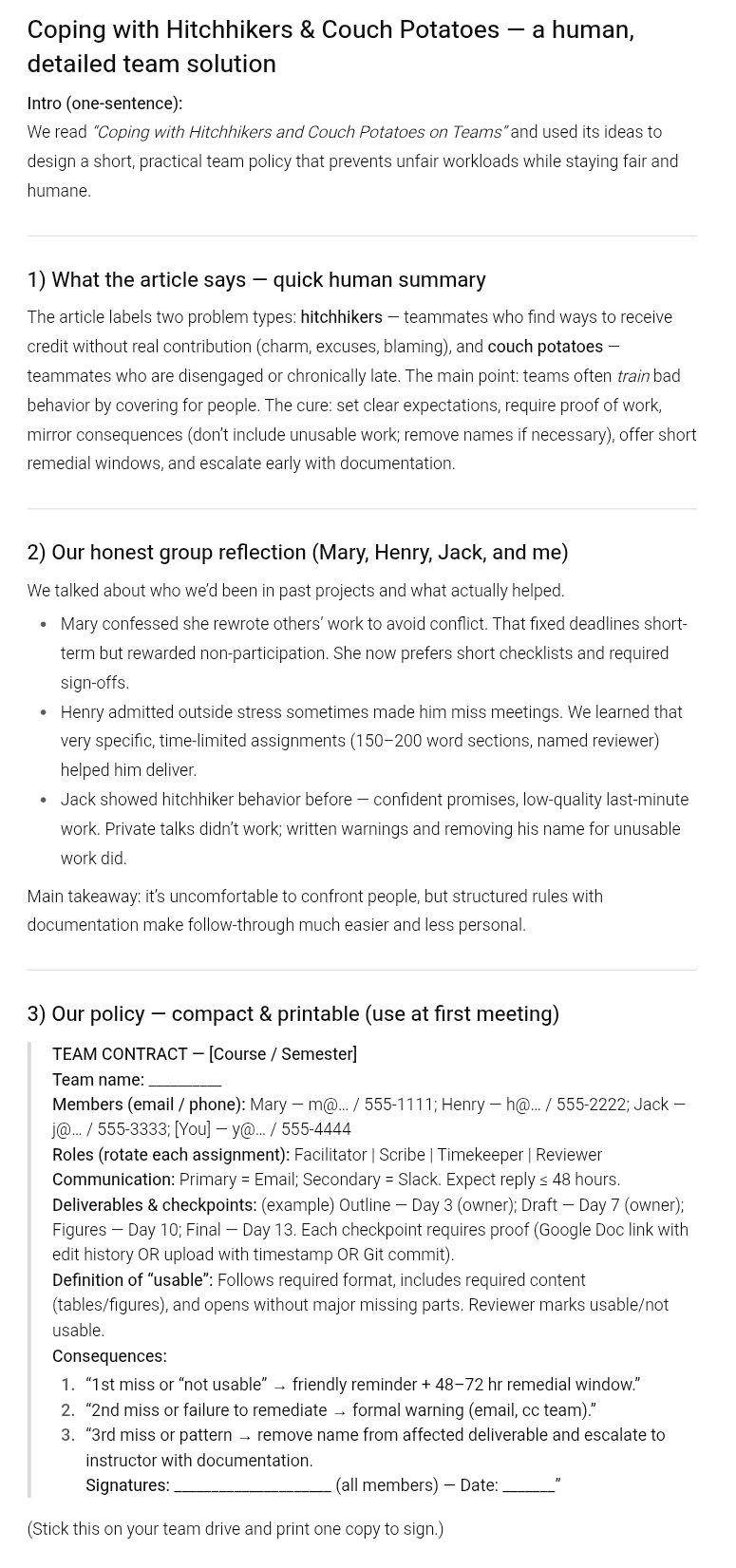
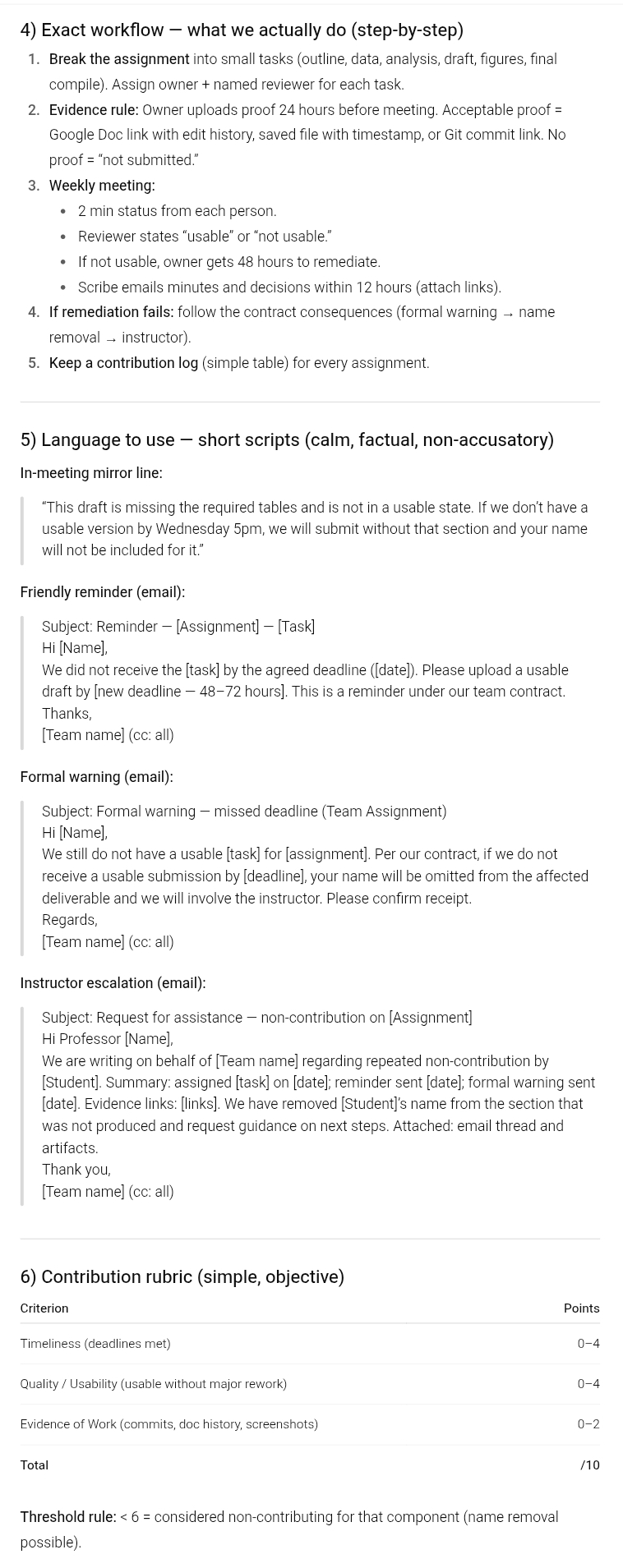
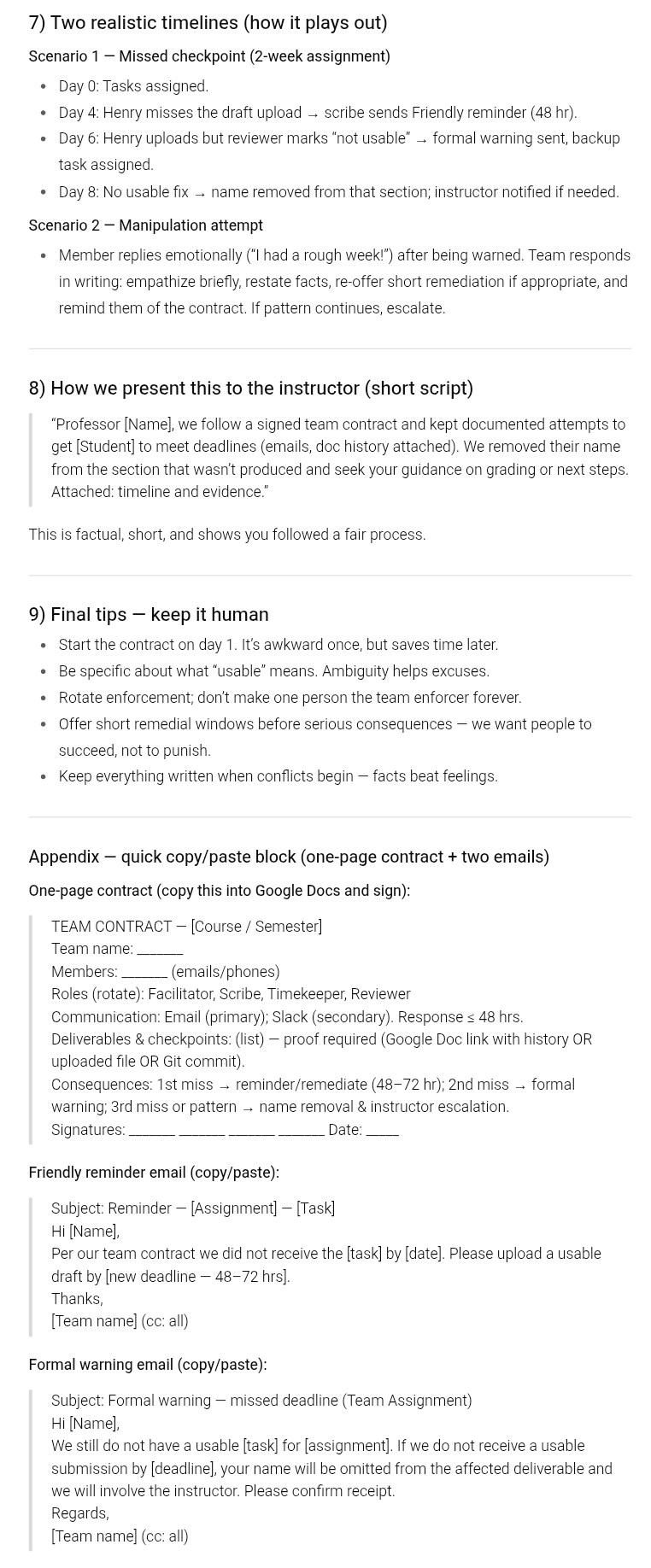 Coping with Hitchhikers & Couch Potatoes a human, detailed team solution Intro (one-sentence): We read \"Coping with Hitchhikers and Couch Potatoes on Teams\" and used its ideas to design a short, practical team policy that prevents unfair workloads while staying fair and humane. 1) What the article says quick human summary The article labels two problem types: hitchhikers teammates who find ways to receive credit without real contribution (charm, excuses, blaming), and couch potatoes teammates who are disengaged or chronically late. The main point: teams often train bad behavior by covering for people. The cure: set clear expectations, require proof of work, mirror consequences (don't include unusable work; remove names if necessary), offer short remedial windows, and escalate early with documentation. 2) Our honest group reflection (Mary, Henry, Jack, and me) We talked about who we'd been in past projects and what actually helped. * Mary confessed she rewrote others' work to avoid conflict. That fixed deadlines short- term but rewarded non-participation. She now prefers short checklists and required sign-offs. Henry admitted outside stress sometimes made him miss meetings. We learned that very specific, time-limited assignments (150-200 word sections, named reviewer) helped him deliver. Jack showed hitchhiker behavior before confident promises, low-quality last-minute work. Private talks didn't work; written warnings and removing his name for unusable work did. Main takeaway: it's uncomfortable to confront people, but structured rules with documentation make follow-through much easier and less personal. 3) Our policy compact & printable (use at first meeting) TEAM CONTRACT [Course / Semester] Team name: Members (email / phone): Mary m@... / 555-1117; Henry h@... / 555-2222; Jack j@.. | 555-3333; [You] y@... / 555-4444 Roles (rotate each assignment): Facilitator | Scribe | Timekeeper | Reviewer Communication: Primary = Email; Secondary = Slack. Expect reply = 48 hours. Deliverables & checkpoints: (example) Outline Day 3 (owner); Draft Day 7 (owner); Figures Day 10; Final Day 13. Each checkpoint requires proof (Google Doe link with edit history OR upload with timestamp OR Git commit). Definition of \"usable\": Follows required format, includes required content (tables/figures), and opens without major missing parts. Reviewer marks usableot usable. Consequences: 1. \"Ist miss or \"not usable\" = friendly reminder + 48-72 hr remedial window." 2. \"2nd miss or failure to remediate formal warning (email, cc team).\" 3. \"3rd miss or pattern remove name from affected deliverable and escalate to instructor with documentation. Signatures: (all members) Date: a (Stick this on your team drive and print one copy to sign.) 4) 1. 5) Exact workflow what we actually do (step-by-step) Break the assignment into small tasks (outline, data, analysis, draft, figures, final compile). Assign owner + named reviewer for each task. . Evidence rule: Owner uploads proof 24 hours before meeting. Acceptable proof = Google Doc link with edit history, saved file with timestamp, or Git commit link. No proof = \"not submitted.\" . Weekly meeting: * 2min status from each person. * Reviewer states \"usable\" or \"not usable." * lIfnot usable, owner gets 48 hours to remediate. * Scribe emails minutes and decisions within 12 hours (attach links). . If remediation fails: follow the contract consequences (formal warning name removal instructor). . Keep a contribution log (simple table) for every assignment. Language to use short scripts (calm, factual, non-accusatory) In-meeting mirror line: \"This draft is missing the required tables and is not in a usable state. If we don't have a usable version by Wednesday Spm, we will submit without that section and your name will not be included for it.\" Friendly reminder (email): Subject: Reminder [Assignment] [Task] Hi [Name], We did not receive the [task] by the agreed deadline ([date]). Please upload a usable draft by [new deadline 48-72 hours]. This is a reminder under our team contract. Thanks, [Team name] (cc: all) Formal warning (email): Subject: Formal warning missed deadline (Team Assignment) Hi [Name], We still do not have a usable [task] for [assignment]. Per our contract, if we do not receive a usable submission by [deadline], your name will be omitted from the affected deliverable and we will involve the instructor. Please confirm receipt. Regards, [Team name] (cc: all) Instructor escalation (email): Subject: Request for assistance non-contribution on [Assignment] Hi Professor [Name], We are writing on behalf of [Tear name] regarding repeated non-contribution by [Student]. Summary: assigned [task] on [date]; reminder sent [date]; formal warning sent [date]. Evidence links: [links]. We have removed [Student]'s name from the section that was not produced and request guidance on next steps. Attached: email thread and artifacts. Thank you, [Team name] (ce: all) 6) Contribution rubric (simple, objective) Criterion Points Timeliness (deadlines met) 0-4 Quality / Usability (usable without major rework) 0-4 Evidence of Work (commits, doc history, screenshots) 0-2 Total /10 Threshold rule:
 Step by Step Solution
There are 3 Steps involved in it

Get step-by-step solutions from verified subject matter experts
 Study Help