







Question: This assignment to be done in C++ Build two hash tables Assume that in the file, a3.txt, there are no more than 50 names (entries).
This assignment to be done in C++
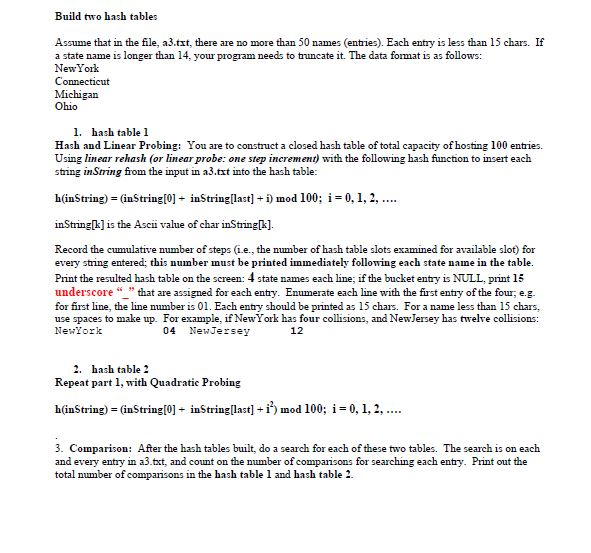
Build two hash tables Assume that in the file, a3.txt, there are no more than 50 names (entries). Each entry is less than 15 chars. If a state name is longer than 14, your program needs to truncate it. The data format is as follows: NewYorlk Connecticut Michigan Ohio 1. hash table 1 Hash and Linear Probing: You are to construct a closed hash table of total capacity of hosting 100 enries. Using linear rehash (or linear probe: one step increment) with the following hash function to insert each string inSring from the input in a3.txt into the hash table h(inString) = (inString[0]-inString[last]-i) mod 100: 1-0, 1, 2, .. .. inStringk] is the Ascii value of char inStingk]. Record the cumulative number of steps (ie., the number of hash table slots examinedfor available slot) for every string entered; this number must be printed immediately following each state name in the table. Print the resulted hash table on the screen: 4 state names each line; if the bucket enty is NULL, print 15 underscore"" that are assigned for each enty. Enumerate each line with the first entry of the four, e.g. for first line, the line number is 01. Each enty should be printed as 15 chars. For a name less than 15 chars, use spaces to make up. For example, if NewYork has four collisions, and NewJersey has twelve collisions: NewYork 04 NewJersey 12 2. hash table 2 Repeat part 1, with Quadratic Probing hnString) = (inString[0]-inString[last] + f) mod 100: 1-0, 1, 2, 3. Comparison: After the hash tables built, do a search for each of these two tables. The search is on each and every entry in a3.txt, and count on the number of comparisons for searching each entry. Print out the total number of comparisons in the hash table 1 and hash table 2 Build two hash tables Assume that in the file, a3.txt, there are no more than 50 names (entries). Each entry is less than 15 chars. If a state name is longer than 14, your program needs to truncate it. The data format is as follows: NewYorlk Connecticut Michigan Ohio 1. hash table 1 Hash and Linear Probing: You are to construct a closed hash table of total capacity of hosting 100 enries. Using linear rehash (or linear probe: one step increment) with the following hash function to insert each string inSring from the input in a3.txt into the hash table h(inString) = (inString[0]-inString[last]-i) mod 100: 1-0, 1, 2, .. .. inStringk] is the Ascii value of char inStingk]. Record the cumulative number of steps (ie., the number of hash table slots examinedfor available slot) for every string entered; this number must be printed immediately following each state name in the table. Print the resulted hash table on the screen: 4 state names each line; if the bucket enty is NULL, print 15 underscore"" that are assigned for each enty. Enumerate each line with the first entry of the four, e.g. for first line, the line number is 01. Each enty should be printed as 15 chars. For a name less than 15 chars, use spaces to make up. For example, if NewYork has four collisions, and NewJersey has twelve collisions: NewYork 04 NewJersey 12 2. hash table 2 Repeat part 1, with Quadratic Probing hnString) = (inString[0]-inString[last] + f) mod 100: 1-0, 1, 2, 3. Comparison: After the hash tables built, do a search for each of these two tables. The search is on each and every entry in a3.txt, and count on the number of comparisons for searching each entry. Print out the total number of comparisons in the hash table 1 and hash table 2
Step by Step Solution
There are 3 Steps involved in it

Get step-by-step solutions from verified subject matter experts
 Study Help