



Question: This case focuses on developing a deeper understanding of the personnel scheduling problem. Big Town Fire Department would like to schedule their human resource requirements
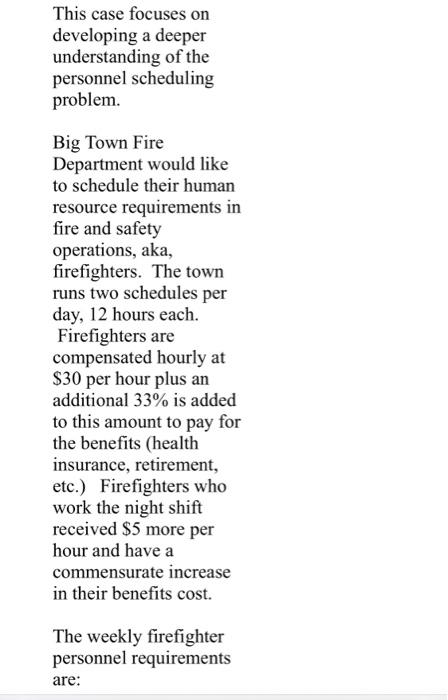
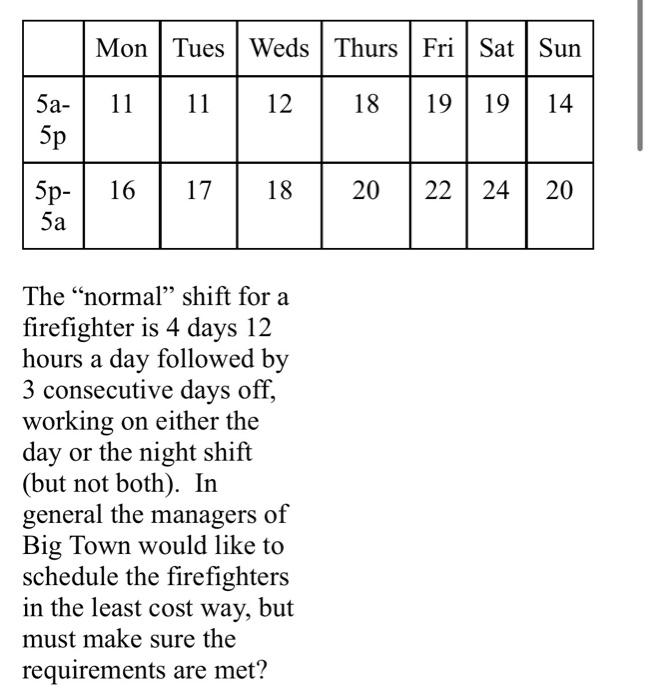
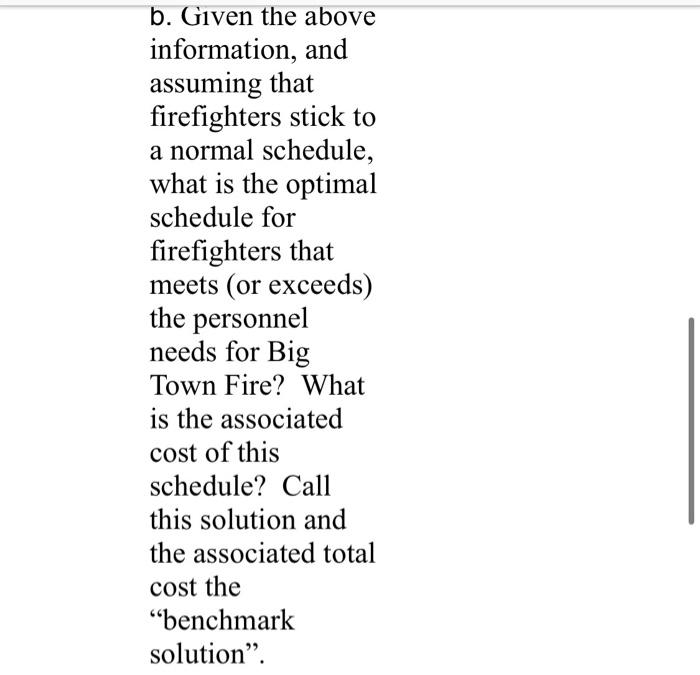
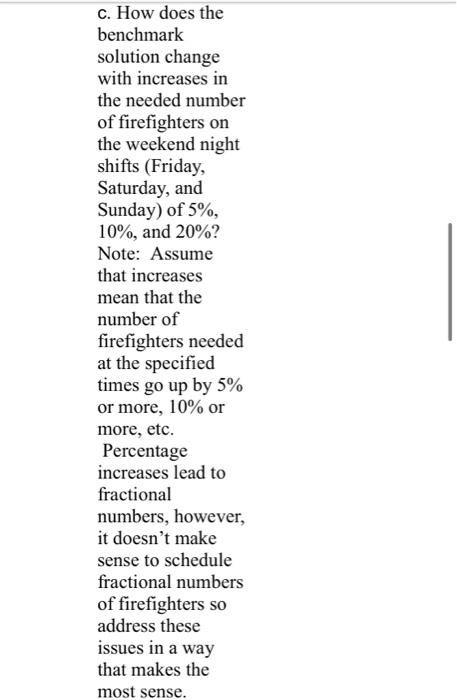
This case focuses on developing a deeper understanding of the personnel scheduling problem. Big Town Fire Department would like to schedule their human resource requirements in fire and safety operations, aka, firefighters. The town runs two schedules per day, 12 hours each. Firefighters are compensated hourly at $30 per hour plus an additional 33% is added to this amount to pay for the benefits (health insurance, retirement, etc.) Firefighters who work the night shift received $5 more per hour and have a commensurate increase in their benefits cost. The weekly firefighter personnel requirements are: Mon Tues Weds Thurs Fri Sat Sun 5a- 11 11 12 18 19 19 14 5p 16 17 18 20 22 24 5p- 5a The "normal" shift for a firefighter is 4 days 12 hours a day followed by 3 consecutive days off, working on either the day or the night shift (but not both). In general the managers of Big Town would like to schedule the firefighters in the least cost way, but must make sure the requirements are met? 20 b. Given the above information, and assuming that firefighters stick to a normal schedule, what is the optimal schedule for firefighters that meets (or exceeds) the personnel needs for Big Town Fire? What is the associated cost of this schedule? Call this solution and the associated total cost the "benchmark solution". c. How does the benchmark solution change with increases in the needed number of firefighters on the weekend night shifts (Friday, Saturday, and Sunday) of 5%, 10%, and 20%? Note: Assume that increases mean that the number of firefighters needed at the specified times go up by 5% or more, 10% or more, etc. Percentage increases lead to fractional numbers, however, it doesn't make sense to schedule fractional numbers of firefighters so address these issues in a way that makes the most sense
Step by Step Solution
There are 3 Steps involved in it

Get step-by-step solutions from verified subject matter experts