







Question: This case is about the standard-setting process and presents 5 different possibilities to consider for choosing a standard performance rate (impressions per hour) for a
This case is about the standard-setting process and presents 5 different possibilities to consider for choosing a standard performance rate (impressions per hour) for a printing press.From the 5 options presented, please choose one option that you can support and one option that you cannot support and then discuss your reasons on each side of the argument.
?
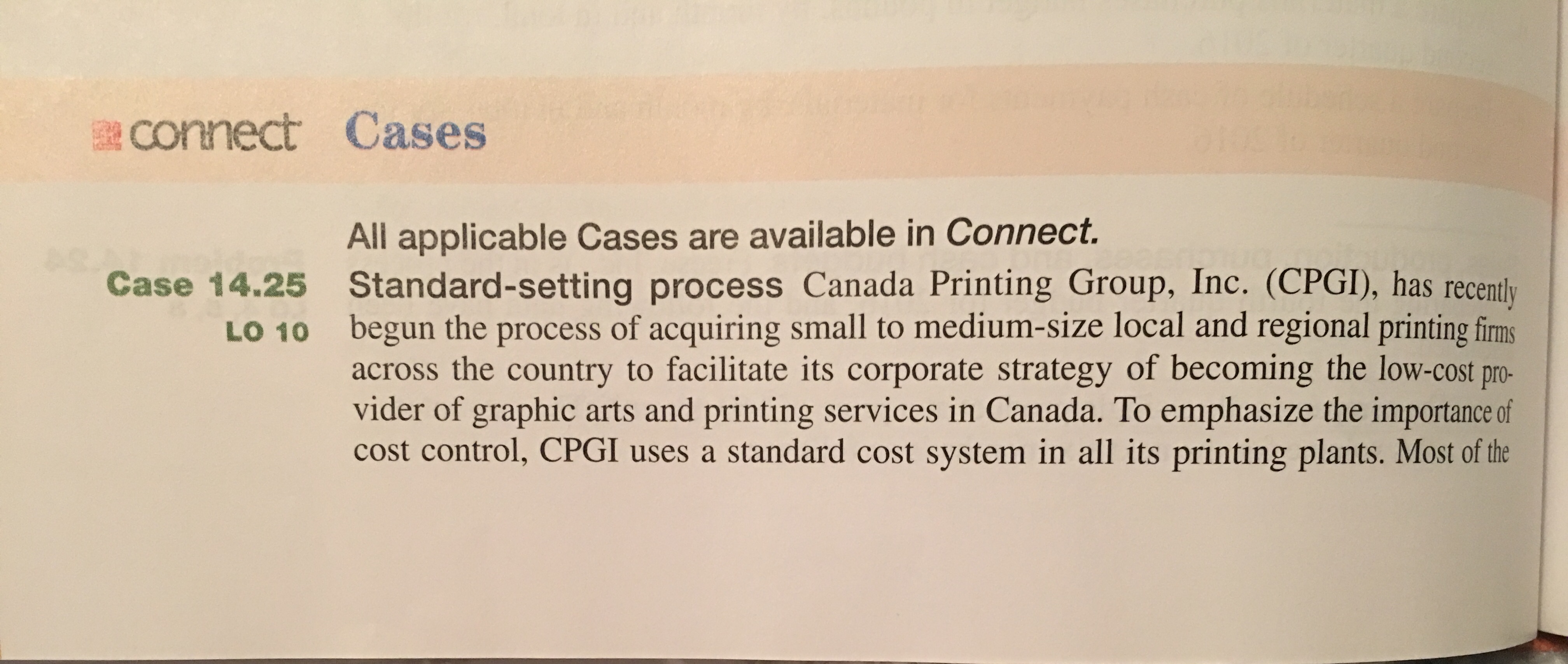
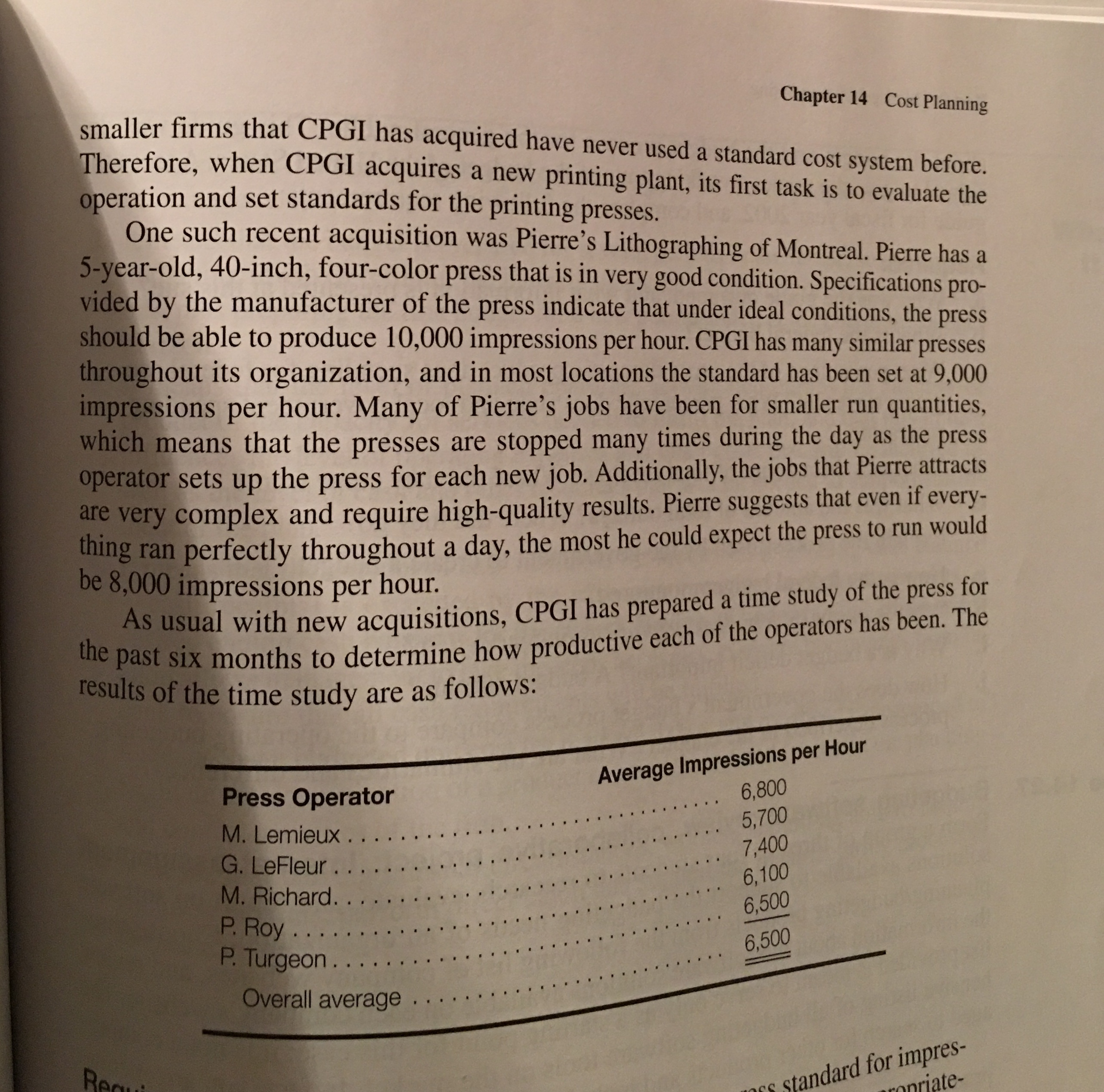
connect Cases All applicable Cases are available in Connect. Case 14.25 Standard-setting process Canada Printing Group, Inc. (CPGI), has recently Lo 10 begun the process of acquiring small to medium-size local and regional printing firms across the country to facilitate its corporate strategy of becoming the low-cost pro- vider of graphic arts and printing services in Canada. To emphasize the importance of cost control, CPGI uses a standard cost system in all its printing plants. Most of theChapter 14 Cost Planning smaller firms that CPGI has acquired have never used a standard cost system before. Therefore, when CPGI acquires a new printing plant, its first task is to evaluate the operation and set standards for the printing presses. One such recent acquisition was Pierre's Lithographing of Montreal. Pierre has a 5-year-old, 40-inch, four-color press that is in very good condition. Specifications pro- vided by the manufacturer of the press indicate that under ideal conditions, the press should be able to produce 10,000 impressions per hour. CPGI has many similar presses throughout its organization, and in most locations the standard has been set at 9,000 impressions per hour. Many of Pierre's jobs have been for smaller run quantities, which means that the presses are stopped many times during the day as the press operator sets up the press for each new job. Additionally, the jobs that Pierre attracts are very complex and require high-quality results. Pierre suggests that even if every- thing ran perfectly throughout a day, the most he could expect the press to run would be 8,000 impressions per hour. As usual with new acquisitions, CPGI has prepared a time study of the press for the past six months to determine how productive each of the operators has been. The results of the time study are as follows: Average Impressions per Hour Press Operator . . . . . 6,800 M. Lemieux .. . . . . . . . . . . 5,700 G. LeFleur . . . . . . 7,400 M. Richard. 6, 100 . . . .. . 6,500 P. Roy ...... . . P. Turgeon . . . .. . . 6,500 Overall average standard for impres- priate
Step by Step Solution
There are 3 Steps involved in it

Get step-by-step solutions from verified subject matter experts
 Study Help