Question: This case study requires students to develop a strategic plan that will enable Walmarts e-Commerce division to effectively compete with Amazon. The case study comprises

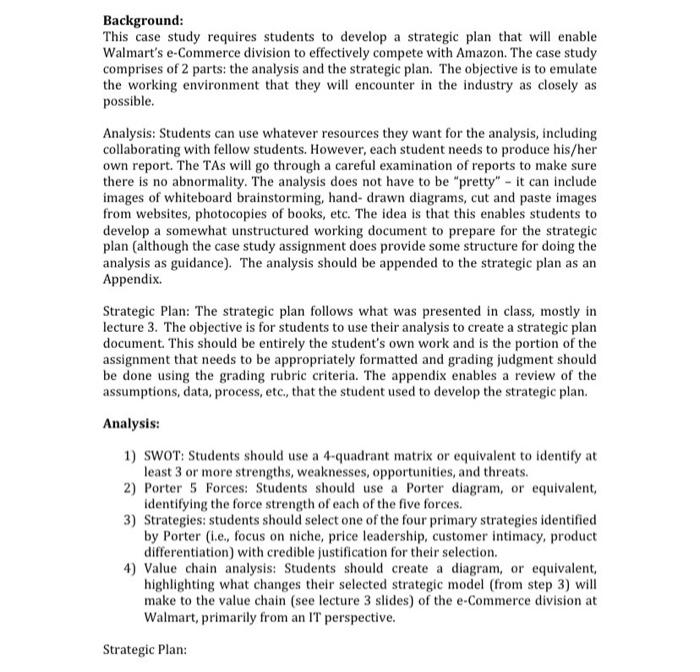
This case study requires students to develop a strategic plan that will enable
Walmarts e-Commerce division to effectively compete with Amazon. The case study
comprises of 2 parts: the analysis and the strategic plan. The objective is to emulate
the working environment that they will encounter in the industry as closely as
possible.
Analysis: Students can use whatever resources they want for the analysis, including
collaborating with fellow students. However, each student needs to produce his/her
own report. The TAs will go through a careful examination of reports to make sure
there is no abnormality. The analysis does not have to be pretty it can include
images of whiteboard brainstorming, hand- drawn diagrams, cut and paste images
from websites, photocopies of books, etc. The idea is that this enables students to
develop a somewhat unstructured working document to prepare for the strategic
plan (although the case study assignment does provide some structure for doing the
analysis as guidance). The analysis should be appended to the strategic plan as an
Appendix.
Strategic Plan: The strategic plan follows what was presented in class, mostly in
lecture 3. The objective is for students to use their analysis to create a strategic plan
document. This should be entirely the students own work and is the portion of the
assignment that needs to be appropriately formatted and grading judgment should
be done using the grading rubric criteria. The appendix enables a review of the
assumptions, data, process, etc., that the student used to develop the strategic plan.
Analysis:
1) SWOT: Students should use a 4-quadrant matrix or equivalent to identify at
least 3 or more strengths, weaknesses, opportunities, and threats.
2) Porter 5 Forces: Students should use a Porter diagram, or equivalent,
identifying the force strength of each of the five forces.
3) Strategies: students should select one of the four primary strategies identified
by Porter (i.e., focus on niche, price leadership, customer intimacy, product
differentiation) with credible justification for their selection.
4) Value chain analysis: Students should create a diagram, or equivalent,
highlighting what changes their selected strategic model (from step 3) will
make to the value chain (see lecture 3 slides) of the e-Commerce division at Walmart, primarily from an IT perspective
Strategic Plan: The strategic plan document should follow the structure of the strategic plan as
presented in class (see lecture 3 slides). This needs to be a formal document that
should be of a quality, both in presentation and in content that can be reviewed by
the senior management of a company.
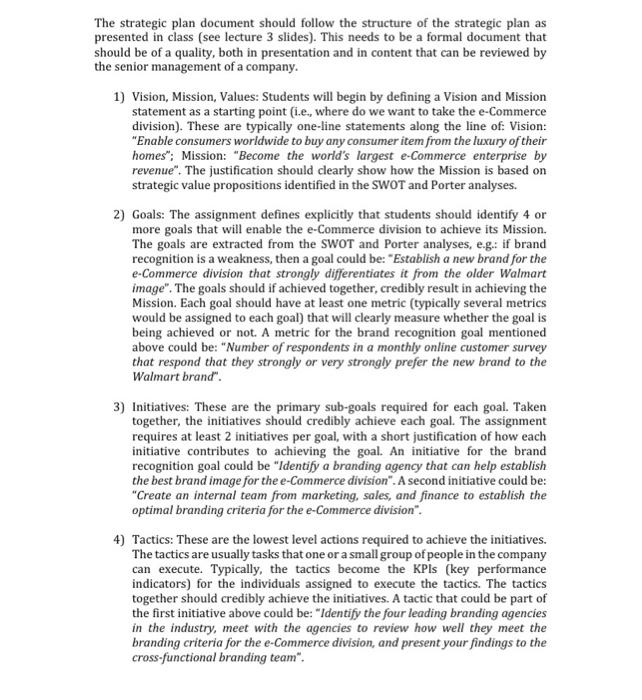
1) Vision, Mission, Values: Students will begin by defining a Vision and Mission
statement as a starting point (i.e., where do we want to take the e-Commerce
division). These are typically one-line statements along the line of: Vision:
Enable consumers worldwide to buy any consumer item from the luxury of their
homes; Mission: Become the worlds largest e-Commerce enterprise by
revenue. The justification should clearly show how the Mission is based on
strategic value propositions identified in the SWOT and Porter analyses.
2) Goals: The assignment defines explicitly that students should identify 4 or
more goals that will enable the e-Commerce division to achieve its Mission.
The goals are extracted from the SWOT and Porter analyses, e.g.: if brand
recognition is a weakness, then a goal could be: Establish a new brand for the
e-Commerce division that strongly differentiates it from the older Walmart
image. The goals should if achieved together, credibly result in achieving the
Mission. Each goal should have at least one metric (typically several metrics
would be assigned to each goal) that will clearly measure whether the goal is
being achieved or not. A metric for the brand recognition goal mentioned
above could be: Number of respondents in a monthly online customer survey
that respond that they strongly or very strongly prefer the new brand to the
Walmart brand.
3) Initiatives: These are the primary sub-goals required for each goal. Taken
together, the initiatives should credibly achieve each goal. The assignment
requires at least 2 initiatives per goal, with a short justification of how each
initiative contributes to achieving the goal. An initiative for the brand
recognition goal could be Identify a branding agency that can help establish
the best brand image for the e-Commerce division. A second initiative could be:
Create an internal team from marketing, sales, and finance to establish the
optimal branding criteria for the e-Commerce division.
4) Tactics: These are the lowest level actions required to achieve the initiatives.
The tactics are usually tasks that one or a small group of people in the company
can execute. Typically, the tactics become the KPIs (key performance
indicators) for the individuals assigned to execute the tactics. The tactics
together should credibly achieve the initiatives. A tactic that could be part of
the first initiative above could be: Identify the four leading branding agencies
in the industry, meet with the agencies to review how well they meet the
branding criteria for the e-Commerce division, and present your findings to the cross-functional branding team.
This case study requires students to develop a
Background: This case study requires students to develop a strategic plan that will enable Walmart's e-Commerce division to effectively compete with Amazon. The case study comprises of 2 parts: the analysis and the strategic plan. The objective is to emulate the working environment that they will encounter in the industry as closely as possible. Analysis: Students can use whatever resources they want for the analysis, including collaborating with fellow students. However, each student needs to produce his/her own report. The TAs will go through a careful examination of reports to make sure there is no abnormality. The analysis does not have to be "pretty" - it can include images of whiteboard brainstorming, hand- drawn diagrams, cut and paste images from websites, photocopies of books, etc. The idea is that this enables students to develop a somewhat unstructured working document to prepare for the strategic plan (although the case study assignment does provide some structure for doing the analysis as guidance). The analysis should be appended to the strategic plan as an Appendix. Strategic Plan: The strategic plan follows what was presented in class, mostly in lecture 3 . The objective is for students to use their analysis to create a strategic plan document. This should be entirely the student's own work and is the portion of the assignment that needs to be appropriately formatted and grading judgment should be done using the grading rubric criteria. The appendix enables a review of the assumptions, data, process, etc., that the student used to develop the strategic plan. Analysis: 1) SWOT: Students should use a 4-quadrant matrix or equivalent to identify at least 3 or more strengths, weaknesses, opportunities, and threats. 2) Porter 5 Forces: Students should use a Porter diagram, or equivalent, identifying the force strength of each of the five forces. 3) Strategies: students should select one of the four primary strategies identified by Porter (i.e., focus on niche, price leadership, customer intimacy, product differentiation) with credible justification for their selection. 4) Value chain analysis: Students should create a diagram, or equivalent, highlighting what changes their selected strategic model (from step 3) will make to the value chain (see lecture 3 slides) of the e-Commerce division at Walmart, primarily from an IT perspective. Strategic Plan: The strategic plan document should follow the structure of the strategic plan as presented in class (see lecture 3 slides). This needs to be a formal document that should be of a quality, both in presentation and in content that can be reviewed by the senior management of a company. 1) Vision, Mission, Values: Students will begin by defining a Vision and Mission statement as a starting point (i.e., where do we want to take the e-Commerce division). These are typically one-line statements along the line of: Vision: "Enable consumers worldwide to buy any consumer item from the luxury of their homes"; Mission: "Become the world's largest e-Commerce enterprise by revenue". The justification should clearly show how the Mission is based on strategic value propositions identified in the SWOT and Porter analyses. 2) Goals: The assignment defines explicitly that students should identify 4 or more goals that will enable the e-Commerce division to achieve its Mission. The goals are extracted from the SWOT and Porter analyses, e.g.: if brand recognition is a weakness, then a goal could be: "Establish a new brand for the e-Commerce division that strongly differentiates it from the older Walmart image". The goals should if achieved together, credibly result in achieving the Mission. Each goal should have at least one metric (typically several metrics would be assigned to each goal) that will clearly measure whether the goal is being achieved or not. A metric for the brand recognition goal mentioned above could be: "Number of respondents in a monthly online customer survey that respond that they strongly or very strongly prefer the new brand to the Walmart brand". 3) Initiatives: These are the primary sub-goals required for each goal. Taken together, the initiatives should credibly achieve each goal. The assignment requires at least 2 initiatives per goal, with a short justification of how each initiative contributes to achieving the goal. An initiative for the brand recognition goal could be "Identify a branding agency that can help establish the best brand image for the e-Commerce division". A second initiative could be: "Create an internal team from marketing, sales, and finance to establish the optimal branding criteria for the e-Commerce division". 4) Tactics: These are the lowest level actions required to achieve the initiatives. The tactics are usually tasks that one or a small group of people in the company can execute. Typically, the tactics become the KPls (key performance indicators) for the individuals assigned to execute the tactics. The tactics together should credibly achieve the initiatives. A tactic that could be part of the first initiative above could be: "Identify the four leading branding agencies in the industry, meet with the agencies to review how well they meet the branding criteria for the e-Commerce division, and present your findings to the cross-functional branding team". Background: This case study requires students to develop a strategic plan that will enable Walmart's e-Commerce division to effectively compete with Amazon. The case study comprises of 2 parts: the analysis and the strategic plan. The objective is to emulate the working environment that they will encounter in the industry as closely as possible. Analysis: Students can use whatever resources they want for the analysis, including collaborating with fellow students. However, each student needs to produce his/her own report. The TAs will go through a careful examination of reports to make sure there is no abnormality. The analysis does not have to be "pretty" - it can include images of whiteboard brainstorming, hand- drawn diagrams, cut and paste images from websites, photocopies of books, etc. The idea is that this enables students to develop a somewhat unstructured working document to prepare for the strategic plan (although the case study assignment does provide some structure for doing the analysis as guidance). The analysis should be appended to the strategic plan as an Appendix. Strategic Plan: The strategic plan follows what was presented in class, mostly in lecture 3 . The objective is for students to use their analysis to create a strategic plan document. This should be entirely the student's own work and is the portion of the assignment that needs to be appropriately formatted and grading judgment should be done using the grading rubric criteria. The appendix enables a review of the assumptions, data, process, etc., that the student used to develop the strategic plan. Analysis: 1) SWOT: Students should use a 4-quadrant matrix or equivalent to identify at least 3 or more strengths, weaknesses, opportunities, and threats. 2) Porter 5 Forces: Students should use a Porter diagram, or equivalent, identifying the force strength of each of the five forces. 3) Strategies: students should select one of the four primary strategies identified by Porter (i.e., focus on niche, price leadership, customer intimacy, product differentiation) with credible justification for their selection. 4) Value chain analysis: Students should create a diagram, or equivalent, highlighting what changes their selected strategic model (from step 3) will make to the value chain (see lecture 3 slides) of the e-Commerce division at Walmart, primarily from an IT perspective. Strategic Plan: The strategic plan document should follow the structure of the strategic plan as presented in class (see lecture 3 slides). This needs to be a formal document that should be of a quality, both in presentation and in content that can be reviewed by the senior management of a company. 1) Vision, Mission, Values: Students will begin by defining a Vision and Mission statement as a starting point (i.e., where do we want to take the e-Commerce division). These are typically one-line statements along the line of: Vision: "Enable consumers worldwide to buy any consumer item from the luxury of their homes"; Mission: "Become the world's largest e-Commerce enterprise by revenue". The justification should clearly show how the Mission is based on strategic value propositions identified in the SWOT and Porter analyses. 2) Goals: The assignment defines explicitly that students should identify 4 or more goals that will enable the e-Commerce division to achieve its Mission. The goals are extracted from the SWOT and Porter analyses, e.g.: if brand recognition is a weakness, then a goal could be: "Establish a new brand for the e-Commerce division that strongly differentiates it from the older Walmart image". The goals should if achieved together, credibly result in achieving the Mission. Each goal should have at least one metric (typically several metrics would be assigned to each goal) that will clearly measure whether the goal is being achieved or not. A metric for the brand recognition goal mentioned above could be: "Number of respondents in a monthly online customer survey that respond that they strongly or very strongly prefer the new brand to the Walmart brand". 3) Initiatives: These are the primary sub-goals required for each goal. Taken together, the initiatives should credibly achieve each goal. The assignment requires at least 2 initiatives per goal, with a short justification of how each initiative contributes to achieving the goal. An initiative for the brand recognition goal could be "Identify a branding agency that can help establish the best brand image for the e-Commerce division". A second initiative could be: "Create an internal team from marketing, sales, and finance to establish the optimal branding criteria for the e-Commerce division". 4) Tactics: These are the lowest level actions required to achieve the initiatives. The tactics are usually tasks that one or a small group of people in the company can execute. Typically, the tactics become the KPls (key performance indicators) for the individuals assigned to execute the tactics. The tactics together should credibly achieve the initiatives. A tactic that could be part of the first i

Step by Step Solution

There are 3 Steps involved in it

1 Expert Approved Answer
Step: 1 Unlock blur-text-image

Question Has Been Solved by an Expert!

Get step-by-step solutions from verified subject matter experts

Step: 2 Unlock
Step: 3 Unlock

Students Have Also Explored These Related General Management Questions!