







Question: ----------------------------------------------------------------------------------------------------------------------------------------------------------------------- /* This class implements a linked list which contains all the page tables in the system */ public class PageTableList { public PageTableList() {
-----------------------------------------------------------------------------------------------------------------------------------------------------------------------
/* This class implements a linked list which contains all the page tables in the system */ public class PageTableList { public PageTableList() { first = null; } /* add a new entry to the head of the linked list */ public void addFirst(PageTable pt) { Node newNode = new Node(); newNode.pt = pt; newNode.next = first; first = newNode; } /* return the page table associated with the thread id */ public PageTable lookup(int id) { Node t = first; while(t != null) { if(t.pt.getThreadID() == id) return t.pt; t = t.next; } return null; } /* head of the linked list */ private Node first; private class Node { public PageTable pt; public Node next; } }-----------------------------------------------------------------------------------------------------------------------------------------------------------------------
/* This class implements a page table associated with a thread */ import java.util.Arrays; public class PageTable { /* id of the thread a page table is associated with */ private int tid; /* size of the page table */ private int size; /* frame number array. page number is used to index the array to find the corresponding frame number */ private int[] pageTableArray; /* length of the page table */ private int length; public PageTable(int id, int s) { tid = id; size = s; length = 0; pageTableArray = new int[s]; } /* return the frame number of the page number (index) */ public int lookupPageTable(int index) { return pageTableArray[index]; } /* add an entry to the end of the page table */ public void appendEntry(int frameNumber) { pageTableArray[length] = frameNumber; length++; } /* return length of the page table */ public int getLength() { return length; } /* return thread ID */ public int getThreadID() { return tid; } /* print the content of the page table */ public void printPageTable() { for(int i=0; i -----------------------------------------------------------------------------------------------------------------------------------------------------------------------
/** * This is the thread to simulate the request, access and release of memory space */ import java.util.Random; public class MemoryThread implements Runnable { public MemoryThread(PhysicalMemory m, int id) { physicalMemory = m; threadID = id; } public void run() { //Generate a memory request of a random size Random generator = new Random(); int requestSize = 1 + generator.nextInt(MAX_REQUEST_SIZE); //Debuging message //System.out.println("Thread " + threadID + " has been started"); //request memory space boolean flag = physicalMemory.requestMemory(threadID, requestSize); //Debuging message //System.out.println("Thread " + threadID + " has been allocate memory space " + flag); while (!flag) { flag = physicalMemory.requestMemory(threadID, requestSize); } //Generate a random memory access int requestPageNumber = generator.nextInt(requestSize); int frameNumber = physicalMemory.accessMemory(threadID, requestPageNumber); System.out.printf("Thread %d requests for page number %d which has frame number %d ", threadID, requestPageNumber, frameNumber); // Release the memory physicalMemory.releaseMemory(threadID); } private PhysicalMemory physicalMemory; private int threadID; public static final int MAX_REQUEST_SIZE = 50; } -----------------------------------------------------------------------------------------------------------------------------------------------------------------------
/** * Factory class to start five threads. * */ public class Factory { public static void main(String args[]) { PhysicalMemory physicalMemory = new PhysicalMemory(); Thread[] threadArray = new Thread[5]; for(int i=0; i
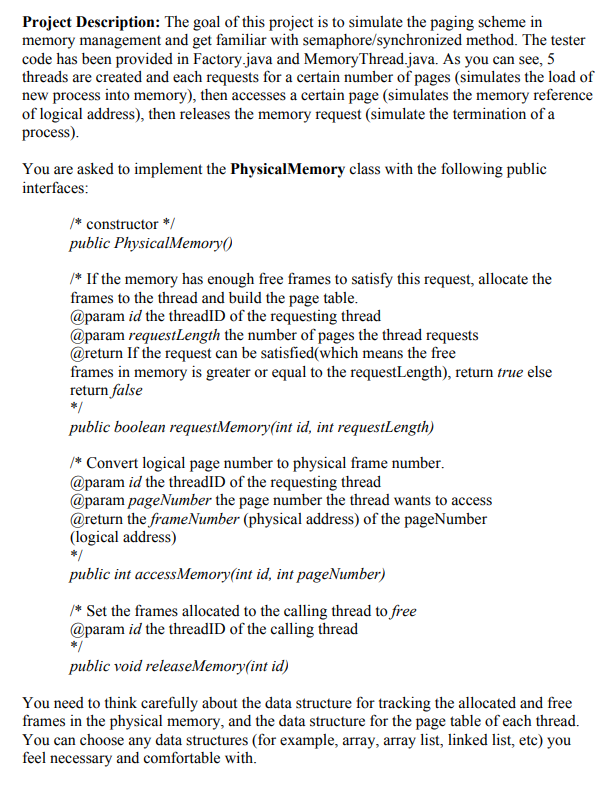
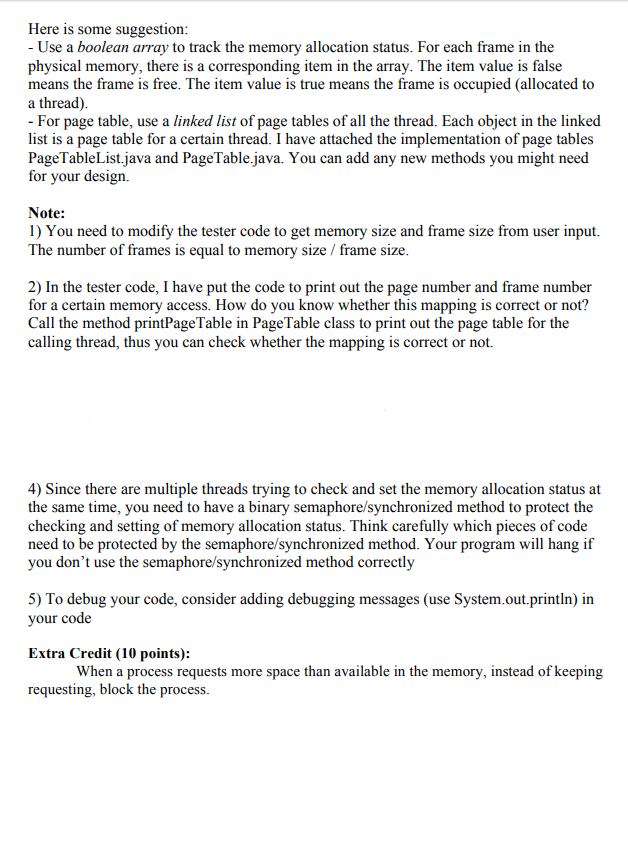
Project Description: The goal of this project is to simulate the paging scheme in memory management and get familiar with semaphore/synchronized method. The tester code has been provided in Factory.java and MemoryThread.java. As you can see, 5 threads are created and each requests for a certain number of pages (simulates the load of new process into memory), then accesses a certain page (simulates the memory reference of logical address), then releases the memory request (simulate the termination of a process) You are asked to implement the PhysicalMemory class with the following public interfaces /* constructor */ public PhysicalMemory /* If the memory has enough free frames to satisfy this request, allocate the frames to the thread and build the page table @param id the threadID of the requesting thread @param requestLength the number of pages the thread requests @return If the request can be satisfied(which means the free frames in memory is greater or equal to the requestLength), return true else return false public boolean requestMemory(int id, int requestLength) /* Convert logical page number to physical frame number @param id the threadID of the requesting thread @param pageNumber the page number the thread wants to access @return the frameNumber (physical address) of the pageNumber (logical address) public int accessMemory(int id, int pageNumber) /* Set the frames allocated to the calling thread to free @param id the threadID of the calling thread public void releaseMemory(int id) You need to think carefully about the data structure for tracking the allocated and free frames in the physical memory, and the data structure for the page table of each thread. You can choose any data structures (for example, array, array list, linked list, etc) you feel necessary and comfortable with. Project Description: The goal of this project is to simulate the paging scheme in memory management and get familiar with semaphore/synchronized method. The tester code has been provided in Factory.java and MemoryThread.java. As you can see, 5 threads are created and each requests for a certain number of pages (simulates the load of new process into memory), then accesses a certain page (simulates the memory reference of logical address), then releases the memory request (simulate the termination of a process) You are asked to implement the PhysicalMemory class with the following public interfaces /* constructor */ public PhysicalMemory /* If the memory has enough free frames to satisfy this request, allocate the frames to the thread and build the page table @param id the threadID of the requesting thread @param requestLength the number of pages the thread requests @return If the request can be satisfied(which means the free frames in memory is greater or equal to the requestLength), return true else return false public boolean requestMemory(int id, int requestLength) /* Convert logical page number to physical frame number @param id the threadID of the requesting thread @param pageNumber the page number the thread wants to access @return the frameNumber (physical address) of the pageNumber (logical address) public int accessMemory(int id, int pageNumber) /* Set the frames allocated to the calling thread to free @param id the threadID of the calling thread public void releaseMemory(int id) You need to think carefully about the data structure for tracking the allocated and free frames in the physical memory, and the data structure for the page table of each thread. You can choose any data structures (for example, array, array list, linked list, etc) you feel necessary and comfortable with Step by Step Solution
There are 3 Steps involved in it

Get step-by-step solutions from verified subject matter experts
 Study Help