


Question: ?This data is from the Household Survey as reported in the monthlyBLS Employment Situation Report..All variables are measured in thousands of persons. These are levels,not

?This data is from the Household Survey as reported in the monthlyBLS Employment Situation Report..All variables are measured in thousands of persons. These are levels,not rates.?When looking at FRED time series charts, the gray bars indicate recessions. The white spaces between the gray bars are expansions.The date of the peak corresponds with the left edge of the gray bar.The date of the trough corresponds with the right edge of the gray bar.?Put your cursor on the graph to see the data values for each date. o Examine the general trends in the Labor Force, Employment, and Unemployment levels over the entire period since 1950. Write down three (3) observations.?Click in the date box above the chart and change the start date to 1/1/2000 and the end date to 2/1/2020.o Examine the changes in the Labor Force, Employment, and Unemployment before, during, and after the Great Recession (12/2007-6/2009). Note how long it takes for each to return to their pre-recession levels. Write down three (3) observations.?Click in the date box above the chart and change the end date to 5/1/23and the start date to 1/1/2019.o Examine the changes in the Labor Force, Employment, and Unemployment before, during, and after the Pandemic Recession (2/2020-4/2020). Note how long it takes for each to return to their pre-recession levels. Write down three (3) observations.
?This data is from the Household Survey as
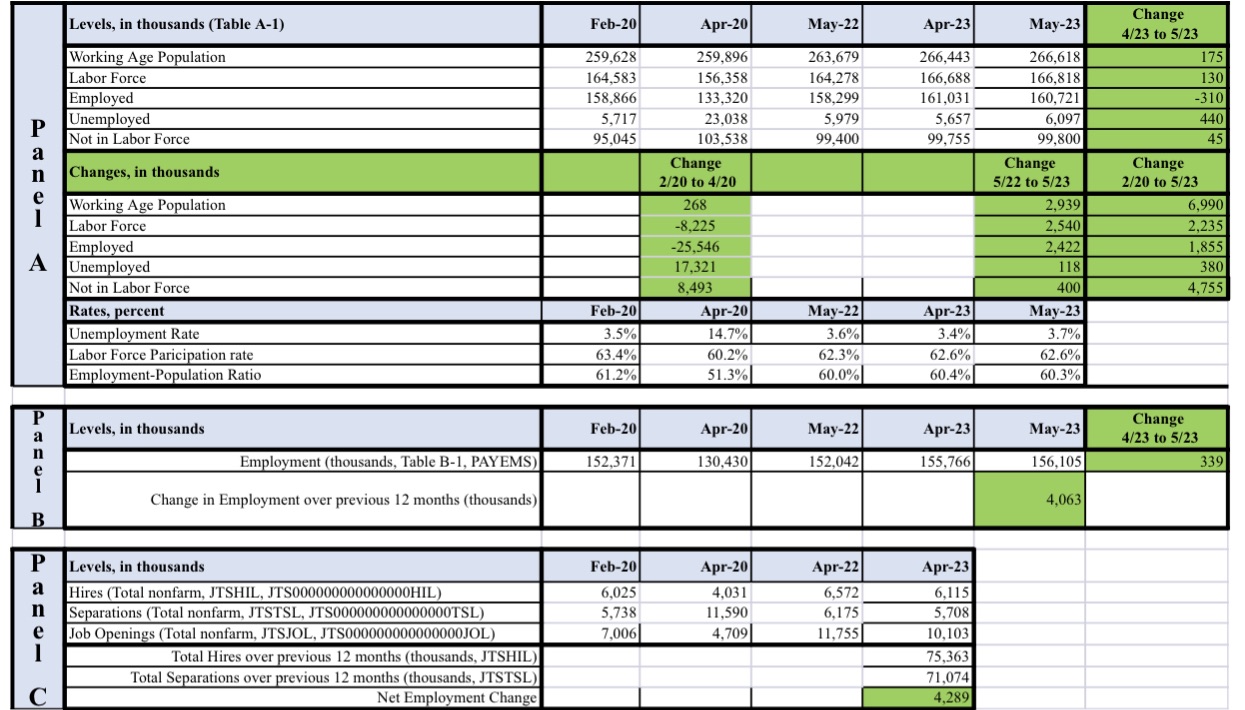
Levels, in thousands (Table A-1) Feb-20 Apr-20 May-22 Apr-23 May-23 Change 4/23 to 5/23 Working Age Population 259,628 259,896 263,679 266,443 266,618 175 Labor Force 164,583 156,358 164,278 166,688 166,818 130 Employed 158,866 133,320 158,299 161,031 160,721 -310 Unemployed 5,717 23,038 5,979 5,657 6.097 440 Not in Labor Force 95,045 103,538 99.400 99,755 99,800 45 a n Changes, in thousands Change Change Change 2/20 to 4/20 5/22 to 5/23 2/20 to 5/23 Working Age Population 268 2.939 5,990 Labor Force -8,225 2,540 2,235 Employed -25,546 2,422 1,855 A Unemployed 17,321 118 380 Not in Labor Force 8,493 400 4,755 Rates, percent Feb-20 Apr-20 May-22 Apr-23 May-23 Unemployment Rate 3.5% 14.7% 3.6% 3.4% 3.7% Labor Force Paricipation rate 63.4% 60.2% 62.3% 62.6% 62.6% Employment-Population Ratio 61.2% 51.3% 60.0% 60.4% 60.3% Levels, in thousands Feb-20 Apr-20 May-22 Apr-23 May-23 Change 4/23 to 5/23 Employment (thousands, Table B-1, PAYEMS) 152,371 130,430 152,042 155,766 156,105 339 Change in Employment over previous 12 months (thousands) 4,063 Levels, in thousands Feb-20 Apr-20 Apr-22 Apr-23 Hires (Total nonfarm, JTSHIL, JTS000000000000000HIL 6,025 4,031 6,572 6,115 Separations (Total nonfarm, JTSTSL, JTS000000000000000TSL) 5,738 11,590 6,175 5,708 Job Openings (Total nonfarm, JTSJOL, JTS000000000000000JOL) 7,006 4.709 11,755 10,103 Total Hires over previous 12 months (thousands, JTSHIL) 75,363 Total Separations over previous 12 months (thousands, JTSTSL) 71,074 Net Employment Change 4,289

Step by Step Solution

There are 3 Steps involved in it

1 Expert Approved Answer
Step: 1 Unlock blur-text-image
Question Has Been Solved by an Expert!

Get step-by-step solutions from verified subject matter experts

Step: 2 Unlock
Step: 3 Unlock

Students Have Also Explored These Related Finance Questions!