







Question: This dataset is from a WBS case study that looks at some work done by Discovery Vitality on their Facebook page. Over the years, the
This dataset is from a WBS case study that looks at some work done by Discovery Vitality on their Facebook page.
Over the years, the Vitality research and development (R&D) department, in collaboration with the Vitality marketing team, had monitored the Vitality Facebook progress from a business perspective. Initially, the R&D team had only monitored the impact of the marketing content, but from 2010, Head of Strategic Initiatives had started to research other questions. One of these questions was whether different ways of phrasing an invitation to join the Facebook page would lead to differing response rates. She was also interested in whether participation in the Facebook page led to better health outcomes, this question is explored in a different case study.
Johnson, in conjunction with Prof Lee, considered two major communications dimensions which could form the content of an invitation to join the Vitality site.
Benefits vs. health focus: One dimension involves the incentive presented to customers for joining the page, which could be either a benefits focus (e.g. urging customers to join in order to improve their opportunities to gain Vitality points) or a health focus (e.g. urging customers to join to get more access to health tips).
Gain vs. loss focus: Another dimension regards the way the company frames the incentive. One could urge customers to join in order not to lose out on the incentive (a loss focus) or to gain more of the incentive (a gain focus).
Which combinations of these messages would form the most attractive invitation to join the Vitality Facebook page?
In order to study the effect of these different ways of inviting customers to Facebook in the Vitality context, as well as other outcomes, Johnson chose to perform a natural experiment on a sample of new members who belonged to Facebook but had not joined the Vitality page. The survey investigated the members current social media habits (e.g. whether they currently had a Facebook account and how much they used Facebook), as well as a range of questions regarding their current health behaviours (e.g. how much they exercised). Some other demographics were also considered, like gender. The survey finally randomly assigned the people to four groups, each of which received a different combination of the messages discussed above to invite them to like the Vitality Facebook page:
1. Invitation with a benefit /gains focus which invited people to like Vitalitys Facebook page on the basis that the information shared on this page could help them achieve Gold status quickly and thereby maximise the rewards and benefits they could receive from the Vitality programme;
2. Invitation with a benefit/loss focus which invited people to like the Vitality Facebook page on the basis that the information shared could help them achieve Gold status and thereby avoid missing out on the rewards and benefits they could receive from the Vitality programme;
3. Invitation with a health/gains focus which invited people to like the Vitality Facebook page on the basis that the information shared on this page would give them tips and information that could help them engage in healthy behaviour; and
4. Invitation with a health/loss focus which invited them to like the Vitality Facebook page on the basis that the information shared on this page, would give them tips and information to help them to avoid unhealthy behaviours.
Anyone agreeing to the invitation could click Yes in the email and was forwarded automatically to the Discovery Vitality Facebook page.
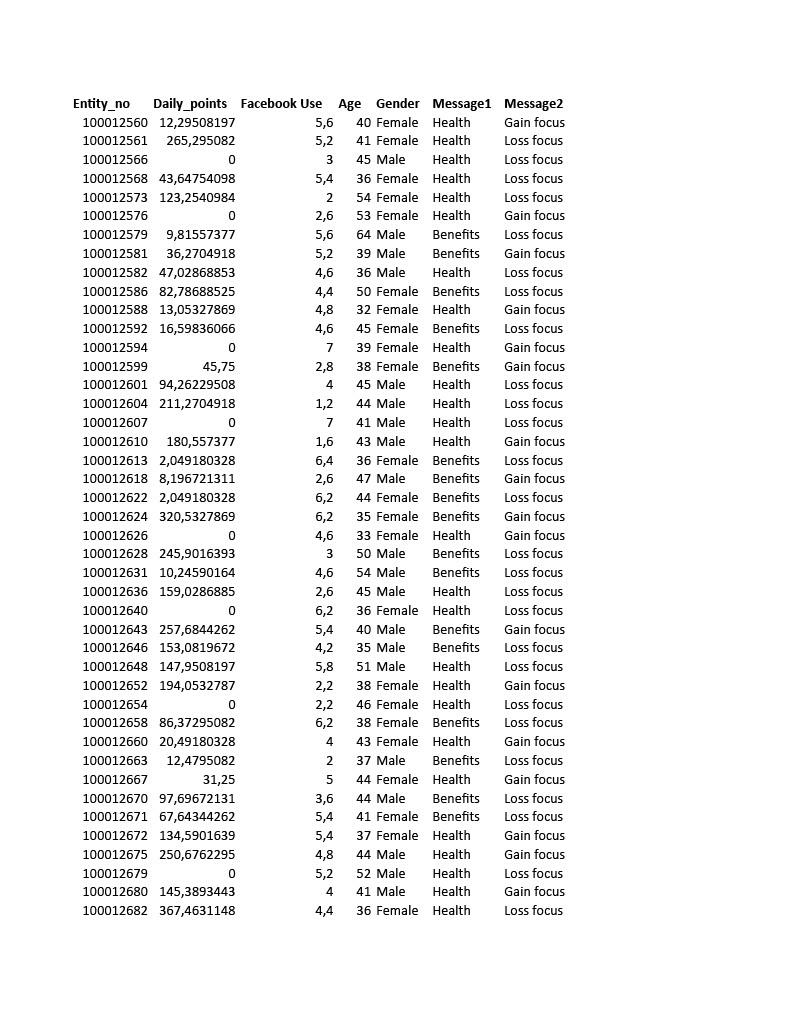
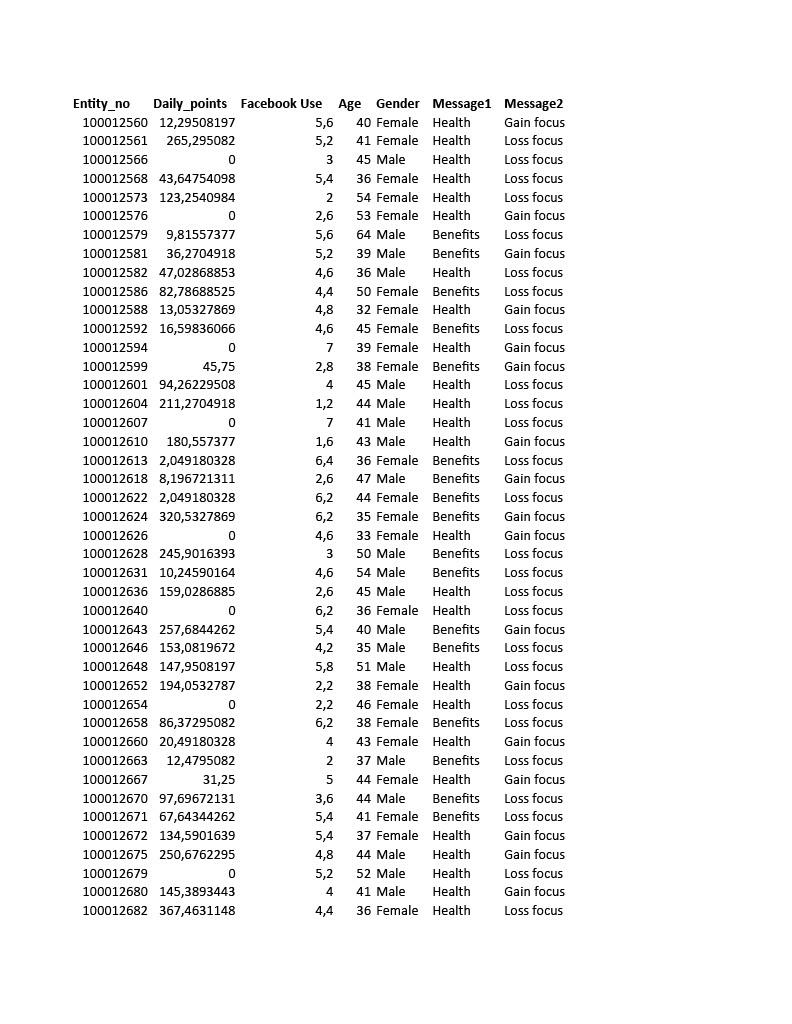
To summarise the data that you will see in the download, the following variables are in the set: See the Microsoft Excel dataset Vitality Facebook Invitation Data for the data.
Variables (data columns) measured here are:
Entity_no: The individuals unique entity number
Age: Individual age at the time of the invitation
Gender: Individual gender
Facebook use: a survey variable that measures the extent to which the individuals use Facebook in general, higher scores mean that they are more regular and enthusiastic Facebook users.
Daily_points: Daily vitality points per day gained from 1 July 2013 to the time of the invite, as a proxy for healthy behaviours prior to the study Message
1: Benefits or health focus in the message?
Message 2: Gain or loss focus in the message?
Accepted_invite: Whether the person accepted the invitation to the Facebook group.
Johnsons main initial interest was in whether certain combinations of messages elicited higher response rates (Facebook likes). Later, she would also study whether the health outcomes of Vitality Facebook participants would be better than those who had not joined, a question which is considered in another case.
Requirement: Your task is to analyse and present this data in as much detail as you can, highlighting your findings and any recommendations you may have. You need to treat this assignment as if you are a paid consultant, i.e., produce work worthy of your post PDBA fee.
Format: You will need to submit your assignment in a PowerPoint presentation format. (You will not be presenting), but it needs to be submitted in PowerPoint. There is no limited to the number of slides (pages) allowed.
Step by Step Solution
There are 3 Steps involved in it

Get step-by-step solutions from verified subject matter experts
 Study Help