





Question: This exercise covers all five steps in the five steps of process costing under the standard costing method. Can you please help me understand how

This exercise covers all five steps in the five steps of process costing under the standard costing method. Can you please help me understand how to get all the calculations.

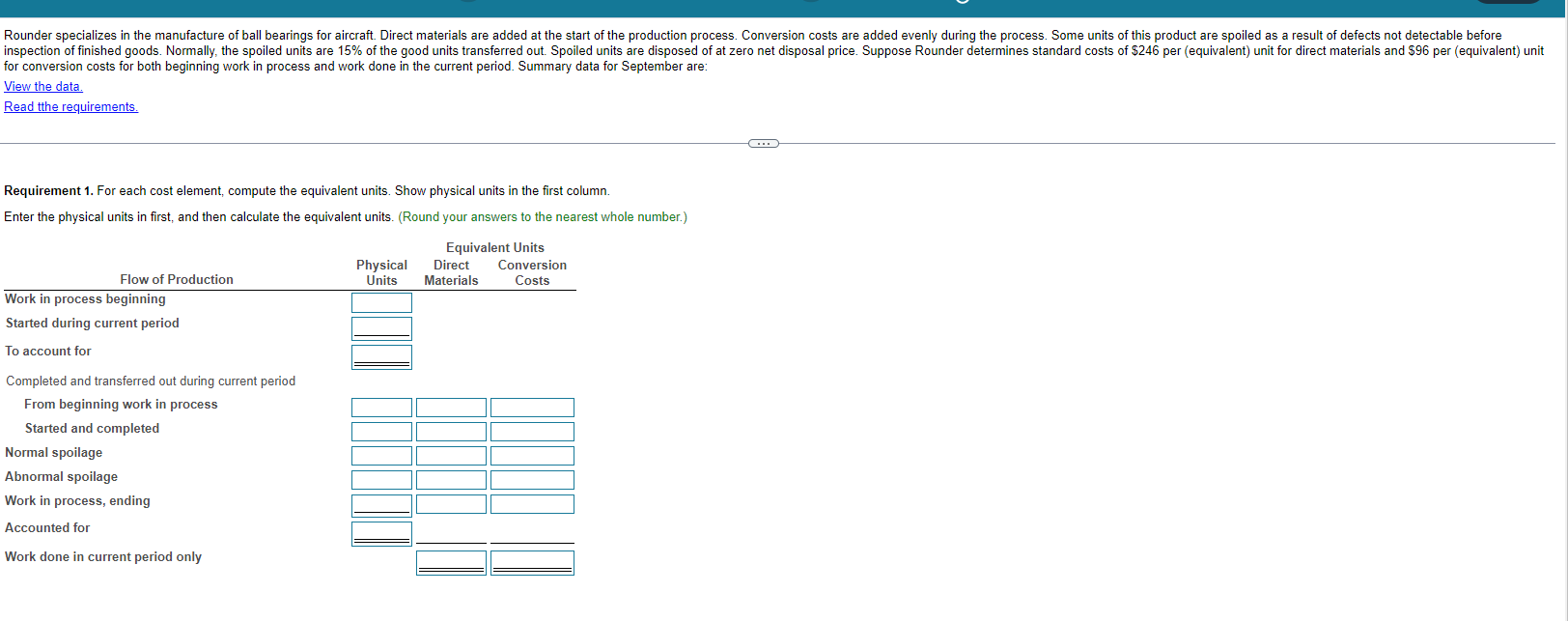
  1. For each cost? element, compute the equivalent units. Show physical units in the first column.
  2. For each cost? element, calculate the cost per equivalent unit.
  3. Summarize the total costs to account? for, and assign these costs to units completed and transferred out? (to normal? spoilage), to abnormal? spoilage, and to units in ending work in process.
This exercise covers all five steps in the fiveThis exercise covers all five steps in the five
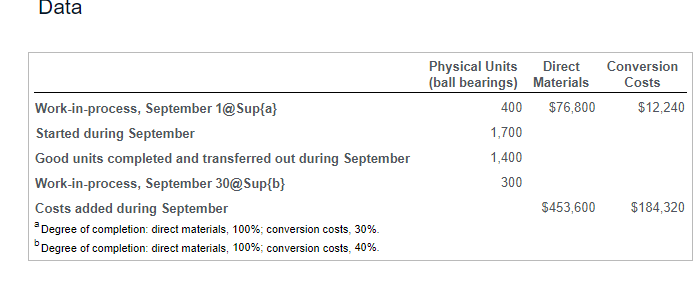
Data Physical Units Direct Conversion (ball bearings) Materials Costs Work-in-process, September 1@Sup[a} 400 $76,800 $12,240 Started during September 1,700 Good units completed and transferred out during September 1,400 Work-in-process, September 30@Sup{b} 300 Costs added during September $453,600 $184,320 Degree of completion: direct materials, 100%; conversion costs, 30%. "Degree of completion: direct materials, 100%; conversion costs, 40%.Rounder spacializes in the manufacture of ball bearings for aircraft Direct materials are added at the start of the production procass. Conversion costs are added evenly during the process. Some units of this product are spoiled as a result of defects not detectable before inspection of finished goods. Normally, the spoiled units are 15% of the good units transferred out. Speiled units are disposed of at zero net disposal price. Suppose Rounder determines standard costs of $246 per (equivalent) unit for direct materials and 596 per (equivalent) unit for conversien costs for both beginning werk in process and work done in the current period. Summary data for September are: View the data Read tthe requirements Requirement 1. For each cost element, compute the equivalent units. Show physical units in the first column. Enter the physical units in first, and then calculate the equivalent units. (Round your answers to the nearest whole number.) Equivalent Units Physical Direct Conversion Flow of Production Units Materials Costs Work in process beginning Started during current period To account for Completed and transferred out during current period From beginning work in process Started and completed Normal spoilage Abnormal spoilage Work in process, ending Accounted for Work done in current period only

Step by Step Solution

There are 3 Steps involved in it

1 Expert Approved Answer
Step: 1 Unlock blur-text-image

Question Has Been Solved by an Expert!

Get step-by-step solutions from verified subject matter experts

Step: 2 Unlock
Step: 3 Unlock

Students Have Also Explored These Related Accounting Questions!