







Question: This exercise is intended to demonstrate recursive coding, the Java Math class, and exception You are to write a Java program that has at least
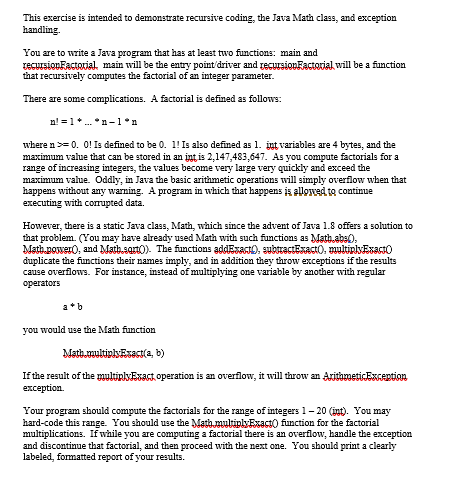
This exercise is intended to demonstrate recursive coding, the Java Math class, and exception You are to write a Java program that has at least two functions: main and ecursionFactorial main will be the entry point driver and recursionFactorial will be a function that recursively computes the factorial of an integer parameter. There are some complications. A factorial is defined as follows where n >=0. 0! Is defined to be 0. l! Is also defined as l. gut variables are 4 bytes, and the maximum value that can be stored in an int is 2,147,483,647. As you compute factorials for a range of increasing integers, the values become very large very quickly and exceed the maximum value. Oddly, in Java the basic arithmetic operations will simply overflow when that happens without any warning. A program in which that happens is alloyred to continue executing with comupted data. However, there is a static Java class, Math, which since the advent of Java 1.8 offers a solution to that problem. (You may have already used Math with such functions as Math.abe0, Mathpower0, and blath.sart0) The functions addExato, gubtractEact0, moltiplsExasto duplicate the functions their names imply, and in addition they throw exceptions if the results cause overflows. For instance, instead of multiplying one variable by another with regular operators vou would uee the Math function operation is an overflow, it will throw an AutuggeticExcept AA If the result of the uultRbRa exceptio2 Your program should compute the factorials for the range of integers 1 - 20 (int). You may hard-code this range. You multiplications. If while you are computing a factorial there is an overflow, handle the exception and discontinue that factorial, and then proceed with the next one. You should print a clearly labeled, formatted report of your results. should use the MathmulriplyFxact0 fimction for the factorial
Step by Step Solution
There are 3 Steps involved in it

Get step-by-step solutions from verified subject matter experts
 Study Help