Question: This full question. there are only 2 pages SCHOOL ZONE PUBLISHING: EDUCATING THE COMPETITION School Zone publishing company began as The School Zone Learning Center
This full question. there are only 2 pages
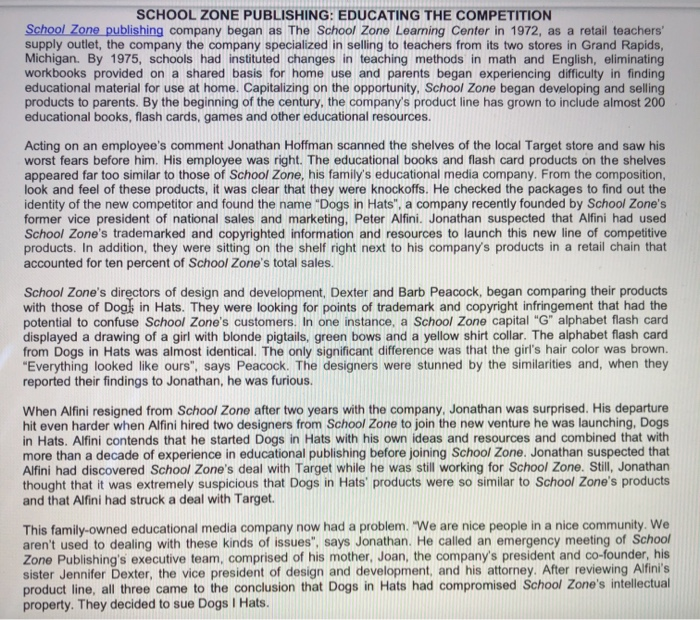
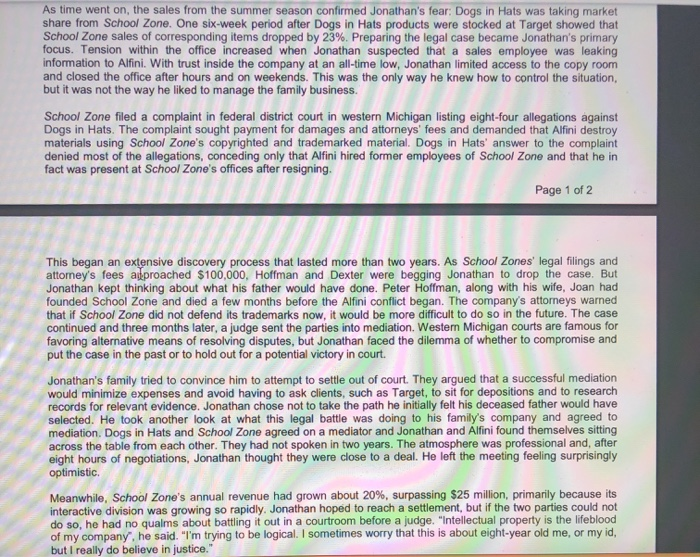

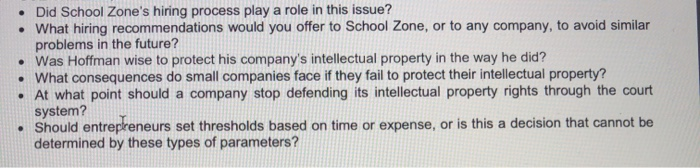
SCHOOL ZONE PUBLISHING: EDUCATING THE COMPETITION School Zone publishing company began as The School Zone Learning Center in 1972, as a retail teachers' supply outlet, the company the company specialized in selling to teachers from its two stores in Grand Rapids, Michigan. By 1975, schools had instituted changes in teaching methods in math and English, eliminating workbooks provided on a shared basis for home use and parents began experiencing difficulty in finding educational material for use at home. Capitalizing on the opportunity, School Zone began developing and selling products to parents. By the beginning of the century, the company's product line has grown to include almost 200 educational books, flash cards, games and other educational resources. Acting on an employee's comment Jonathan Hoffman scanned the shelves of the local Target store and saw his worst fears before him. His employee was right. The educational books and flash card products on the shelves appeared far too similar to those of School Zone, his family's educational media company. From the composition, look and feel of these products, it was clear that they were knockoffs. He checked the packages to find out the identity of the new competitor and found the name "Dogs in Hats", a company recently founded by School Zone's former vice president of national sales and marketing, Peter Alfini. Jonathan suspected that Alfini had used School Zone's trademarked and copyrighted information and resources to launch this new line of competitive products. In addition, they were sitting on the shelf right next to his company's products in a retail chain that accounted for ten percent of School Zone's total sales. School Zone's directors of design and development, Dexter and Barb Peacock, began comparing their products with those of Dogte in Hats. They were looking for points of trademark and copyright infringement that had the potential to confuse School Zone's customers. In one instance, a School Zone capital "G" alphabet flash card displayed a drawing of a girl with blonde pigtails, green bows and a yellow shirt collar. The alphabet flash card from Dogs in Hats was almost identical. The only significant difference was that the girl's hair color was brown. "Everything looked like ours", says Peacock. The designers were stunned by the similarities and, when they reported their findings to Jonathan, he was furious. When Alfini resigned from School Zone after two years with the company, Jonathan was surprised. His departure hit even harder when Alfini hired two designers from School Zone to join the new venture he was launching, Dogs in Hats. Alfini contends that he started Dogs in Hats with his own ideas and resources and combined that with more than a decade of experience in educational publishing before joining School Zone. Jonathan suspected that Alfini had discovered School Zone's deal with Target while he was still working for School Zone. Still, Jonathan thought that it was extremely suspicious that Dogs in Hats' products were so similar to School Zone's products and that Alfini had struck a deal with Target This family-owned educational media company now had a problem. "We are nice people in a nice community. We aren't used to dealing with these kinds of issues", says Jonathan. He called an emergency meeting of School Zone Publishing's executive team, comprised of his mother, Joan, the company's president and co-founder, his sister Jennifer Dexter, the vice president of design and development, and his attorney. After reviewing Alfini's product line, all three came to the conclusion that Dogs in Hats had compromised School Zone's intellectual property. They decided to sue Dogs I Hats. After months of discussion, Jonathan and Alfini finally reached an out-of-court settlement. Although the terms of the settlement will not allow Jonathan to discuss the details, he is happy that he can focus on his customers once again. He credits the case with providing perspective. Alfini is still in business, now living with his mother, and continues to have legal problems with disgruntled employees. "Some of the employees who left School Zone have been in contact with us and said they now realize what a great company School Zone is" says Jonathan. "I don't regret engaging in legal action" sates Jonathan. "But this was an emotionally intense, pendulum-like experience that proved to be a distraction from the business." As far as offering advice to others, Jonathan suggests assessing the costs before going to court. "Know when to use the law and when not to. The costs may not be worth it." Did School Zone's hiring process play a role in this issue? What hiring recommendations would you offer to School Zone, or to any company, to avoid similar problems in the future? Was Hoffman wise to protect his company's intellectual property in the way he did? What consequences do small companies face if they fail to protect their intellectual property? At what point should a company stop defending its intellectual property rights through the court system? Should entrepreneurs set thresholds based on time or expense, or is this a decision that cannot be determined by these types of parameters









 Study Help