







Question: this is a calc problem in matlab question.. this is matlab question .. thats it. Your assignment One of the real power of numerical methods
 this is a calc problem in matlab question.. this is matlab question .. thats it.
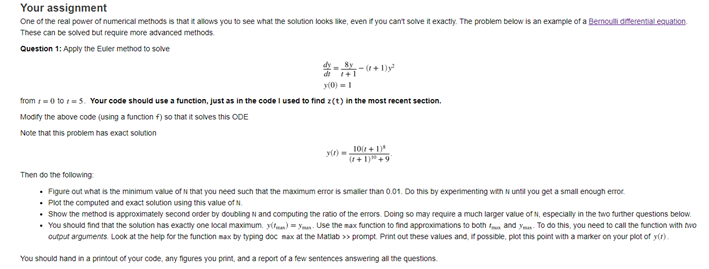
Your assignment One of the real power of numerical methods is that it allows you to see what the solution looks like, even if you can't solve it exactly. The problem below is an example of a Bemculi differential equation These can be solved but require more advanced methods Question 1: Apply the Euler method to solve (+1) (0)=1 from 1 = 0 to 1 = 5. Your code should use a function, just as in the code I used to find z(t) in the most recent section. Modify the above code (using a function f) so that it solves this ODE Note that this problem has exact solution 101 + 1) Then do the following . Figure out what is the minimum value of n that you need such that the maximum error is smaller than 0.01. Do this by experimenting with Nuntil you get a small enough error. Plot the computed and exact solution using this value of N. Show the method is approximately second order by doubling and computing the ratio of the errors. Doing so may require a much larger value of N, especially in the two further questions below. . You should find that the solution has exactly one local maximum) = You Use the max function to find approximations to both and you. To do this, you need to call the function with two output arguments Look at the help for the function sax by typing doc max at the Matlab >> prompt Print out these values and if possible, plot this point with a marker on your plot of y(t) You should hand in a printout of your code, any figures you print, and a report of a few sentences answering all the questions Your assignment One of the real power of numerical methods is that it allows you to see what the solution looks like, even if you can't solve it exactly. The problem below is an example of a Bemculi differential equation These can be solved but require more advanced methods Question 1: Apply the Euler method to solve (+1) (0)=1 from 1 = 0 to 1 = 5. Your code should use a function, just as in the code I used to find z(t) in the most recent section. Modify the above code (using a function f) so that it solves this ODE Note that this problem has exact solution 101 + 1) Then do the following . Figure out what is the minimum value of n that you need such that the maximum error is smaller than 0.01. Do this by experimenting with Nuntil you get a small enough error. Plot the computed and exact solution using this value of N. Show the method is approximately second order by doubling and computing the ratio of the errors. Doing so may require a much larger value of N, especially in the two further questions below. . You should find that the solution has exactly one local maximum) = You Use the max function to find approximations to both and you. To do this, you need to call the function with two output arguments Look at the help for the function sax by typing doc max at the Matlab >> prompt Print out these values and if possible, plot this point with a marker on your plot of y(t) You should hand in a printout of your code, any figures you print, and a report of a few sentences answering all the questions
Step by Step Solution
There are 3 Steps involved in it

Get step-by-step solutions from verified subject matter experts
 Study Help