







Question: This is a case study with 5 questions! making these terms onerous to find. This positioning raises questions about how Facebook will Case Study employ
This is a case study with 5 questions!
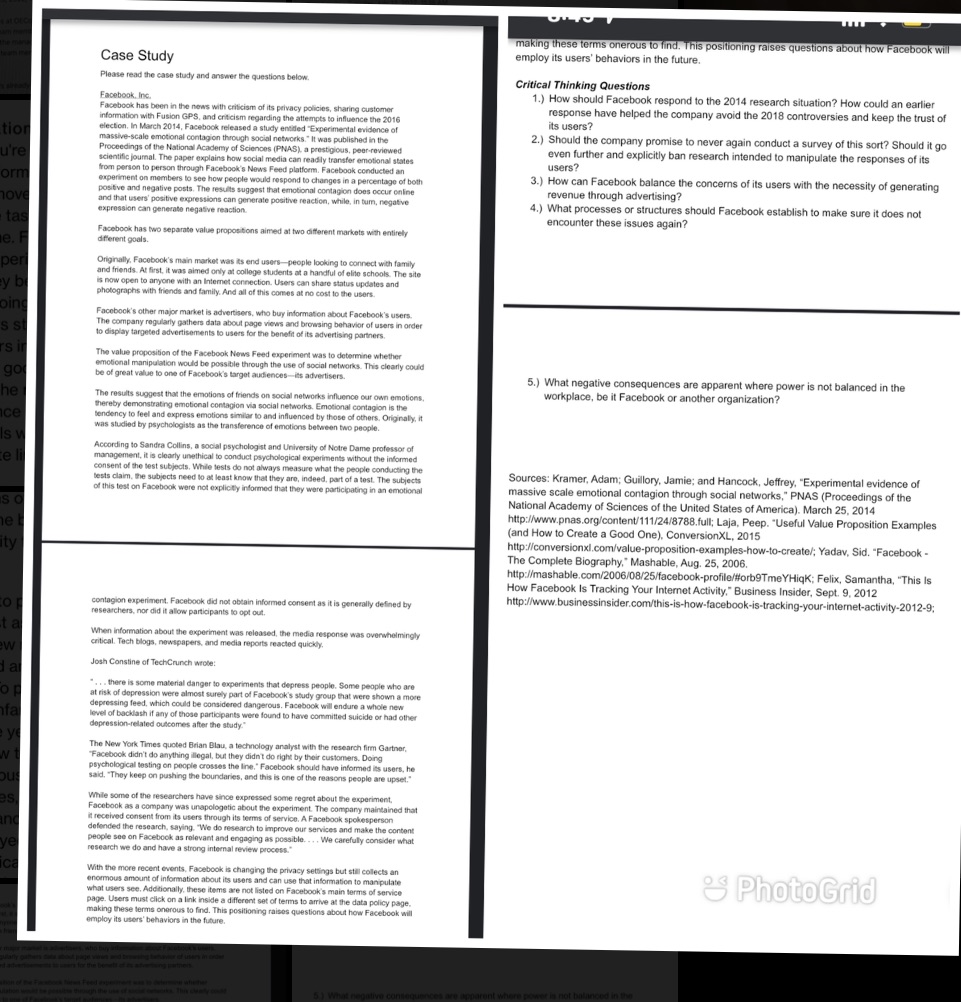
making these terms onerous to find. This positioning raises questions about how Facebook will Case Study employ its users' behaviors in the future. Please read the case study and answer the questions below. Critical Thinking Questions Facebook, Inc. 1.) How should Facebook respond to the 2014 research situation? How could an earlier Facebook has been in the nows with criticism of its privacy policies, sharing customer information with Fusion response have helped the company avoid the 2018 controversies and keep the trust of criticism regarding the attempts to influence the 2016 election, In March 2014, Facebook released a study entide thided Experimental evidence of ts users? massive-scale emotional contagion through social networks." It was published in the 2.) Should the company promise to never again conduct a survey of this sort? Should it go Proceedings of the National Academy of Sciences (PNAS), a prestigious, pear-reviewed cientificournal. The paper explains how social medi even further and explicitly ban research intended to manipulate the responses of its social media can readily transfer emotional stat rom person to person through Facebook's News Feed Facebook conducted an users? experiment on members to see how people would respond to changes in a percentage of be 3.) How can Facebook balance the concerns of its users with the necessity of generating positive and negative posts. The results sun to results suggest that emotions and that users positive expressions can generate positive reaction, while in ture revenue through advertising? expression can generate negative reaction. 4.) What processes or structures should Facebook establish to make sure it does not encounter these issues again? Facebook has two separate value propositions aimed at two different markets with entirely different goals. Originally, Facebook's main market was its end users-people looking to connect with family and friends. At first, it was aimed only at college students at a handful of elite schools. The site photographs wit is now open to anyone with an Internet connection. Users can share status updates and nd family. And all of this comes at no cost to the users. Facebook's other major market is advertisers, who buy information a The company regularly gathers data about page views and brows to display targeted advertisements to users for the benefit of its advertising partners. sition of the Facebook News Feed experiment was to determine whether emotional manipulation would be possible through the use of social networks. This clea be of great value to one of Facebook's target audiences-its advertisers. 5.) What negative consequences are apparent where power is not balanced in the The results suggest that the emotions of friends on social networks influence our own emotions. workplace, be it Facebook or another organization? thereby demonstrating emotional contagion v a social network Emotional contagion is the utions similar to and influenced by those of others. Originally, it was studied by psychologists as the transference of emotions here of emotions between two people. According to Sandra Collins, a social psychologist and University of Notre Dame professor of managemer clearly unethical pariments without the informed consent of the test subjects, While tests do not always measure what the people conducting the s claim, the subjects need to at least know that they are, indeed, part of a test. The subjects Sources: Kramer, Adam; Guillory, Jamie; and Hancock, Jeffrey, "Experimental evidence of Facebook were not explicitly informed that they were participating in an emotional massive scale emotional contagion through social networks," PNAS (Proceedings of the National Academy of Sciences of the United States of America). March 25, 2014 http:/www.pnas.org/content/111/24/8788.full; Laja, Peep. "Useful Value Proposition Examples (and How to Create a Good One), ConversionXL, 2015 http://conversionxl.com/value-proposition -examples-how-to-create/; Yadav, Sid. "Facebook - The Complete Biography," Mashable, Aug. 25, 2006. http://mashable.com/2006/08/25/facebook-profile/#orb9TmeYHiqK; Felix, Samantha, "This Is How Facebook Is Tracking Your Internet Activity," Business Insider, Sept. 9, 2012 contagion experiment. Facebook did not obtain informed consent as it is generally defined by http://www.businessinsider.com/this-is-how-facebook-is-tracking-your-internet-activity-2012-9; researchers, nor did it allow participants to opt out. When information about the experiment was released, the media response was overwhelm critical. Tech blogs, nowspa wspapers, and media reports reacted quickly. Josh Constine of TechCrunch wrote: ". . . there is some material danger to experiments that depress people. Some people who are at risk of depression were almost surely part of Facebook's study group that were shown a more lovedwhich could be considered dangerous. Facebook will endure a whole new cash if any of those participants were found to have committed suicide or had other depression-related outcomes after the study." The New York Times quoted Brian Blau, a technology analyst with the research firm Gartner, "Facebook didn't do anything illegal, but ing illegal, but they didn't do right by their customers. Doing psychological testing on people crosses the line." Facebook should have informed its users, he said. "They keep on pushing the boundaries, and oundaries, and this is one of the reasons people are upset." While some of the researchers have since expressed some regret about the experiment. Facebook as a company was unapologetic about the ment experi my maintained that it received consent in ad consent from its users through its terms of service. A Facebook spokesperson defended the research, saying. "We do research to improve our services and make the content people see on Facebook as relevant and engaging . We carefully consider what we do and have a strong internal review process With the more recent events, Facebook is changing the privacy settings but still collects an enormous amount of information about its users and ca s users and can use that information to manipulate users see. Additionally, these items are not listed on Facebook's main terms of service PhotoGrid page. Users must click on a link inside a different set of terms to arrive at the data policy page. making these terms onerous to find. This positioning raises questions about how Facebook will employ its users' behaviors in the future
Step by Step Solution
There are 3 Steps involved in it

Get step-by-step solutions from verified subject matter experts
 Study Help