Question: This is a continuation of study two. please continue as if you are finishing the paper attached. Add the appropriate tables which are the demographics
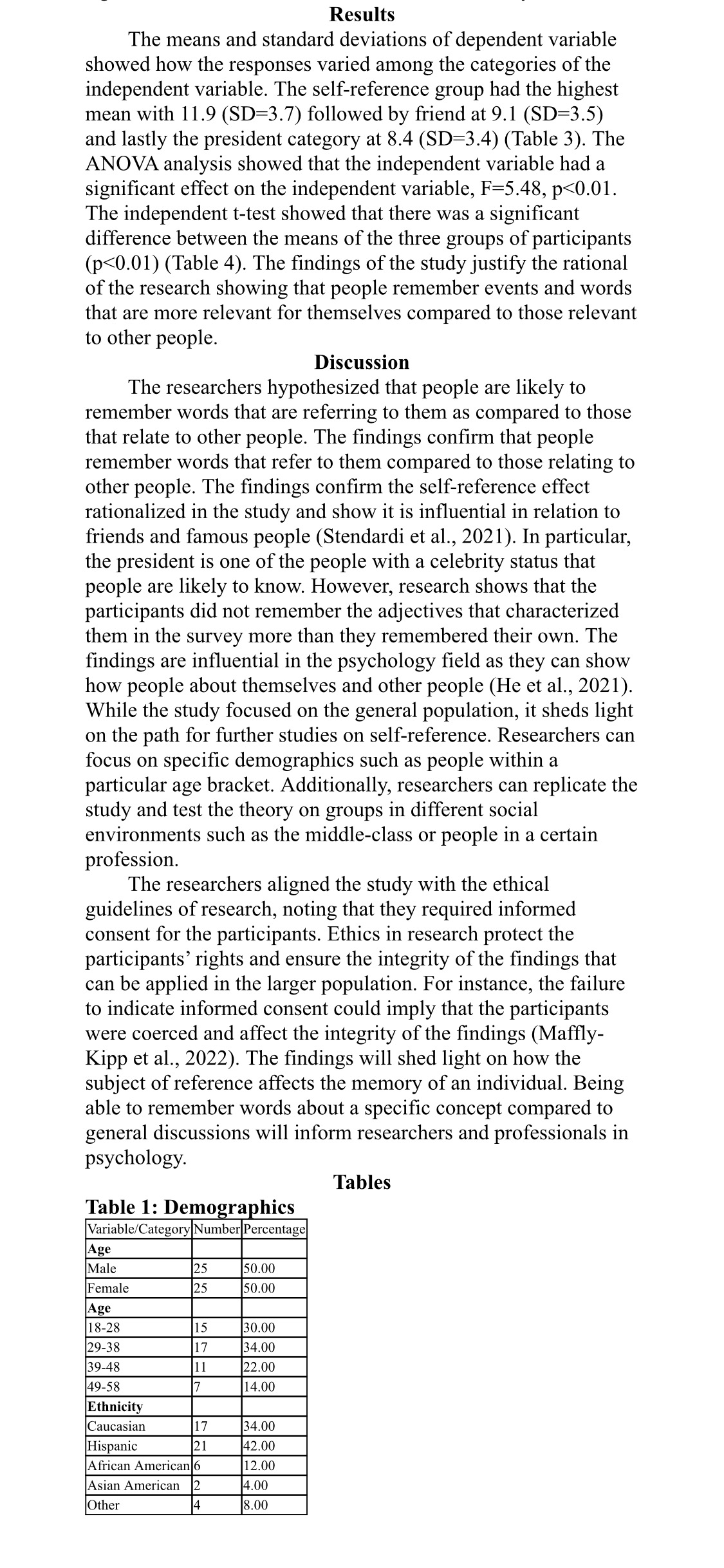
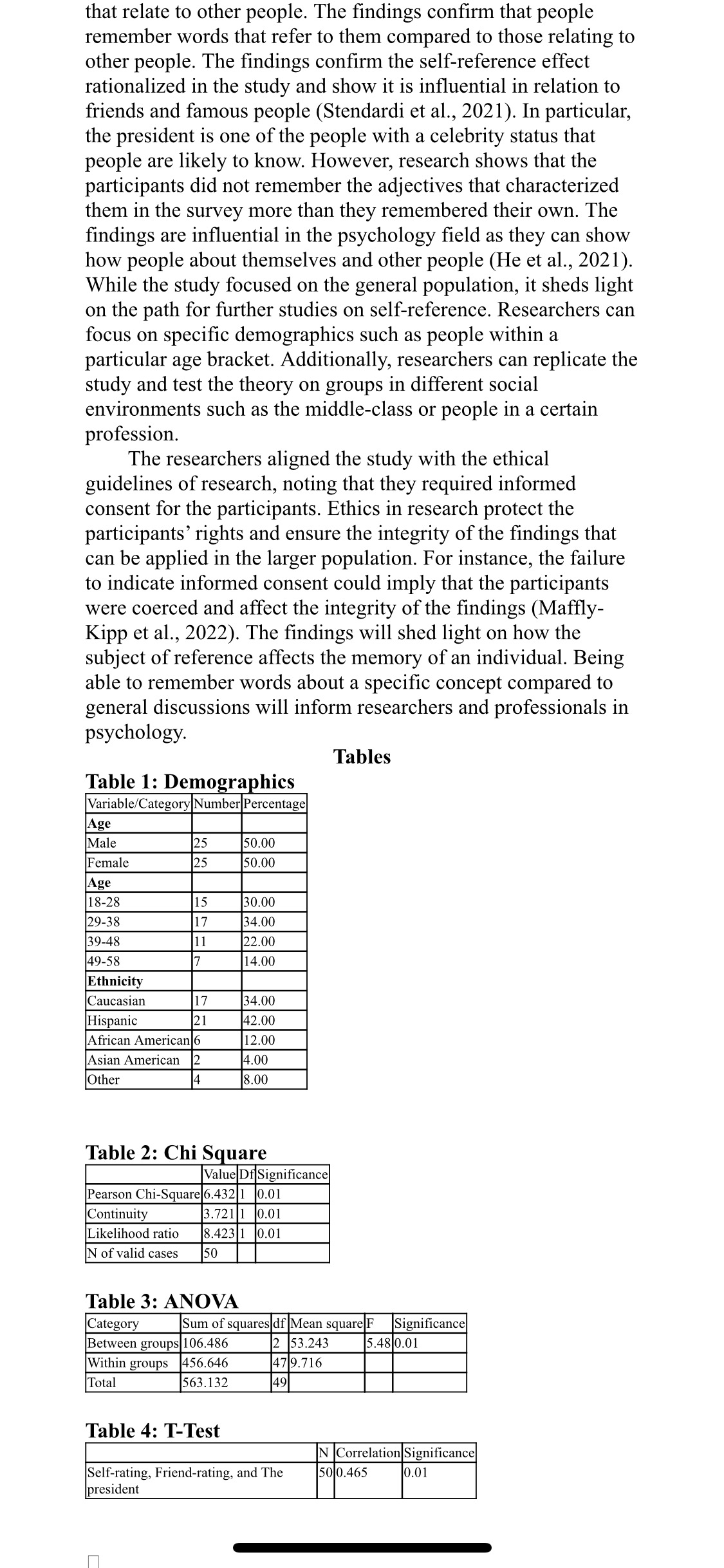
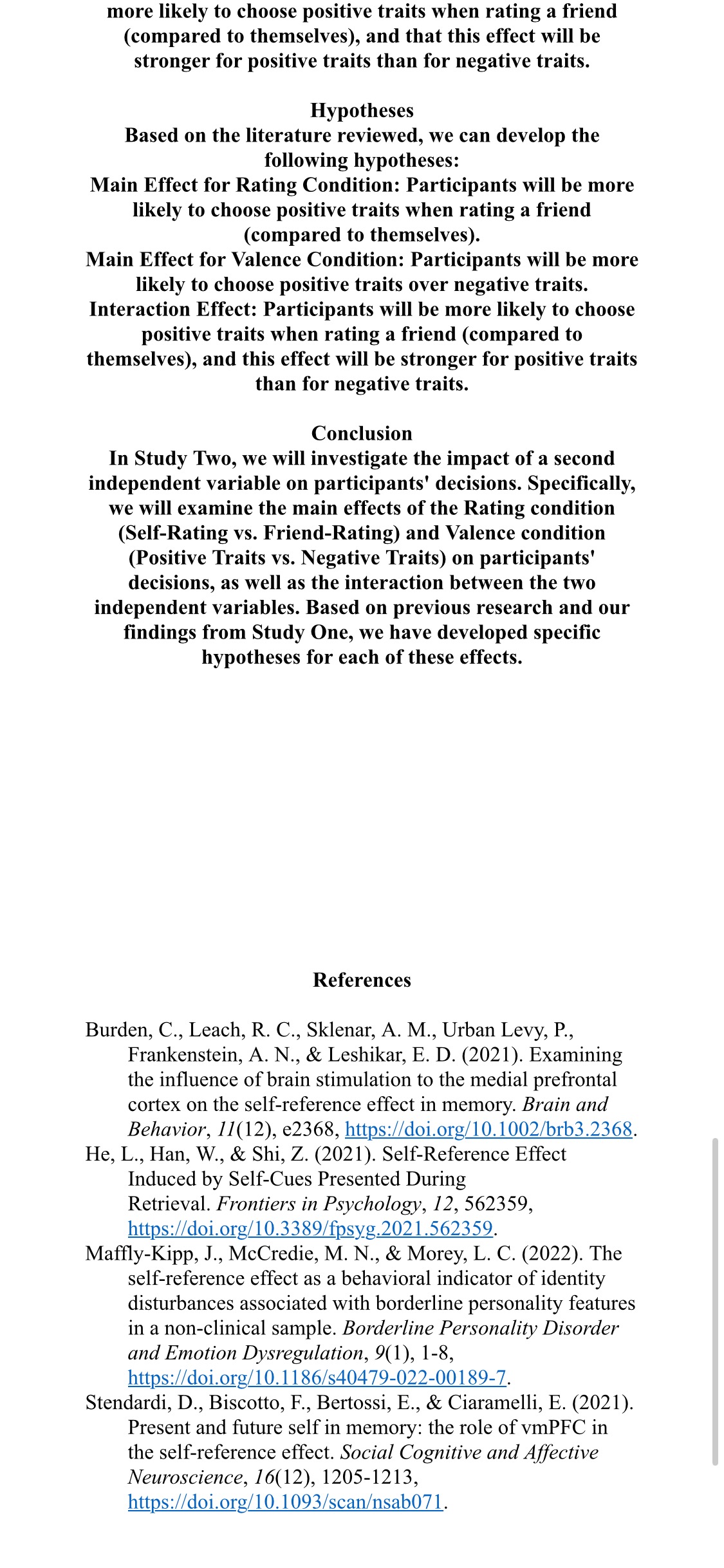
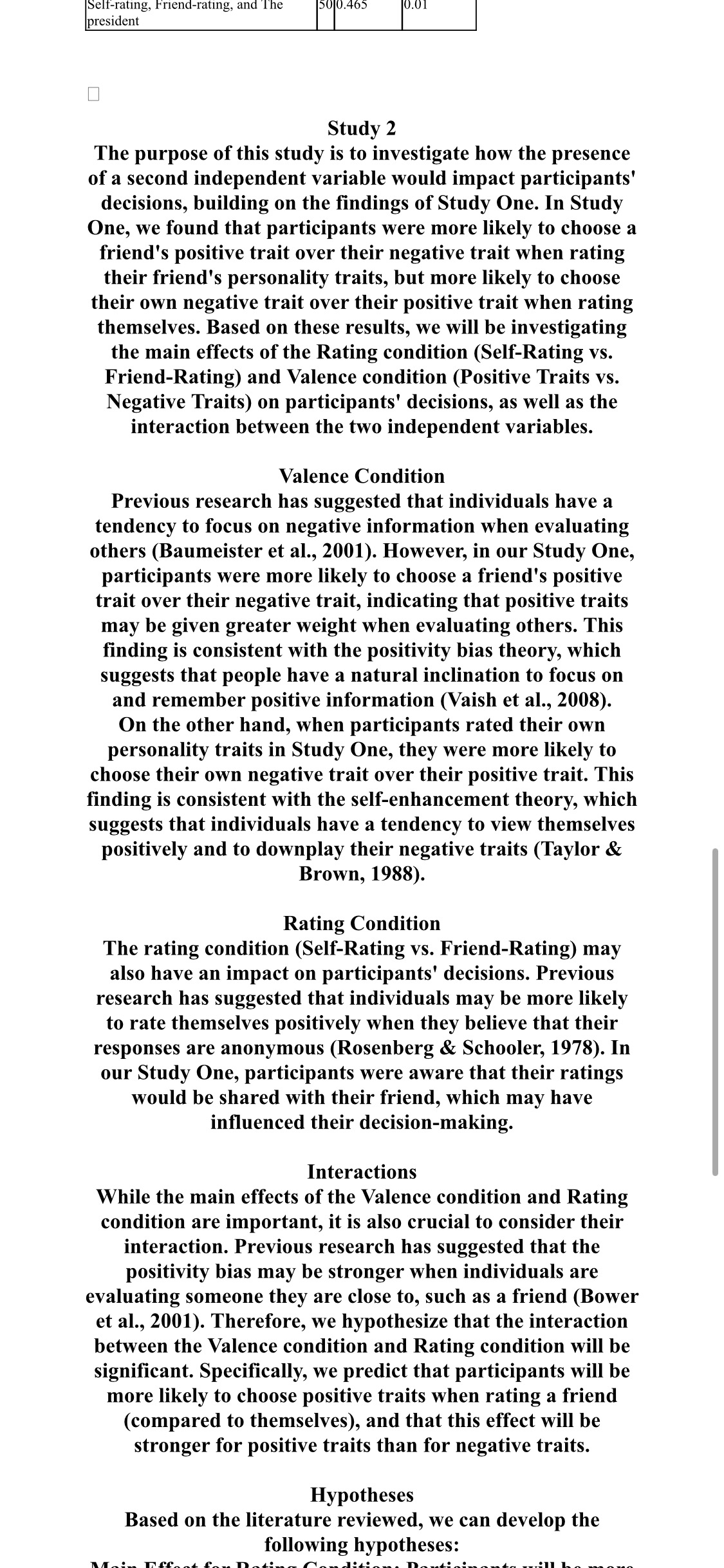
This is a continuation of study two. please continue as if you are finishing the paper attached. Add the appropriate tables which are the demographics table, Chi Sqaure, Anova, T-Test table for each section with the information provided in the paper below. please use the references at the bottom of the paper.
References
Burden, C., Leach, R. C., Sklenar, A. M., Urban Levy, P., Frankenstein, A. N., & Leshikar, E. D. (2021). Examining the influence of brain stimulation to the medial prefrontal cortex on the selfreference effect in memory. Brain and Behavior, 11(12), e2368, https://doi.org/10.1002/brb3.2368.
He, L., Han, W., & Shi, Z. (2021). Self-Reference Effect Induced by Self-Cues Presented During Retrieval. Frontiers in Psychology, 12, 562359, https://doi.org/10.3389/fpsyg.2021.562359.
Maffly-Kipp, J., McCredie, M. N., & Morey, L. C. (2022). The self-reference effect as a behavioral indicator of identity disturbances associated with borderline personality features in a non-clinical sample. Borderline Personality Disorder and Emotion Dysregulation, 9(1), 1-8, https://doi.org/10.1186/s40479-022-00189-7.
Stendardi, D., Biscotto, F., Bertossi, E., & Ciaramelli, E. (2021). Present and future self in memory: the role of vmPFC in the self-reference effect. Social Cognitive and Affective Neuroscience, 16(12), 1205-1213, https://doi.org/10.1093/scansab071
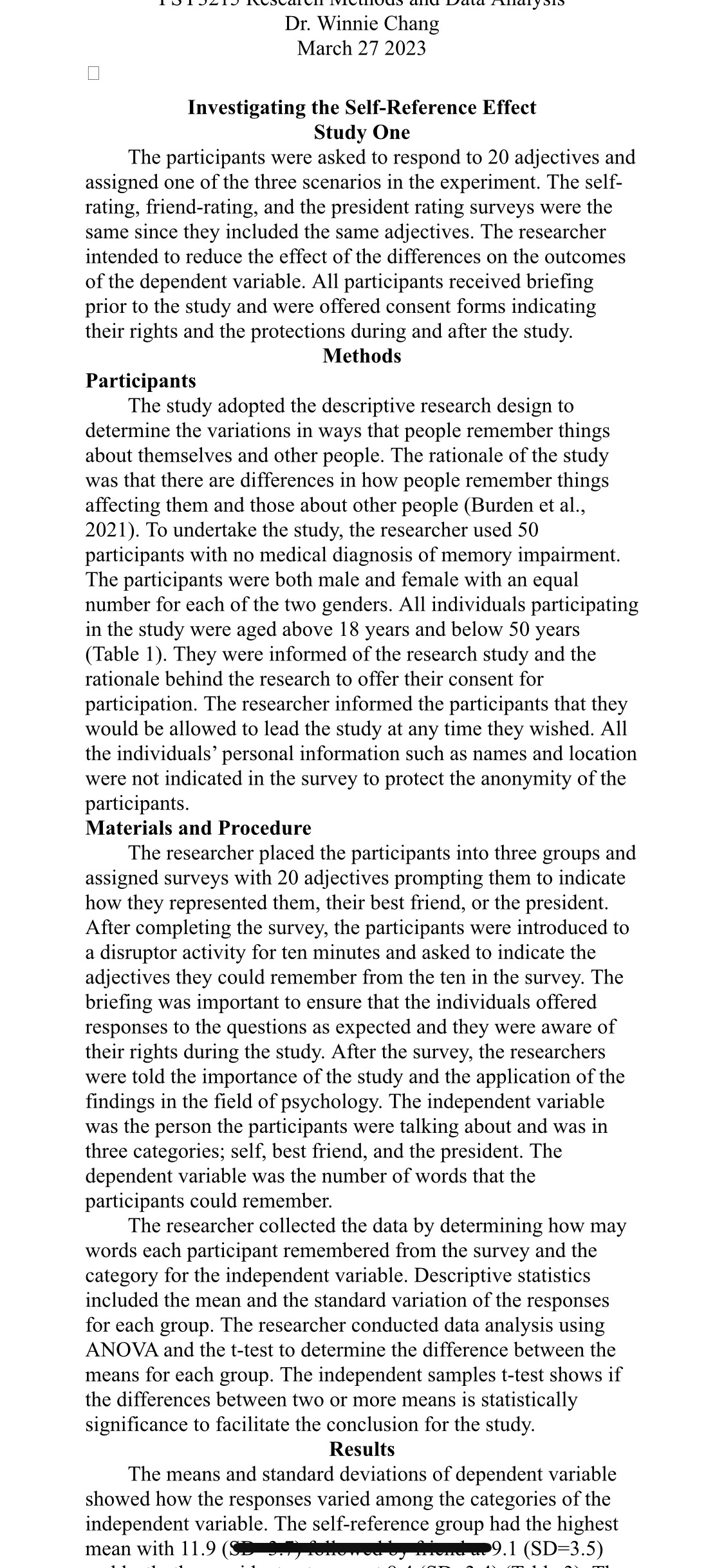
Dr. Winnie Chang March 27 2023 Investigating the Self-Reference Effect Study One The participants were asked to respond to 20 adjectives and assigned one of the three scenarios in the experiment. The self- rating, friend-rating, and the president rating surveys were the same since they included the same adjectives. The researcher intended to reduce the effect of the differences on the outcomes of the dependent variable. All participants received briefing prior to the study and were offered consent forms indicating their rights and the protections during and after the study. Methods Participants The study adopted the descriptive research design to determine the variations in ways that people remember things about themselves and other people. The rationale of the study was that there are differences in how people remember things affecting them and those about other people (Burden et al., 2021). To undertake the study, the researcher used 50 participants with no medical diagnosis of memory impairment. The participants were both male and female with an equal number for each of the two genders. All individuals participating in the study were aged above 18 years and below 50 years (Table 1). They were informed of the research study and the rationale behind the research to offer their consent for participation. The researcher informed the participants that they would be allowed to lead the study at any time they wished. All the individuals' personal information such as names and location were not indicated in the survey to protect the anonymity of the participants. Materials and Procedure The researcher placed the participants into three groups and assigned surveys with 20 adjectives prompting them to indicate how they represented them, their best friend, or the president. After completing the survey, the participants were introduced to a disruptor activity for ten minutes and asked to indicate the adjectives they could remember from the ten in the survey. The briefing was important to ensure that the individuals offered responses to the questions as expected and they were aware of their rights during the study. After the survey, the researchers were told the importance of the study and the application of the findings in the field of psychology. The independent variable was the person the participants were talking about and was in three categories; self, best friend, and the president. The dependent variable was the number of words that the participants could remember. The researcher collected the data by determining how may words each participant remembered from the survey and the category for the independent variable. Descriptive statistics included the mean and the standard variation of the responses for each group. The researcher conducted data analysis using ANOVA and the t-test to determine the difference between the means for each group. The independent samples t-test shows if the differences between two or more means is statistically significance to facilitate the conclusion for the study. Results The means and standard deviations of dependent variable showed how the responses varied among the categories of the independent variable. The self-reference group had the highest mean with 11.9 (S 29.1 (SD=3.5)Dr. Winnie Chang March 27 2023 Investigating the Self-Reference Effect Study One The participants were asked to respond to 20 adjectives and assigned one of the three scenarios in the experiment. The self- rating, friend-rating, and the president rating surveys were the same since they included the same adjectives. The researcher intended to reduce the effect of the differences on the outcomes of the dependent variable. All participants received briefing prior to the study and were offered consent forms indicating their rights and the protections during and after the study. Methods Participants The study adopted the descriptive research design to determine the variations in ways that people remember things about themselves and other people. The rationale of the study was that there are differences in how people remember things affecting them and those about other people (Burden et al., 2021). To undertake the study, the researcher used 50 participants with no medical diagnosis of memory impairment. The participants were both male and female with an equal number for each of the two genders. All individuals participating in the study were aged above 18 years and below 50 years (Table 1). They were informed of the research study and the rationale behind the research to offer their consent for participation. The researcher informed the participants that they would be allowed to lead the study at any time they wished. All the individuals' personal information such as names and location were not indicated in the survey to protect the anonymity of the participants. Materials and Procedure The researcher placed the participants into three groups and assigned surveys with 20 adjectives prompting them to indicate how they represented them, their best friend, or the president. After completing the survey, the participants were introduced to a disruptor activity for ten minutes and asked to indicate the adjectives they could remember from the ten in the survey. The briefing was important to ensure that the individuals offered responses to the questions as expected and they were aware of their rights during the study. After the survey, the researchers were told the importance of the study and the application of the findings in the field of psychology. The independent variable was the person the participants were talking about and was in three categories; self, best friend, and the president. The dependent variable was the number of words that the participants could remember. The researcher collected the data by determining how may words each participant remembered from the survey and the category for the independent variable. Descriptive statistics included the mean and the standard variation of the responses for each group. The researcher conducted data analysis using ANOVA and the t-test to determine the difference between the means for each group. The independent samples t-test shows if the differences between two or more means is statistically significance to facilitate the conclusion for the study. Results The means and standard deviations of dependent variable showed how the responses varied among the categories of the independent variable. The self-reference group had the highest mean with 11.9 (S 29.1 (SD=3.5)Results The means and standard deviations of dependent variable showed how the responses varied among the categories of the independent variable. The self-reference group had the highest mean with 11.9 (SD=3.7) followed by friend at 9.1 (SD=3.5) and lastly the president category at 8.4 (SD=3.4) (Table 3). The ANOVA analysis showed that the independent variable had a significant effect on the independent variable, F=5.48, p
Step by Step Solution
There are 3 Steps involved in it
1 Expert Approved Answer
Step: 1 Unlock
Question Has Been Solved by an Expert!
Get step-by-step solutions from verified subject matter experts
Step: 2 Unlock
Step: 3 Unlock
Students Have Also Explored These Related Accounting Questions!









 Study Help