







Question: This is a cost allocation problem for a merchandising firm. Since merchandising firms do not have overhead, you must allocate support costs instead of'overhead costs.
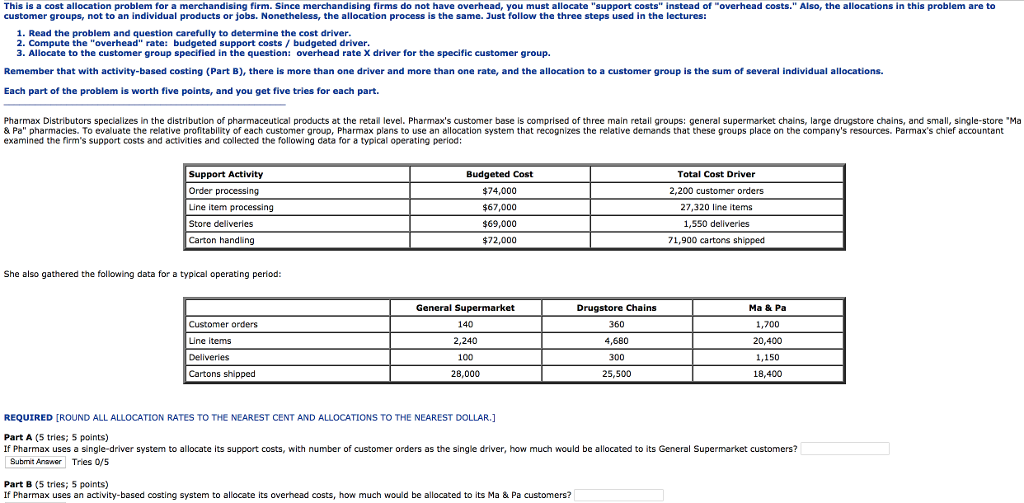
This is a cost allocation problem for a merchandising firm. Since merchandising firms do not have overhead, you must allocate "support costs" instead of'overhead costs." Also, the allocations in this problem are to customer groups, not to an individual products or jobs. Nonetheless, the allocation process is the same. Just follow the three steps used in the lectures: 1. Read the problem and question carefully to determine the cost driver 2. Compute the "overhead" rate: budgeted support costs /budgeted driver 3. Allocate to the customer group specified in the question: overhead rate X driver for the specific customer group. Remember that with activity-based costing (Part B), there is more than one driver and more than one rate, and the allocation to a customer group is the sum of several individual allocations. Each part of the problem is worth five points, and you get five tries for each part. Pharmax Distributors specializes in the distribution of pharmaceutical products at the retail level. Pharmax's customer base is comprised of three main retail groups: general supermarket chains, large drugstore chains, and small, single-store "Ma & Pa" pharmacies. To evaluate the relative profitability of each customer group, Pharmax plans to use an allocation system that recognizes the relative demands that these groups place on the company's resources. Parmax's chief accountant examined the firm's support costs and activities and collected the following data for a typical operating period: Support Activity Order processing Line item processing Store deliveries Carton handing Budgeted Cost $74,000 $67,000 $69,000 $72,000 Total Cost Driver 2,200 customer orders 27,320 line items 1,550 deliveries 71,900 cartons shipped She also gathered the following data for a typical operating period Customer orders Line items Deliveries Cartons shipped General Supermarket 140 2,240 100 28,000 Drugstore Chains 360 4,680 300 25,500 Ma & Pa 1,700 20,400 18,400 REQUIRED [ROUND ALL ALLOCATION RATES TO THE NEAREST CENT AND ALLOCATIONS TO THE NEAREST DOLLAR.] Part A (5 tries; 5 points) If Pharmax uses a single-driver system to allocate its support costs, with number of customer orders as the single driver, how much would be allocated to its General Supermarket customers? Submit Anawer Tries 0s Part B (5 tries; 5 points) If Pharmax uses an activity-based costing system to allocate its overhead costs, how much would be allocated to its Ma & Pa customers
Step by Step Solution
There are 3 Steps involved in it

Get step-by-step solutions from verified subject matter experts
 Study Help