







Question: This is a discussion question where my answer doesn't make any sense. I'm unclear as to what went wrong with my mathematical model. We are
This is a discussion question where my answer doesn't make any sense. I'm unclear as to what went wrong with my mathematical model. We are modeling a bridge that has collapsed using NHSOLDE. Please show your work and thought process so I can compare to mine. It is a bit lengthy but your help would be greatly appreciated.
Background info: On November 7, 1940 at approximately 11:00AM PT, the Tacoma Narrows Bridge in Washington (also known as "Galloping Gertie") collapsed dramatically. Even to date, there is debate about its ultimate demise, but much of the engineering community attributes it to "aeroelastic flutter", the effect of a powerful wind speed of 42 miles per hour.
https://www.youtube.com/watch?v=j-zczJXSxnw
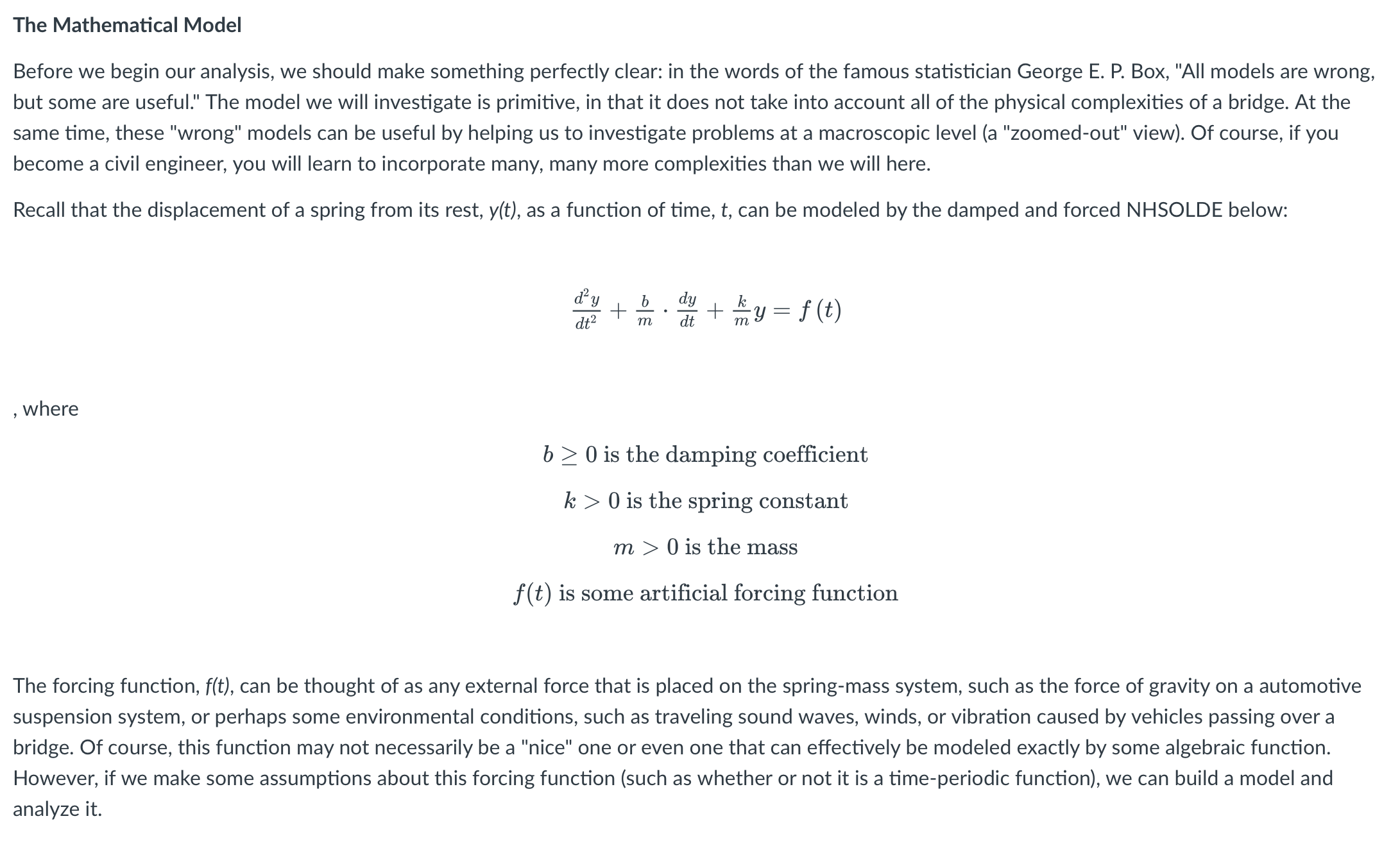
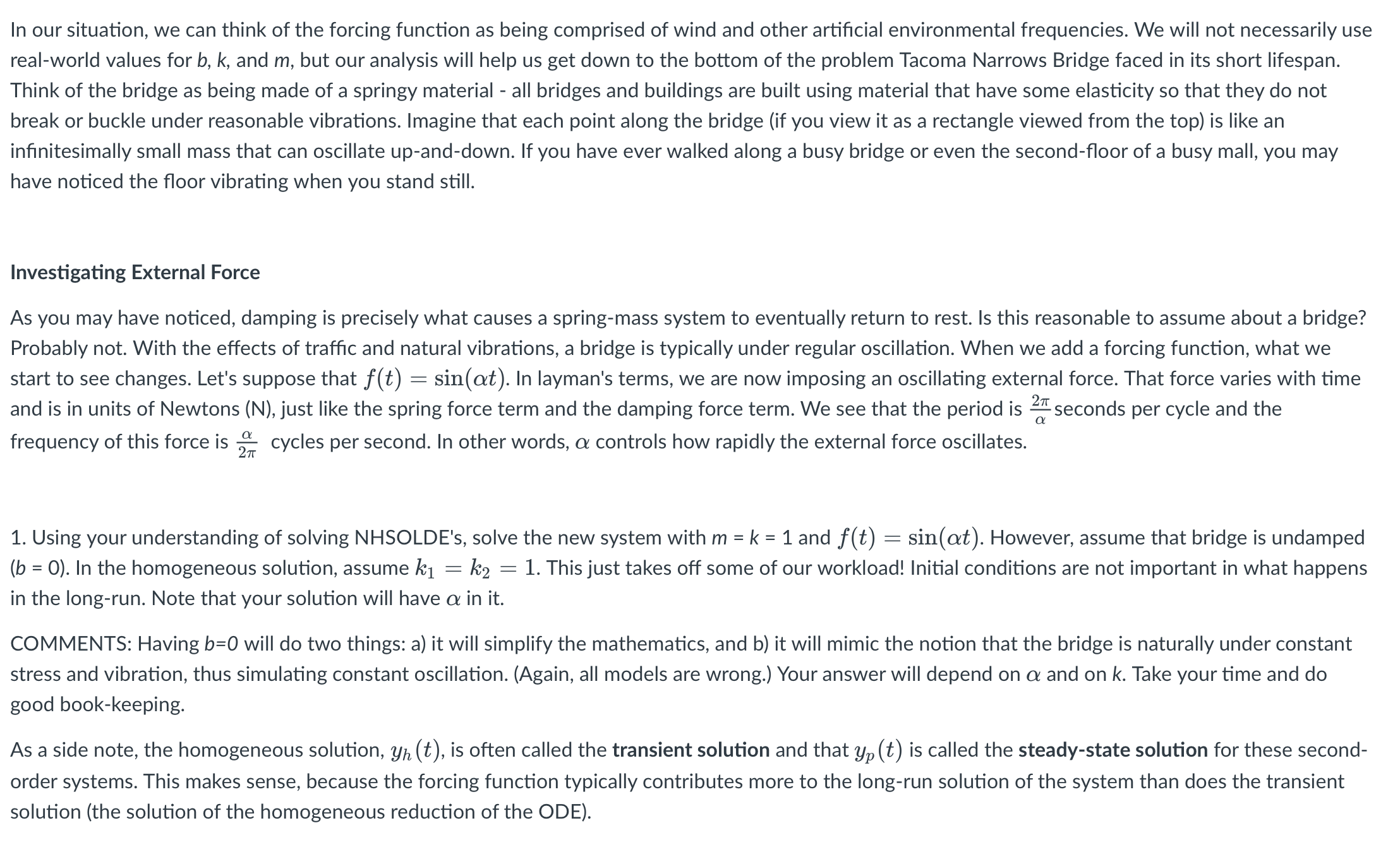
The Mathematical Model Before we begin our analysis, we should make something perfectly clear: in the words of the famous statistician George E. P. Box, "All models are wrong, but some are useful." The model we will investigate is primitive, in that it does not take into account all of the physical complexities of a bridge. At the same time, these "wrong" models can be useful by helping us to investigate problems at a macroscopic level (a "zoomed-out" view). Of course, if you become a civil engineer, you will learn to incorporate many, many more complexities than we will here. Recall that the displacement of a spring from its rest, y(t), as a function of time, t, can be modeled by the damped and forced NHSOLDE below: , where b 3 0 is the damping coefcient k > 0 is the spring constant m > Dis the mass f (t) is some articial forcing function The forcing function, t), can be thought of as any external force that is placed on the spring-mass system, such as the force of gravity on a automotive suspension system, or perhaps some environmental conditions, such as traveling sound waves, winds, or vibration caused by vehicles passing over a bridge. Of course, this function may not necessarily be a "nice" one or even one that can effectively be modeled exactly by some algebraic function. However, if we make some assumptions about this forcing function (such as whether or not it is a time-periodic function), we can build a model and analyze it. In our situation, we can think of the forcing function as being comprised of wind and other articial environmental frequencies. We will not necessarily use real-world values for b, k, and m, but our analysis will help us get down to the bottom of the problem Tacoma Narrows Bridge faced in its short lifespan. Think of the bridge as being made of a springy material - all bridges and buildings are built using material that have some elasticity so that they do not break or buckle under reasonable vibrations. Imagine that each point along the bridge (if you view it as a rectangle viewed from the top) is like an innitesimally small mass that can oscillate up-and-down. If you have ever walked along a busy bridge or even the second-oor of a busy mall, you may have noticed the oor vibrating when you stand still. Investigating External Force As you may have noticed, damping is precisely what causes a spring-mass system to eventually return to rest. Is this reasonable to assume about a bridge? Probably not. With the effects of trafc and natural vibrations, a bridge Is typically under regular oscillation. When we add a forcing function, what we start to see changes. Let's suppose that f(t) = sin(ozt). In layman's terms, we are now imposing an oscillating external force. That force varies with time and is in units of Newtons (N), just like the spring force term and the damping force term. We see that the period is {fseconds per cycle and the CI 2\" cycles per second. In other words, a controls how rapidly the external force oscillates. frequency of this force is 1. Using your understanding of solving NHSOLDE's, solve the new system with m = k = 1 and f(t) = sin(at). However, assume that bridge is undamped (b = O). In the homogeneous solution, assume k1 = 162 = 1. This just takes off some of our workload! Initial conditions are not important in what happens in the long-run. Note that your solution will have a in it. COMMENTS: Having b=0 will do two things: a) it will simplify the mathematics, and b) it will mimic the notion that the bridge is naturally under constant stress and vibration, thus simulating constant oscillation. (Again, all models are wrong.) Your answer will depend on a and on k. Take your time and do good book-keeping. As a side note, the homogeneous solution, yh (t), is often called the transient solution and that yp (t) is called the steady-state solution for these second- order systems. This makes sense, because the forcing function typically contributes more to the long-run solution of the system than does the transient solution (the solution of the homogeneous reduction of the ODE). Final Analysis Now that you have a solution, recall that k=1 (the spring constant). This value causes the oscillations we see in the homogeneous solution; this is because k is the "springiness" of the spring (the elasticity of the bridge, in this case). That is, without any forcing, the model bridge would oscillate at % oscillations per second (one full up-down-up motion every %, or 0.16 seconds). The forcing function contributes a term (the nonhomogeneous part) that causes oscillations at a frequency of % oscillations per second. In our general solution, we sum the homogeneous and nonhomogeneous solutions, and so the natural oscillation of the bridge and the external force's oscillation "interact". This observation is very important in seeing why the Tacoma Narrows began to oscillate more and more violently until the material could no longer withstand it (thereby crumbling). 2. Graph the solution in Desmos and create a slider for a on the interval from O to 1. Experiment with the slider. State any interesting observations. Be a detective! Most notably, spend some time "fine-tuning" a: as it approaches 1 from values close to 1 (like 0.9, 0.99, 0.999). What do you notice as a > 1, that is, as a > k? What happens to the oscillations? 3. Take a peak again at your general solution gquation. What happens in the denominator of one of the terms as a > 1? Does this further support what you saw in the graph in 6)? 4. You have just investigated one of the culprit's of the bridge's collapse. What can you say about what happens to the displacement of the bridge from rest, when the frequency of oscillations of the external environment (sound waves, wind, etc.) approach the same frequency as that of the natural oscillations of the bridge
Step by Step Solution
There are 3 Steps involved in it

Get step-by-step solutions from verified subject matter experts
 Study Help