Question: This is a generic risk management process following the PRAM methodology. Select any type of project, assuming you have one and then apply the methodology
This is a generic risk management process following the PRAM methodology.
Select any type of project, assuming you have one and then apply the methodology appropriately. Making sure to specify the project deliverables for each phase.
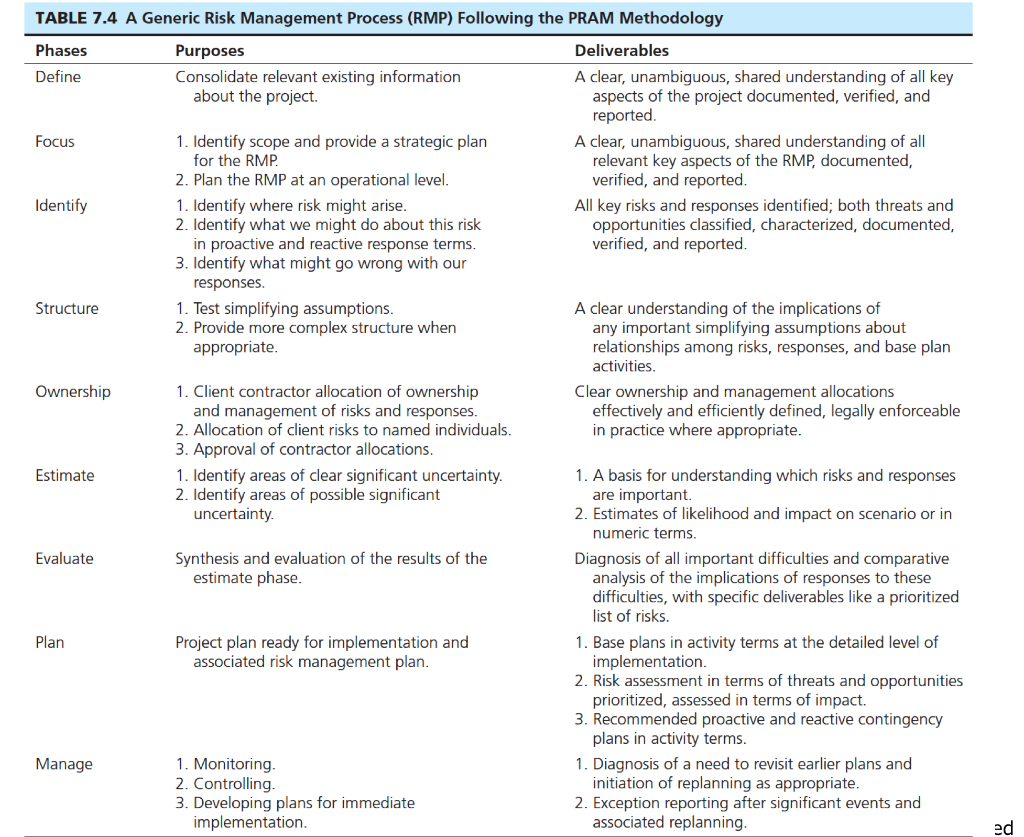
TABLE 7.4 A Generic Risk Management Process (RMP) Following the PRAM Methodology Phases Purposes Deliverables Define Consolidate relevant existing information A clear, unambiguous, shared understanding of all key about the project. aspects of the project documented, verified, and reported. Focus 1. Identify scope and provide a strategic plan A clear, unambiguous, shared understanding of all for the RMP. relevant key aspects of the RMP, documented, 2. Plan the RMP at an operational level. verified, and reported. Identify 1. Identify where risk might arise. All key risks and responses identified; both threats and 2. Identify what we might do about this risk opportunities classified, characterized, documented, in proactive and reactive response terms. verified, and reported. 3. Identify what might go wrong with our responses. Structure 1. Test simplifying assumptions. A clear understanding of the implications of 2. Provide more complex structure when any important simplifying assumptions about appropriate. relationships among risks, responses, and base plan activities. Ownership 1. Client contractor allocation of ownership Clear ownership and management allocations and management of risks and responses. effectively and efficiently defined, legally enforceable 2. Allocation of client risks to named individuals. in practice where appropriate. 3. Approval of contractor allocations. Estimate 1. Identify areas of clear significant uncertainty. 1. A basis for understanding which risks and responses 2. Identify areas of possible significant are important. uncertainty. 2. Estimates of likelihood and impact on scenario or in numeric terms. Evaluate Synthesis and evaluation of the results of the Diagnosis of all important difficulties and comparative estimate phase. analysis of the implications of responses to these difficulties, with specific deliverables like a prioritized list of risks. Plan Project plan ready for implementation and 1. Base plans in activity terms at the detailed level of associated risk management plan. implementation 2. Risk assessment in terms of threats and opportunities prioritized, assessed in terms of impact. 3. Recommended proactive and reactive contingency plans in activity terms. Manage 1. Monitoring 1. Diagnosis of a need to revisit earlier plans and 2. Controlling initiation of replanning as appropriate. 3. Developing plans for immediate 2. Exception reporting after significant events and implementation. associated replanning. ed









 Study Help