Question: This is a Group Theory question. The QUESTION and SOLUTION is shown below. My question relates to part d) only. I have three questions regarding

This is a Group Theory question.

The QUESTION and SOLUTION is shown below.

My question relates to part d) only.

I have three questions regarding SOLUTION shown for part d):

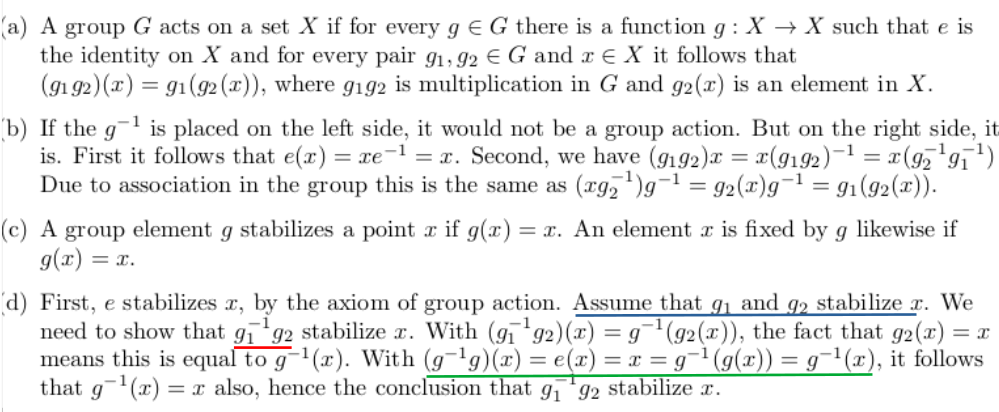
  1. I would like to know why the statement "We need to show that ?g1?1?g2?? stabilize ?x? ", which is underlined in RED, is specified ?
  2. Why is the assumption made that ?g1?? and ?g2?? stabilize ?x? , underlined in BLUE
  3. Please expand the workings shown underlined by GREEN

Please explain clearly showing each step as thoroughly as possible.

If you are using hand-written notes, then please ensure they are tidy and legible as untidy written notes are difficult to interpret.

Alternatively use LaTeX.

QUESTION
This is a Group Theory question. The QUESTION andThis is a Group Theory question. The QUESTION and
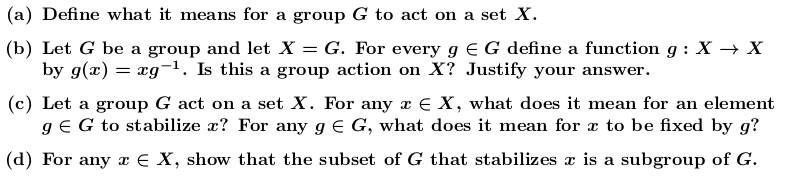
(a) Define what it means for a group G to act on a set X. (b) Let G be a group and let X = G. For every g ( G define a function g : X - X by g(x) = ag -1. Is this a group action on X? Justify your answer. (c) Let a group G act on a set X. For any x E X, what does it mean for an element g E G to stabilize x? For any g E G, what does it mean for a to be fixed by g? (d) For any a E X, show that the subset of G that stabilizes a is a subgroup of G.(a) A group G acts on a set X if for every 9' E G there is a function g : X > X such that e is the identity on X and for every pair 91, 92 E G and :1: E X it follows that (91g2)(:r) = g1(g2(x)), where 9192 is multiplication in G and 92(3) is an element in X. :b) If the g1 is placed on the leit side, it would not be a group action. But on the right side, it is. First it follows that 8(3) = :re'l = 2. Second, we have (9192):: = #9192)\" = 3(92'191'1) Due to association in the group this is the same as (3:95591 : 92(m)g'1 = 91 (92(1)). (0) A group element 9 stabilizes a point x if 9(3) = I. An element I is xed by g likewise if 9(1) = 3- Id) First, e stabilizes 3:, by the axiom of your) action. Assume that g] and g2 stabilize 3:. We need to show that 91192 stabilize 1:. With (91192)(I) = g_1(92(:r)), the fact that 92(3) = I means this is equaltTg'Wm). With (g'lg)(:c) = e 1') = :1: = g'1(g(a:)) = g'1(m), it follows that g_1(:r) = 3: also, hence the cone usion t at 91 gg stabilize

Step by Step Solution

There are 3 Steps involved in it

1 Expert Approved Answer
Step: 1 Unlock blur-text-image

Question Has Been Solved by an Expert!

Get step-by-step solutions from verified subject matter experts

Step: 2 Unlock
Step: 3 Unlock

Students Have Also Explored These Related Mathematics Questions!