







Question: This is a model the instructor demonstrated in class, however I was absent. I need to understand how to proceed with these questions to model
This is a model the instructor demonstrated in class, however I was absent. I need to understand how to proceed with these questions to model the problem from scratch like this example. I am completely lost, starting with question 1 through 17. Thank you.
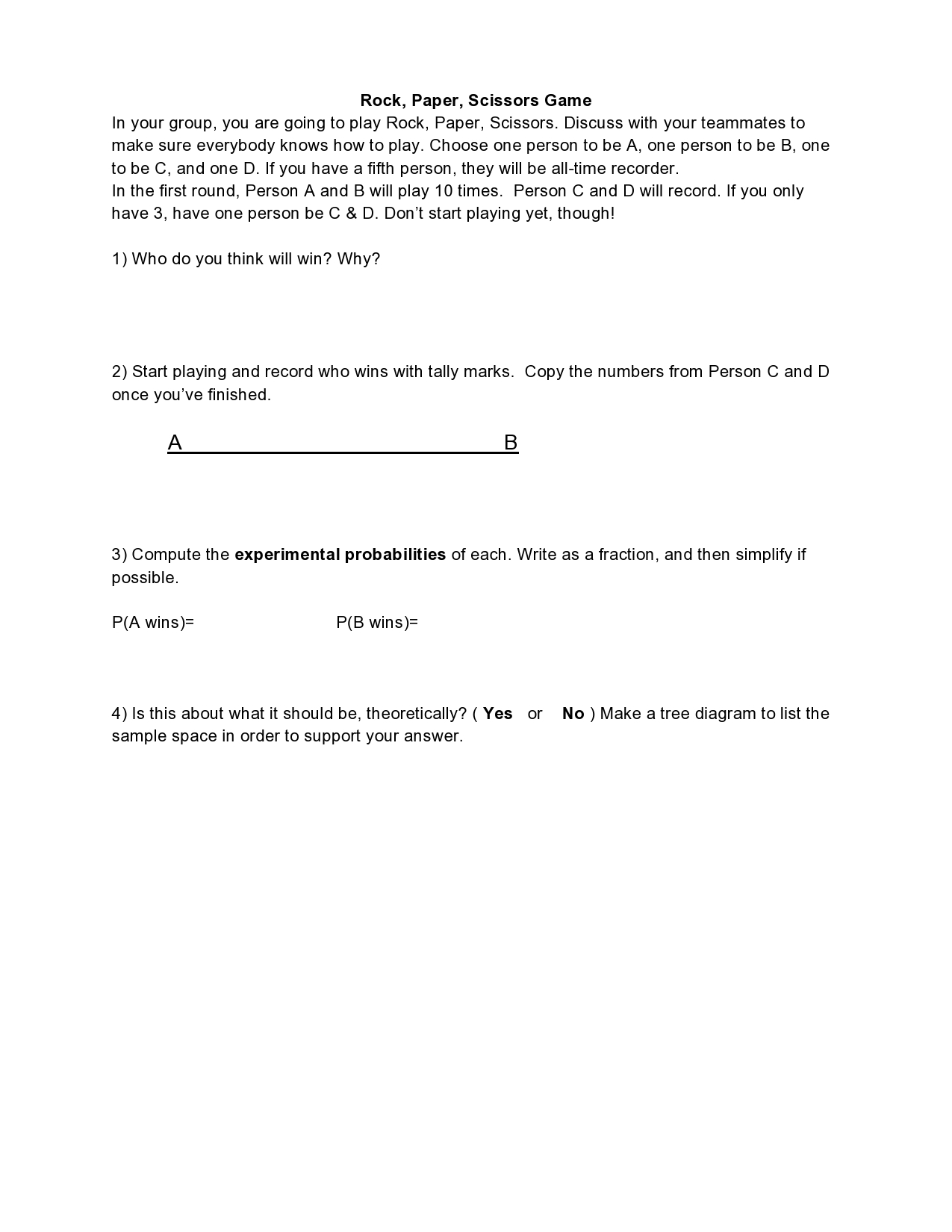
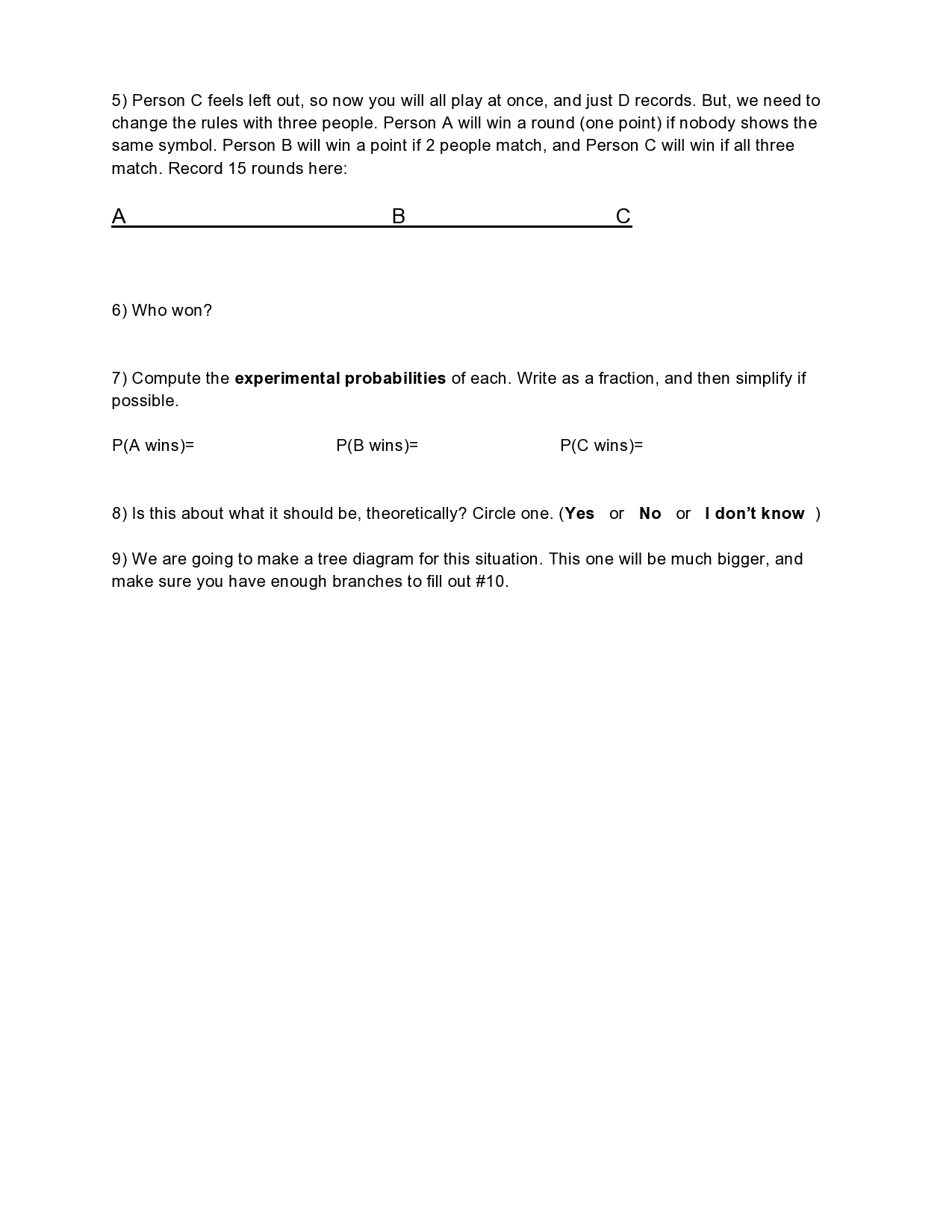
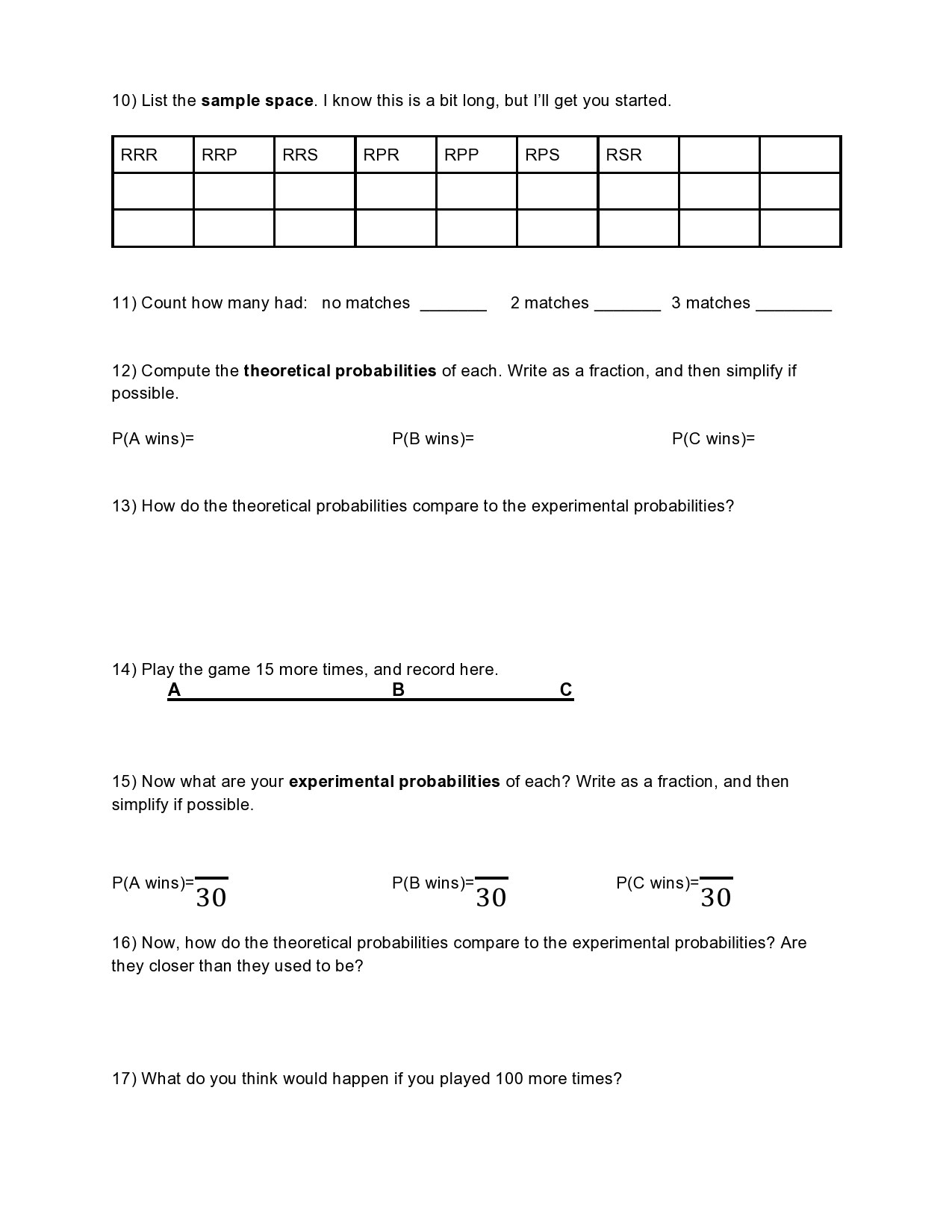
Rock, Paper, Scissors Game In your group, you are going to play Rock, Paper, Scissors. Discuss with your teammates to make sure everybody knows how to play. Choose one person to be A, one person to be B, one to be C, and one D. If you have a fifth person, they will be all-time recorder. In the first round, Person A and B will play 10 times. Person C and D will record. If you only have 3, have one person be C & D. Don't start playing yet, though! 1) Who do you think will win? Why? 2) Start playing and record who wins with tally marks. Copy the numbers from Person C and D once you've finished. A B 3) Compute the experimental probabilities of each. Write as a fraction, and then simplify if possible. P(A wins): P(B wins): 4) Is this about what it should be, theoretically? ( Yes or No ) Make a tree diagram to list the sample space in order to support your answer. 5) Person C feels left out, so now you will all play at once, and just D records. But, we need to change the rules with three people. Person A will win a round (one point) if nobody shows the same symbol. Person B will win a point if 2 people match, and Person 0 will win if all three match. Record 15 rounds here: A B C 6) Who won? 7) Compute the experimental probabilities of each. Write as a fraction, and then simplify if possible. P(A wins): P(B wins): P(C wins): 8) Is this about what it should be, theoretically? Circle one. (Yes or No or I don't know ) 9) We are going to make a tree diagram for this situation. This one will be much bigger, and make sure you have enough branches to fill out #10. 10) List the sample space. I know this is a bit long, but I'll get you started. WEI-\"-- 11) Count how many had: no match es 2 matches 3 matches 12) Compute the theoretical probabilities of each. Write as a fraction, and then simplify if possible. P(A wins): P(B wins): P(C wins): 13) How do the theoretical probabilities compare to the experimental probabilities? 14) Play the game 15 more times, and record here. A B C 15) Now what are your experimental probabilities of each? Write as a fraction, and then simplify if possible. P(A wins)= P(B wins)= P(C wins): 30 30 30 16) Now, how do the theoretical probabilities compare to the experimental probabilities? Are they closer than they used to be? 17) What do you think would happen if you played 100 more times
Step by Step Solution
There are 3 Steps involved in it

Get step-by-step solutions from verified subject matter experts
 Study Help