







Question: This is a multipart problem. Submit your answer for the first part before proceeding to the second. Given the function 32-2 f(I) = Part 1:
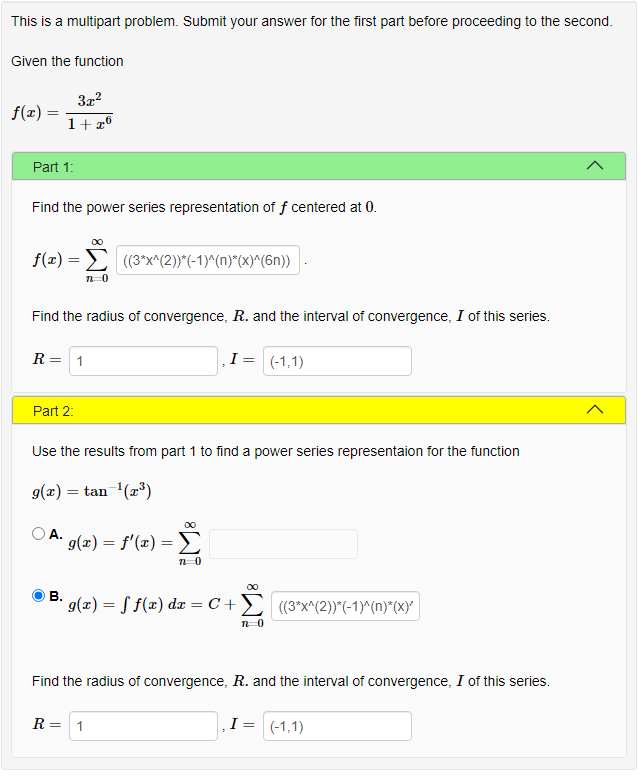
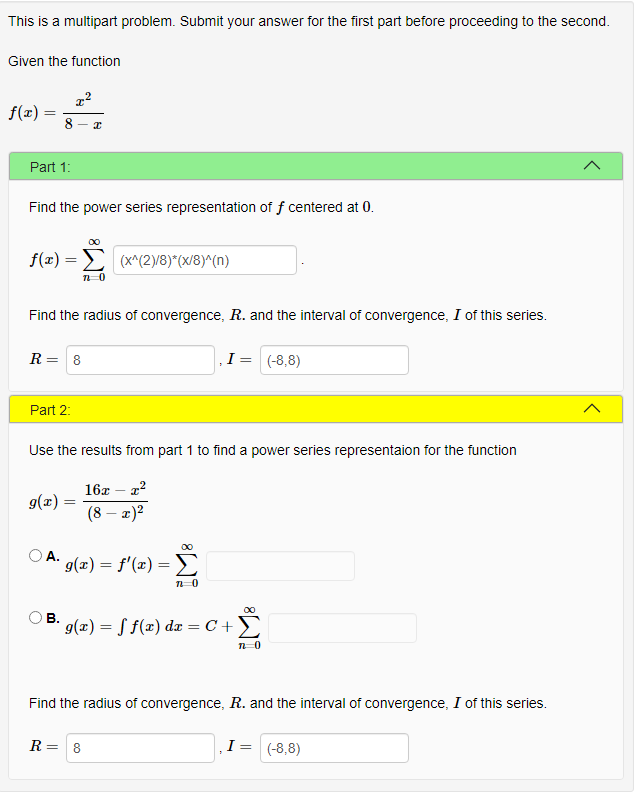
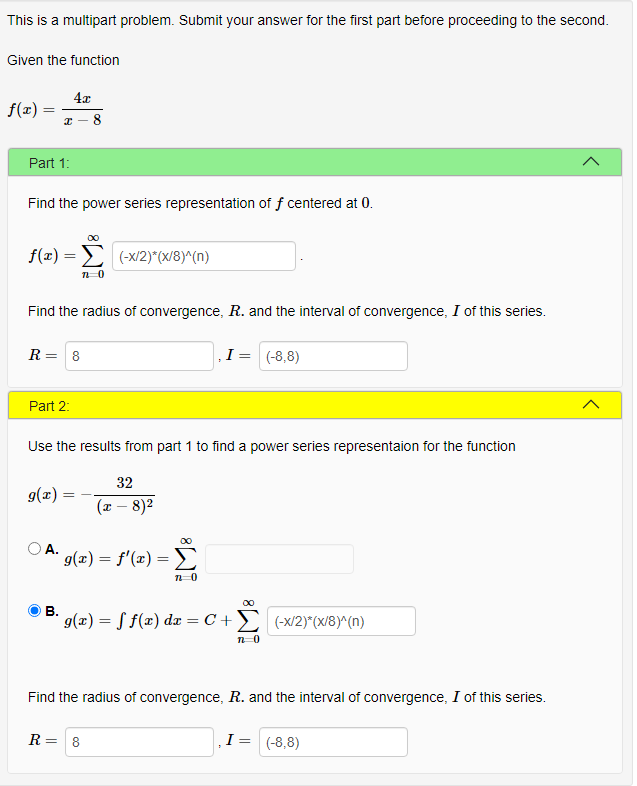
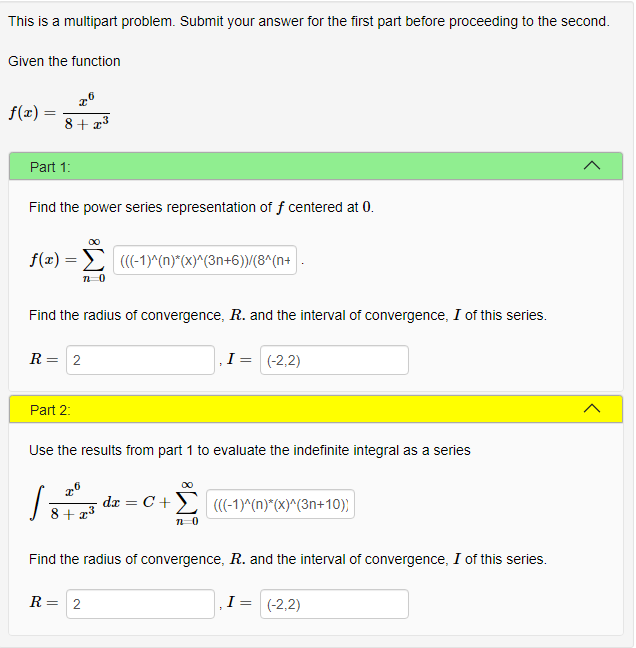
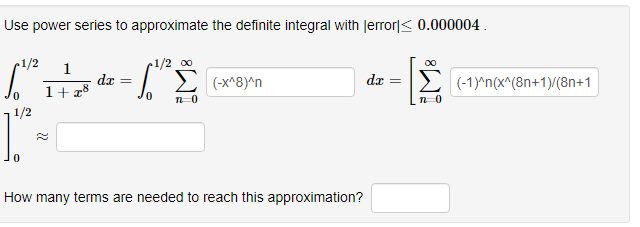
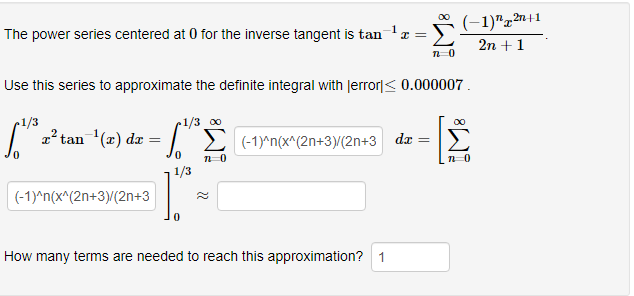
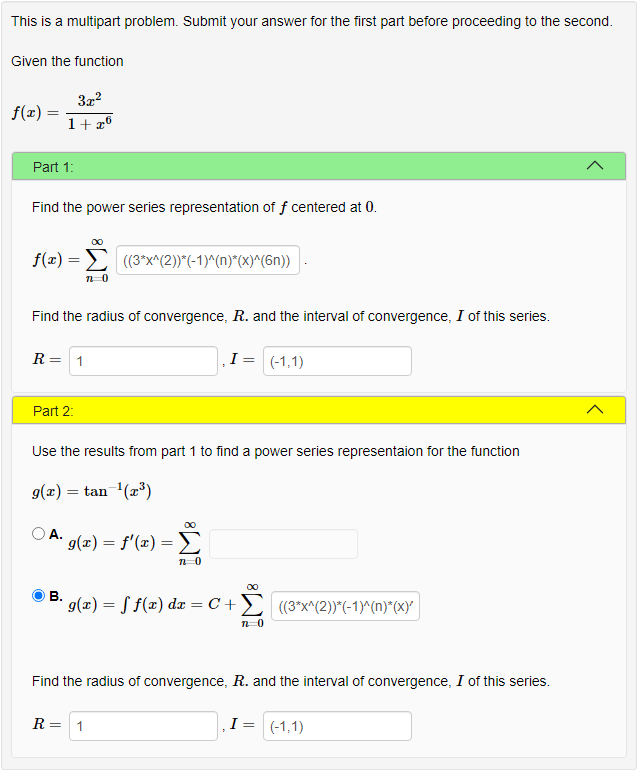
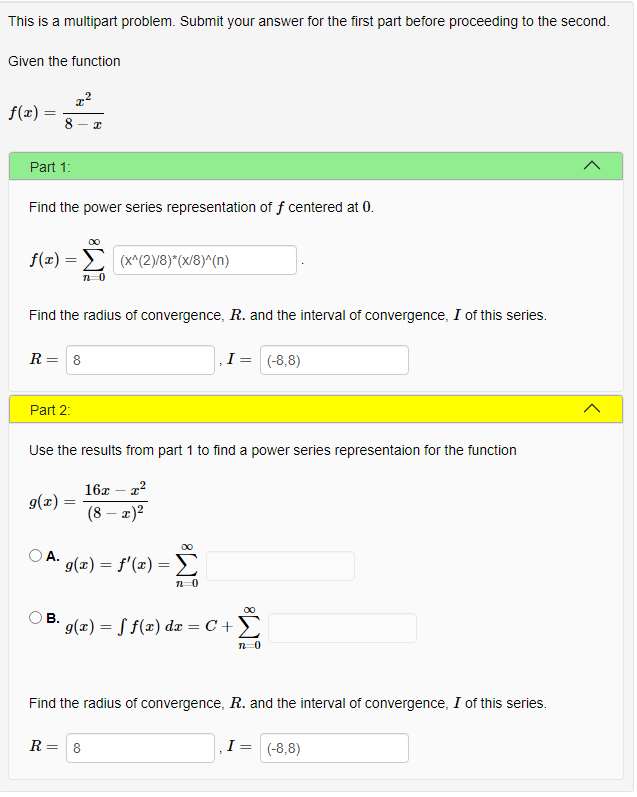
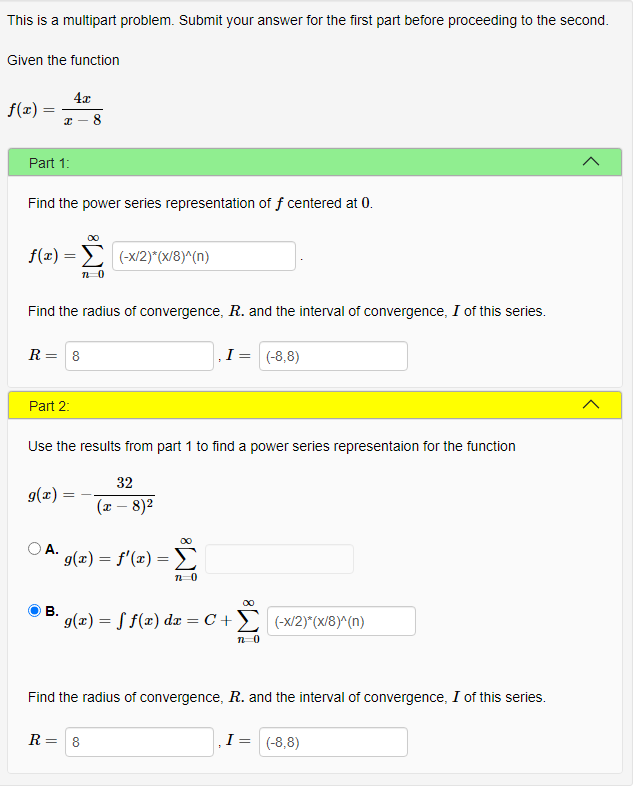
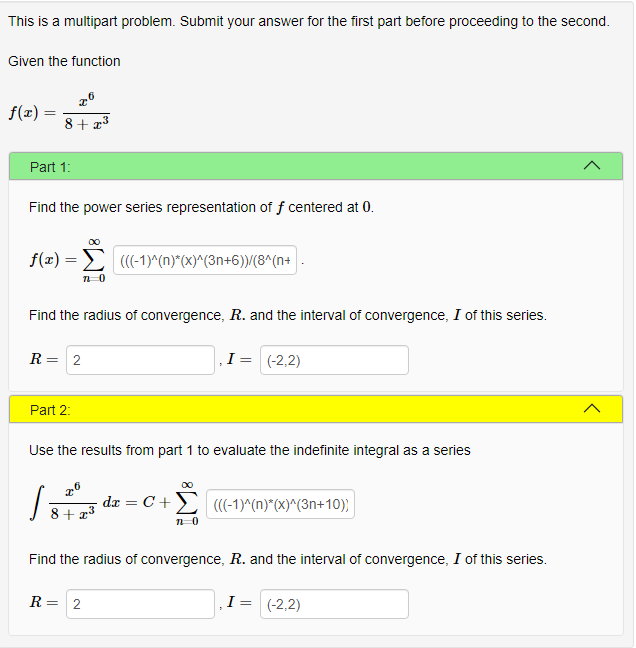
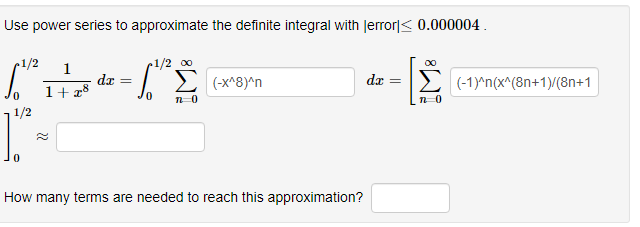
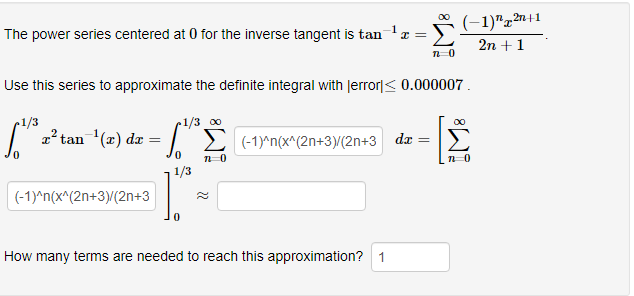
This is a multipart problem. Submit your answer for the first part before proceeding to the second. Given the function 32-2 f(I) = Part 1: A Find the power series representation of f centered at 0. f(x) = > ((3*x*(2))*(-1)^(n)*(x)"(6n)) Find the radius of convergence, R. and the interval of convergence, I of this series. R = 1 I = (-1,1) Part 2: Use the results from part 1 to find a power series representaion for the function g(x) = tan 1(23) Of. q(x) = f'(x) = > 7 0 OB. q(x) = [f(x) da = C+> ((3*x^(2))*(-1)^(n)*(x) n 0 Find the radius of convergence, R. and the interval of convergence, I of this series. R = I = (-1,1 )This is a multipart problem. Submit your answer for the first part before proceeding to the second. Given the function f(I) = 8 - I Part 1: A Find the power series representation of f centered at 0. f(x) = > (x*(2)/8)*(x/8)^(n) Find the radius of convergence, R. and the interval of convergence, I of this series. R = 8 I = (-8,8) Part 2: Use the results from part 1 to find a power series representaion for the function 16x 9(x) = (8-1)2 Of. q(x) = f'(x) = > B. g(x) = ff(x) dx = C+> Find the radius of convergence, R. and the interval of convergence, I of this series. R = 8 = (-8,8)This is a multipart problem. Submit your answer for the first part before proceeding to the second. Given the function 4x f(x) = - 8 Part 1: A Find the power series representation of f centered at 0. f(z) = > (-x/2)*(x/8)^(n) Find the radius of convergence, R. and the interval of convergence, I of this series. R = 8 = (-8,8) Part 2: A Use the results from part 1 to find a power series representaion for the function 32 9(I) = (x - 8)2 O A. ` g(x) = f'(x) = > OB. g(x) = ff(x) dx = C+> (-x/2)*(x/8)^(n) n 0 Find the radius of convergence, R. and the interval of convergence, I of this series. R = 8 I = (-8,8)This is a multipart problem. Submit your answer for the first part before proceeding to the second. Given the function f (I) = 8+ 23 Part 1: A Find the power series representation of f centered at 0. DO f(x) = > (((-1)"(n)*(x)"(3n+6))/(8*(n+ 7 0 Find the radius of convergence, R. and the interval of convergence, I of this series. R = 2 I = (-2,2) Part 2: A Use the results from part 1 to evaluate the indefinite integral as a series 8 + 3 di = c+> (((-1)"(n)*(x)*(3n+10)) Find the radius of convergence, R. and the interval of convergence, I of this series. R = 2 I = (-2,2)Use power series to approximate the definite integral with |error)
Step by Step Solution
There are 3 Steps involved in it

Get step-by-step solutions from verified subject matter experts
 Study Help