







Question: This is a question from FE 530 - Intro to Financial Engineering. We have to derive an equation. This question is not incomplete. This is
This is a question from FE 530 - Intro to Financial Engineering.
We have to derive an equation. This question is not incomplete. This is the complete data.
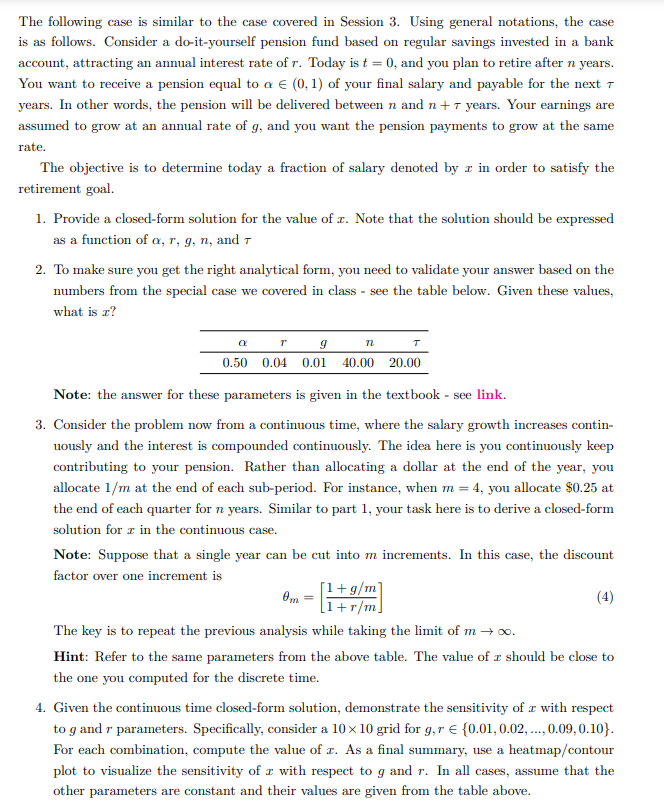
rI'he following case is similar to the case covered in Session 3. Using general notations. the case is as follows. Consider a do-it-yourself pension fund based on regular savings invested in a bank account, attracting an annual interest rate of 1'. Today is t = 0. and you plan to retire after 7: years. You want to receive a pension equal to a: E (0. 1) of your nal salary and payable for the next T years. In other words. the pension will be delivered between I: and n + 7' years. Your earnings are assumed to grow at an annual rate of g. and you want the pension payments to grow at the same rate. The objective is to determine today a fraction of salary denoted by J: in order to satisfy the retirement goal . l. 3. Provide a closed-form solution for the value of 1. Note that the solution should be expressed as a function of 0:, J", g. n. and T To make sure you get the right analytical form. you need to validate your answer based on the numbers from the special case we covered in class - see the table below. Given these values. what is 2:? m: r g- n T 0.50 0.04 0.01 40.00 20.00 Note: the answer for these parameters is given in the textbook - see link. Consider the problem now from a continuous time, where the salary growth increases contin- uously and the interest is compounded continuously. The idea here is you continuously keep contributing to your pension. Rather than allocating a dollar at the end of the year, you allocate l/m at the end of each subperiod. For instance. when m = 4. you allocate $0.25 at the end of each quarter for in years. Similar to part 1, your task here is to derive a closed-form solution for z in the continuous case. Note: Suppose that a single year can he cut into 111 increments. In this case. the discount 9m = [] [4) l rfm factor over one increment is rI'he key is to repeat the previous analysis while taking the limit of m ) co. Hint: Refer to the same parameters from the above table. The value of :1: should be close to the one you computed for the discrete time. Given the continuous time closed-form solution, demonstrate the sensitivity of a: with respect to g and 1" parameters. Specically, consider a 10 X 10 grid for 9.!" E {0.01, 0.02, ....0.09. 0.10}. For each combination. compute the value of I. As a nal summary. use a heatmapfcontour plot to visualize the sensitivity of :1: with respect to g and 1'. In all cases. assume that the other parameters are constant and their values are given from the table above
Step by Step Solution
There are 3 Steps involved in it

Get step-by-step solutions from verified subject matter experts
 Study Help