



Question: This is a question from my textbook, Please refer to the attachment to answer this question, thank you! ? Sum of sinusoids time series model.
This is a question from my textbook, Please refer to the attachment to answer this question, thank you!
?
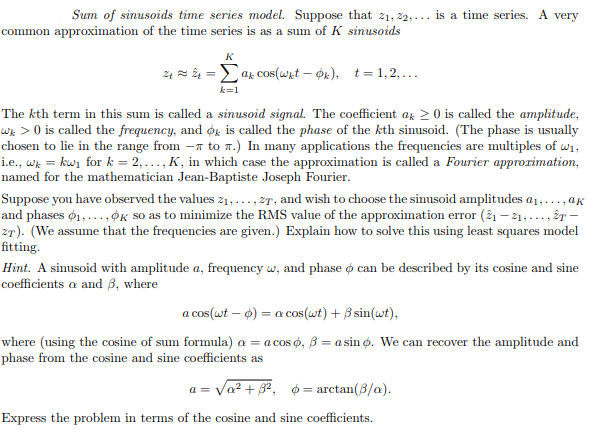
Sum of sinusoids time series model. Suppose that 21, 22,... is a time series. A very common approximation of the time series is as a sum of K sinusoids K 2 = = ) Ocos(wxt -0x), 1=1,2.... k=1 The kth term in this sum is called a sinusoid signal The coefficient ax 2 0 is called the amplitude. we >0 is called the frequency, and or is called the phase of the &th sinusoid. (The phase is usually chosen to lie in the range from -" to #.) In many applications the frequencies are multiples of w1, ie., wk = kwi for k = 2,.... K, in which case the approximation is called a Fourier approximation, named for the mathematician Jean-Baptiste Joseph Fourier. Suppose you have observed the values 21, ..., zy, and wish to choose the sinusoid amplitudes 01, . .., ak and phases $1, ...,ox so as to minimize the RMS value of the approximation error ($1 - 21, . .. ; iT - er). (We assume that the frequencies are given.) Explain how to solve this using least squares model fitting. Hint. A sinusoid with amplitude a, frequency w, and phase o can be described by its cosine and sine coefficients o and 8, where a cos(wt - o) = a cos(wt) + Bsin(wt). where (using the cosine of sum formula) o = acoso, 8 = asino. We can recover the amplitude and phase from the cosine and sine coefficients as a=vo-+8', = arctan(8/o). Express the problem in terms of the cosine and sine coefficients
Step by Step Solution
There are 3 Steps involved in it

Get step-by-step solutions from verified subject matter experts