







Question: This is a question from textbook Algorithm Design 1st edition Chapter 3 Exercise 7 http://www.chegg.com/homework-help/re-helping-security-analysts-monitor-collection-networked-co-chapter-3-problem-7E-solution-9780133072525-exc Some friends of yours work wireless networksre currently studying the
This is a question from textbook "Algorithm Design 1st edition" Chapter 3 Exercise 7
http://www.chegg.com/homework-help/re-helping-security-analysts-monitor-collection-networked-co-chapter-3-problem-7E-solution-9780133072525-exc
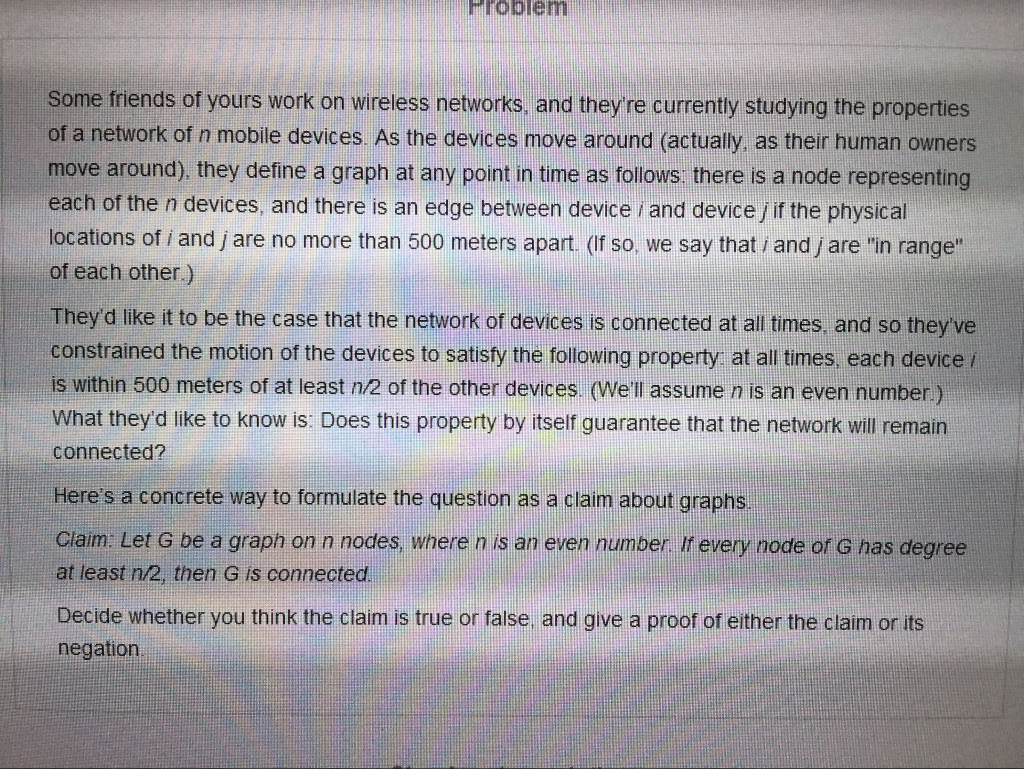
Some friends of yours work wireless networksre currently studying the properties on , and they of a network of n mobile devices. As the devices move around (actually, as their human Owners move each of around the n , devices they define , and a there graph is an at any edge point between in time device as follows and there devices is a if the node physical representing locations of i and j are no more than 500 meters apart. (If so, we say that i and jare "in range" of each other) They d like it to be the case that the network of devices is connected at all times, and so they 've constrained the motion of the devices to satisfy the following property at all times , each device 1 is within 500 meters of at least 2 of the other devices. (We assume n is an even number. What theyd like to know is: Does this property by itself guarantee that the network will remain connected? Here's a concrete way to formulate the question as a claim about graphs. Claim: Let G be a graph on n nodes, where in is an even number, if every node of G has degree at least n2, then G is connected. Decide whether you think the claim is true or false, and give a proof of either the claim or its negation
Step by Step Solution
There are 3 Steps involved in it

Get step-by-step solutions from verified subject matter experts
 Study Help