







Question: This is a time-sensitive question and I would appreciate a detailed explanation. I will absolutely submit a positive review and give a thumbs up! Please
This is a time-sensitive question and I would appreciate a detailed explanation. I will absolutely submit a positive review and give a thumbs up! Please submit in one hour and 30 minutes!
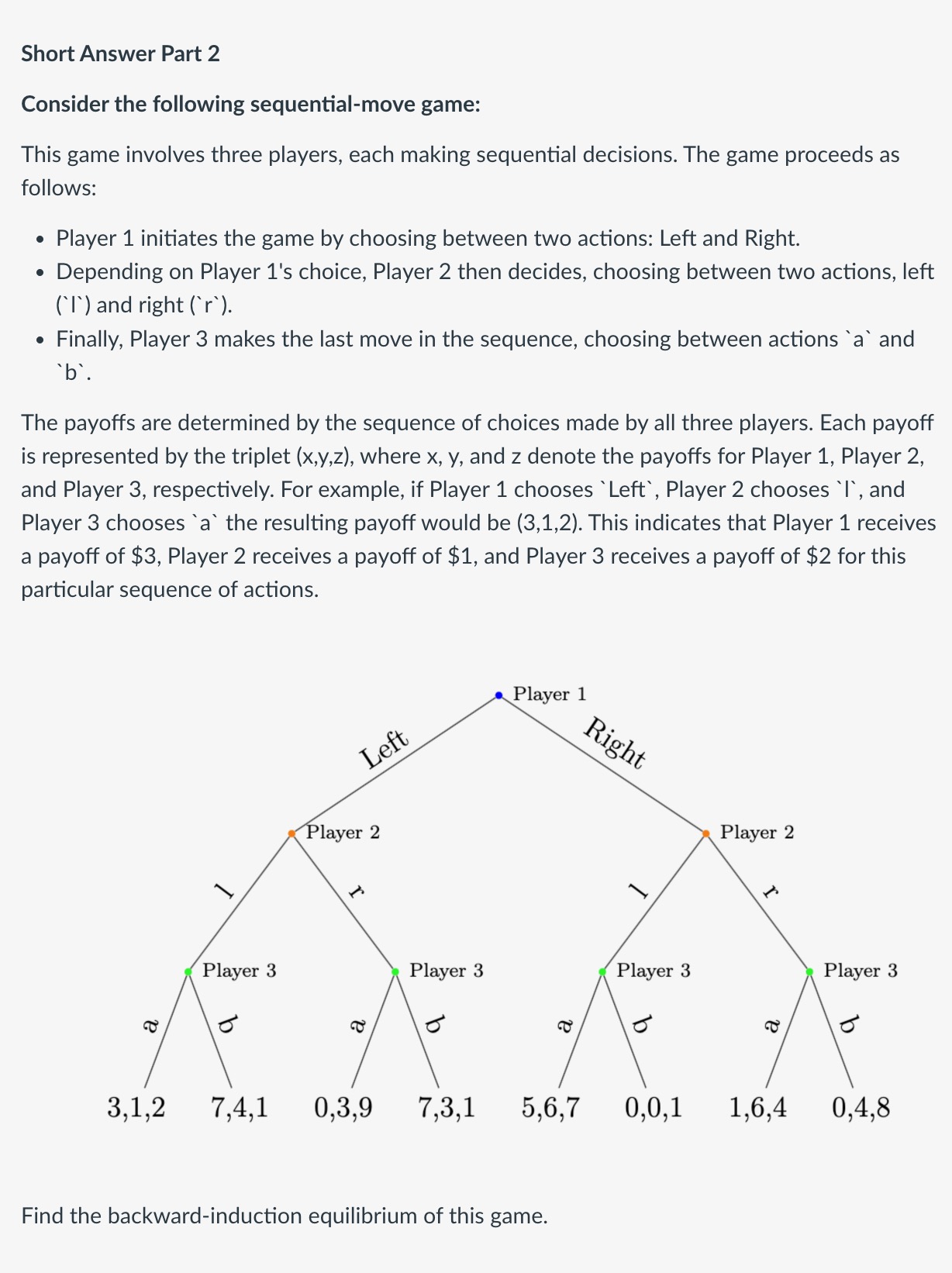
Short Answer Part 2 Consider the following sequential-move game: This game involves three players, each making sequential decisions. The game proceeds as follows: Player 1 initiates the game by choosing between two actions: Left and Right. Depending on Player 1's choice, Player 2 then decides, choosing between two actions, left ('I') and right ('r'). Finally, Player 3 makes the last move in the sequence, choosing between actions "a\" and b The payoffs are determined by the sequence of choices made by all three players. Each payoff is represented by the triplet (x,y,z), where X, y, and z denote the payoffs for Player 1, Player 2, and Player 3, respectively. For example, if Player 1 chooses "Left", Player 2 chooses 'I', and Player 3 chooses "a" the resulting payoff would be (3,1,2). This indicates that Player 1 receives a payoff of $3, Player 2 receives a payoff of $1, and Player 3 receives a payoff of $2 for this particular sequence of actions. N Player 3 Player 3 Player 3 Player 3 f/ k f/ \\f f/ \\f =/ Xf 312 741 039 731 567 001 164 04,8 Find the backward-induction equilibrium of this game
Step by Step Solution
There are 3 Steps involved in it

Get step-by-step solutions from verified subject matter experts
 Study Help