







Question: This is a trend analysis question from the book Designing experiments and analyzing data: A model comparison perspective (2th edition), Chapter 6's exercise section. An
This is a trend analysis question from the book "Designing experiments and analyzing data: A model comparison perspective" (2th edition), Chapter 6's exercise section.
An interesting question to developmental psychologists is whether children's generosity (or altruism) steadily increases with age. The following study is modeled after an experiment reported in Zarbatany, L., Hartmann, D. P., & Gelfand, D. M. (1985). Why does children's generosity increase with age: Susceptibility to experimenter influence or altruism?Child Development, 56,746-756. First-, third-, and fifth-grade children were allowed to select from among four alternatives what they would do if a fixed amount of money were donated to their school. A separate group of children of similar ages was used to create a generosity scale, using a paired-comparisons format. (It is interesting that in the actual study, the experimenters also used a scale with rational weights and obtained different results for the two weighting schemes.) Consider the following data, where each score represents the rating of the child's chosen alternative on the generosity scale:
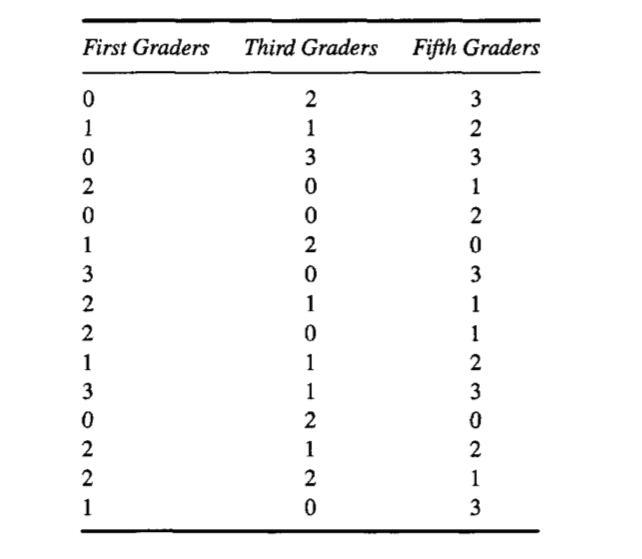
First Graders Third Graders Fifth Graders ON N N N N ON ON DOWN N ANN OWN N N WHONONO W AN OWN - - WONA WN W
Step by Step Solution
There are 3 Steps involved in it

Get step-by-step solutions from verified subject matter experts
 Study Help