







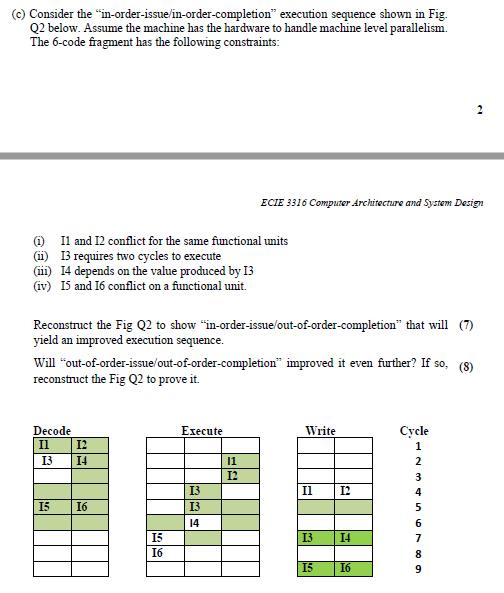
Question: This is above is Fig 2 (c) Consider the in-order-issue/in-order-completion execution sequence shown in Fig. Q2 below. Assume the machine has the hardware to handle
This is above is Fig 2
(c) Consider the "in-order-issue/in-order-completion" execution sequence shown in Fig. Q2 below. Assume the machine has the hardware to handle machine level parallelism. The 6-code fragment has the following constraints: ECIE 3316 Computer Architecture and System Design I1 and 12 conflict for the same functional units (1) 13 requires two cycles to execute (111) 14 depends on the value produced by 13 (iv) 15 and 16 conflict on a functional unit. Reconstruct the Fig Q2 to show "in-order-issue/out-of-order-completion" that will (7) yield an improved execution sequence. Will "out-of-order-issue out-of-order-completion" improved it even futher? If so, (8) reconstruct the Fig Q2 to prove it. Execute Write Decode Il 12 13 14 11 I2 Il 12 Cycle 1 2 3 4 5 6 7 8 9 IS 13 13 14 16 13 14 IS 16 15 16 (c) Consider the "in-order-issue/in-order-completion" execution sequence shown in Fig. Q2 below. Assume the machine has the hardware to handle machine level parallelism. The 6-code fragment has the following constraints: ECIE 3316 Computer Architecture and System Design I1 and 12 conflict for the same functional units (1) 13 requires two cycles to execute (111) 14 depends on the value produced by 13 (iv) 15 and 16 conflict on a functional unit. Reconstruct the Fig Q2 to show "in-order-issue/out-of-order-completion" that will (7) yield an improved execution sequence. Will "out-of-order-issue out-of-order-completion" improved it even futher? If so, (8) reconstruct the Fig Q2 to prove it. Execute Write Decode Il 12 13 14 11 I2 Il 12 Cycle 1 2 3 4 5 6 7 8 9 IS 13 13 14 16 13 14 IS 16 15 16
Step by Step Solution
There are 3 Steps involved in it

Get step-by-step solutions from verified subject matter experts
 Study Help