







Question: this is all one code please make it right and asap Four integers are read from input, where the first two integers are the real
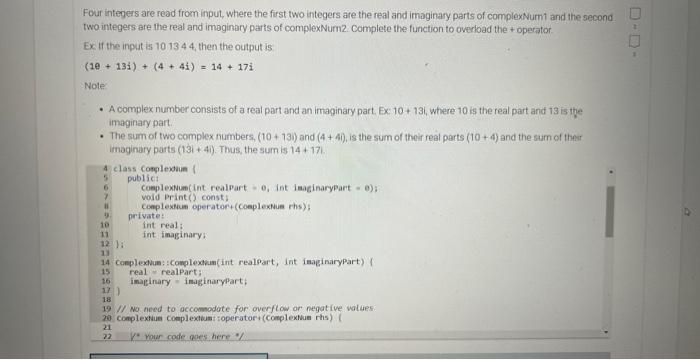
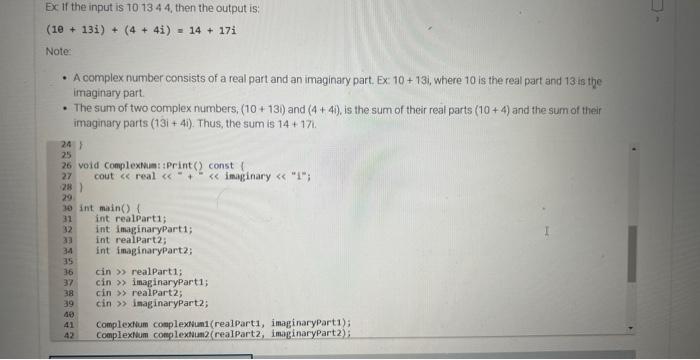
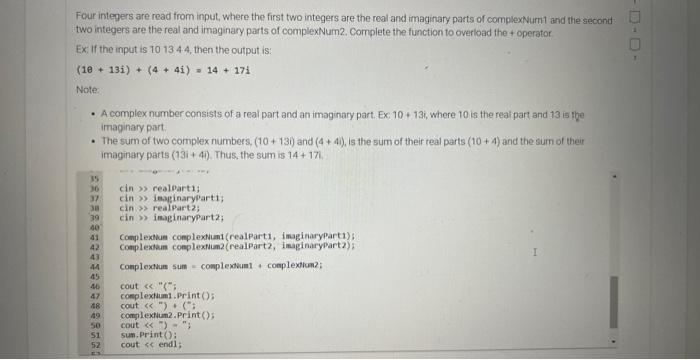
Four integers are read from input, where the first two integers are the real and imaginary parts of complexNum1 and the secont two integers are the real and imaginary parts of complexNurn2. Complete the function to overload the + operator. Ex. If the input is 101344 , then the output is (10+13i)+(4+4i)=14+17i Note: - A complex number consists of a real part and an imaginary part. Ex:10+ 131 , where 10 is the real part and 19 is the imaginary part. - The sum of two complex numbers, (10+73) and (4+41), is the sum of their real parts (10+4) and the surn of their imaginary parts (13i+4i). Thus, the sum is 14+171. Ex If the input is 101344 , then the output is: (10+13i)+(4+4i)=14+17i Note: - A complex number consists of a real part and an imaginary part. Ex: 10+13i, where 10 is the real part and 13 is the imaginary part. - The sum of two complex numbers, (10+13i) and (4+4i), is the sum of their real parts (10+4) and the sum of their imaginary parts (13i+4i). Thus, the sum is 14+17i. Four integers are read from input, where the first two integers are the real and imaginary parts of complexNumt and the second two integers are the real and imaginary parts of complexNum2. Complete the function to overload the + operator. Ex. If the input is 101344 , then the output is: (1e+13i)+(4+4i)=14+17i Note: - A complex number consists of a real part and an imaginary part. Ex: 10+13i, where 10 is the real part and 13 is the imaginary part. - The surn of two complex numbers, (10+13i) and (4+4). is the sum of their real parts (10+4) and the sum of their imaginary parts (13i+4i). Thus, the sum is 14+17i
Step by Step Solution
There are 3 Steps involved in it

Get step-by-step solutions from verified subject matter experts
 Study Help