







Question: THIS IS ALL ONE QUESTION, IT IS JUST MULTI-PART. This is also the only information that I have. You are interested in opening a new
THIS IS ALL ONE QUESTION, IT IS JUST MULTI-PART. This is also the only information that I have.
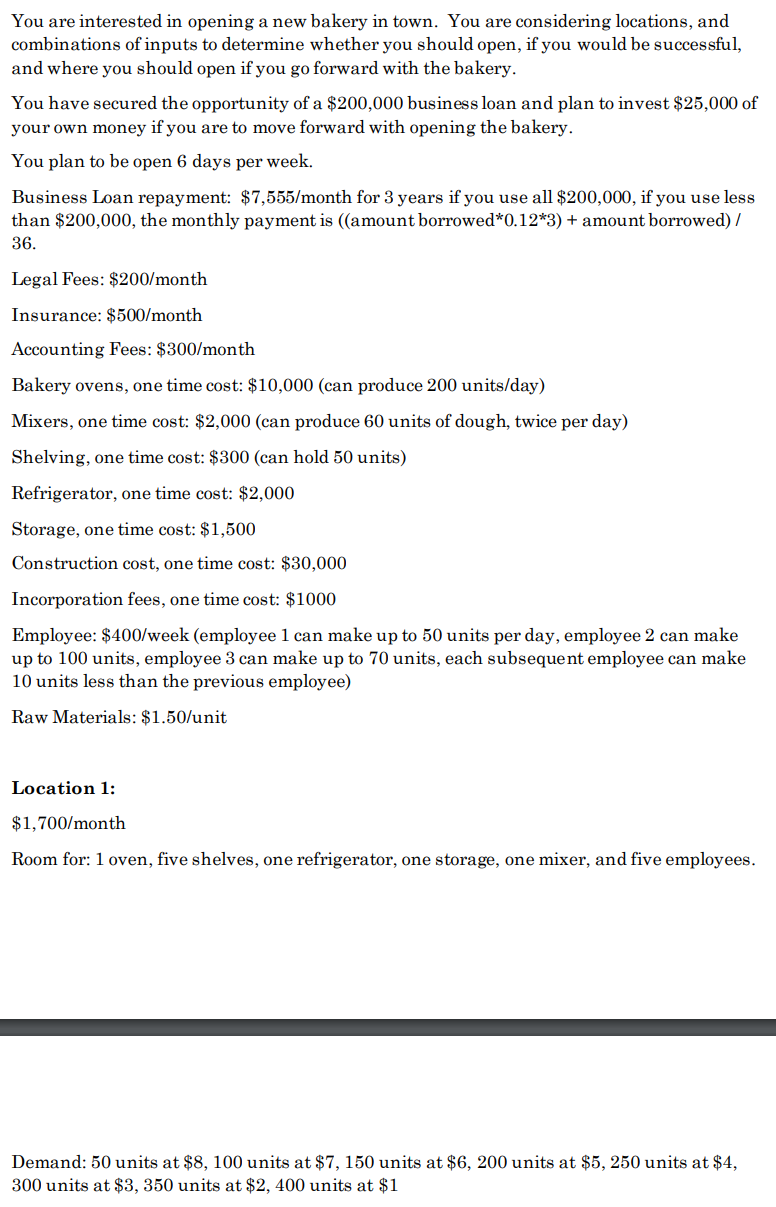
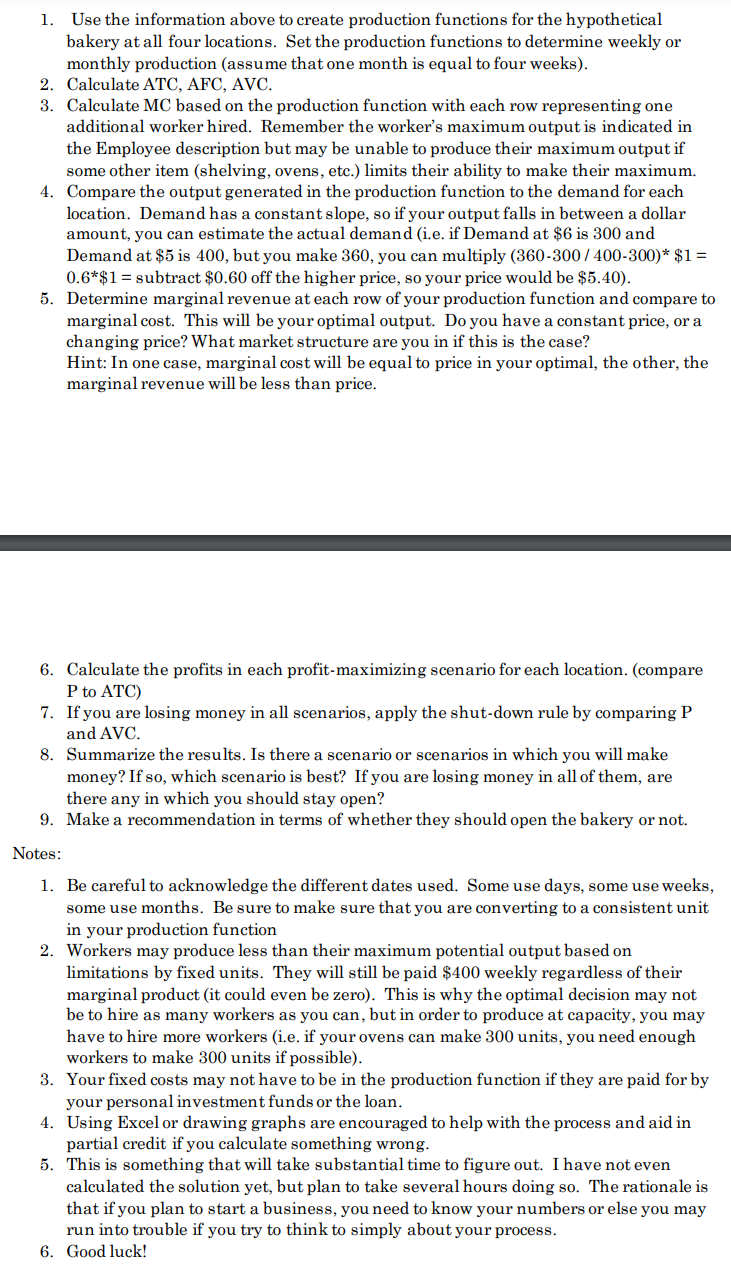
You are interested in opening a new bakery in town. You are considering locations, and combinations of inputs to determine whether you should open, if you would be successful, and where you should open if you go forward with the bakery. You have secured the opportunity of a $200,000 business loan and plan to invest $25,000 of your own money if you are to move forward with opening the bakery. You plan to be open 6 days per week. Business Loan repayment: $7,555/ month for 3 years if you use all $200,000, if you use less than $200,000, the monthly payment is ((amount borrowed 0.123)+ amount borrowed) / 36. Legal Fees: $200/ month Insurance: $500/ month Accounting Fees: $300/ month Bakery ovens, one time cost: $10,000 (can produce 200 units/day) Mixers, one time cost: $2,000 (can produce 60 units of dough, twice per day) Shelving, one time cost: $300 (can hold 50 units) Refrigerator, one time cost: $2,000 Storage, one time cost: $1,500 Construction cost, one time cost: $30,000 Incorporation fees, one time cost: $1000 Employee: $400 /week (employee 1 can make up to 50 units per day, employee 2 can make up to 100 units, employee 3 can make up to 70 units, each subsequent employee can make 10 units less than the previous employee) Raw Materials: $1.50 /unit Location 1: $1,700/ month Room for: 1 oven, five shelves, one refrigerator, one storage, one mixer, and five employees. Demand: 50 units at $8,100 units at $7,150 units at $6,200 units at $5,250 units at $4, 300 units at $3,350 units at $2,400 units at $1 1. Use the information above to create production functions for the hypothetical bakery at all four locations. Set the production functions to determine weekly or monthly production (assume that one month is equal to four weeks). 2. Calculate ATC, AFC, AVC. 3. Calculate MC based on the production function with each row representing one additional worker hired. Remember the worker's maximum output is indicated in the Employee description but may be unable to produce their maximum output if some other item (shelving, ovens, etc.) limits their ability to make their maximum. 4. Compare the output generated in the production function to the demand for each location. Demand has a constant slope, so if your output falls in between a dollar amount, you can estimate the actual demand (i.e. if Demand at $6 is 300 and Demand at $5 is 400 , but you make 360 , you can multiply (360-300/400-300)* $1= 0.6$1= subtract $0.60 off the higher price, so your price would be $5.40 ). 5. Determine marginal revenue at each row of your production function and compare to marginal cost. This will be your optimal output. Do you have a constant price, or a changing price? What market structure are you in if this is the case? Hint: In one case, marginal cost will be equal to price in your optimal, the other, the marginal revenue will be less than price. 6. Calculate the profits in each profit-maximizing scenario for each location. (compare P to ATC) 7. If you are losing money in all scenarios, apply the shut-down rule by comparing P and AVC. 8. Summarize the results. Is there a scenario or scenarios in which you will make money? If so, which scenario is best? If you are losing money in all of them, are there any in which you should stay open? 9. Make a recommendation in terms of whether they should open the bakery or not. Notes: 1. Be careful to acknowledge the different dates used. Some use days, some use weeks, some use months. Be sure to make sure that you are converting to a consistent unit in your production function 2. Workers may produce less than their maximum potential output based on limitations by fixed units. They will still be paid $400 weekly regardless of their marginal product (it could even be zero). This is why the optimal decision may not be to hire as many workers as you can, but in order to produce at capacity, you may have to hire more workers (i.e. if your ovens can make 300 units, you need enough workers to make 300 units if possible). 3. Your fixed costs may not have to be in the production function if they are paid for by your personal investment funds or the loan. 4. Using Excel or drawing graphs are encouraged to help with the process and aid in partial credit if you calculate something wrong. 5. This is something that will take substantial time to figure out. I have not even calculated the solution yet, but plan to take several hours doing so. The rationale is that if you plan to start a business, you need to know your numbers or else you may run into trouble if you try to think to simply about your process. 6. Good luck! You are interested in opening a new bakery in town. You are considering locations, and combinations of inputs to determine whether you should open, if you would be successful, and where you should open if you go forward with the bakery. You have secured the opportunity of a $200,000 business loan and plan to invest $25,000 of your own money if you are to move forward with opening the bakery. You plan to be open 6 days per week. Business Loan repayment: $7,555/ month for 3 years if you use all $200,000, if you use less than $200,000, the monthly payment is ((amount borrowed 0.123)+ amount borrowed) / 36. Legal Fees: $200/ month Insurance: $500/ month Accounting Fees: $300/ month Bakery ovens, one time cost: $10,000 (can produce 200 units/day) Mixers, one time cost: $2,000 (can produce 60 units of dough, twice per day) Shelving, one time cost: $300 (can hold 50 units) Refrigerator, one time cost: $2,000 Storage, one time cost: $1,500 Construction cost, one time cost: $30,000 Incorporation fees, one time cost: $1000 Employee: $400 /week (employee 1 can make up to 50 units per day, employee 2 can make up to 100 units, employee 3 can make up to 70 units, each subsequent employee can make 10 units less than the previous employee) Raw Materials: $1.50 /unit Location 1: $1,700/ month Room for: 1 oven, five shelves, one refrigerator, one storage, one mixer, and five employees. Demand: 50 units at $8,100 units at $7,150 units at $6,200 units at $5,250 units at $4, 300 units at $3,350 units at $2,400 units at $1 1. Use the information above to create production functions for the hypothetical bakery at all four locations. Set the production functions to determine weekly or monthly production (assume that one month is equal to four weeks). 2. Calculate ATC, AFC, AVC. 3. Calculate MC based on the production function with each row representing one additional worker hired. Remember the worker's maximum output is indicated in the Employee description but may be unable to produce their maximum output if some other item (shelving, ovens, etc.) limits their ability to make their maximum. 4. Compare the output generated in the production function to the demand for each location. Demand has a constant slope, so if your output falls in between a dollar amount, you can estimate the actual demand (i.e. if Demand at $6 is 300 and Demand at $5 is 400 , but you make 360 , you can multiply (360-300/400-300)* $1= 0.6$1= subtract $0.60 off the higher price, so your price would be $5.40 ). 5. Determine marginal revenue at each row of your production function and compare to marginal cost. This will be your optimal output. Do you have a constant price, or a changing price? What market structure are you in if this is the case? Hint: In one case, marginal cost will be equal to price in your optimal, the other, the marginal revenue will be less than price. 6. Calculate the profits in each profit-maximizing scenario for each location. (compare P to ATC) 7. If you are losing money in all scenarios, apply the shut-down rule by comparing P and AVC. 8. Summarize the results. Is there a scenario or scenarios in which you will make money? If so, which scenario is best? If you are losing money in all of them, are there any in which you should stay open? 9. Make a recommendation in terms of whether they should open the bakery or not. Notes: 1. Be careful to acknowledge the different dates used. Some use days, some use weeks, some use months. Be sure to make sure that you are converting to a consistent unit in your production function 2. Workers may produce less than their maximum potential output based on limitations by fixed units. They will still be paid $400 weekly regardless of their marginal product (it could even be zero). This is why the optimal decision may not be to hire as many workers as you can, but in order to produce at capacity, you may have to hire more workers (i.e. if your ovens can make 300 units, you need enough workers to make 300 units if possible). 3. Your fixed costs may not have to be in the production function if they are paid for by your personal investment funds or the loan. 4. Using Excel or drawing graphs are encouraged to help with the process and aid in partial credit if you calculate something wrong. 5. This is something that will take substantial time to figure out. I have not even calculated the solution yet, but plan to take several hours doing so. The rationale is that if you plan to start a business, you need to know your numbers or else you may run into trouble if you try to think to simply about your process. 6. Good luck
Step by Step Solution
There are 3 Steps involved in it

Get step-by-step solutions from verified subject matter experts
 Study Help