







Question: This is all part of the same question. Answer Options for first part Blank 1. Net Profit Margin OR Gross Profit Margin Blank 2. Equity
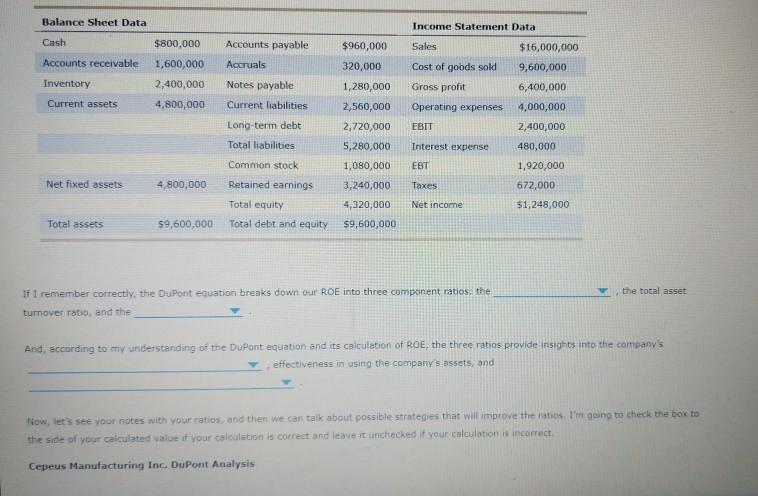
This is all part of the same question. Answer Options for first part Blank 1. Net Profit Margin OR Gross Profit Margin Blank 2. Equity Ratio OR Equity Multiplier Blank 3. Use of debt versus equity financing OR Management of it's sales and share price Blank 4. Management of it's liquidity and it's tax records OR Control over it's expenses
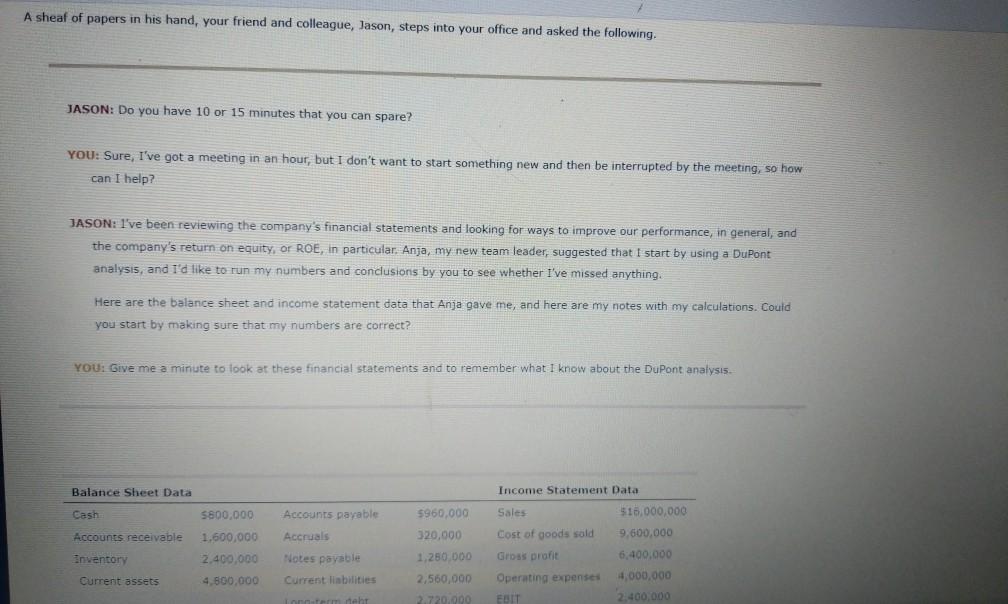
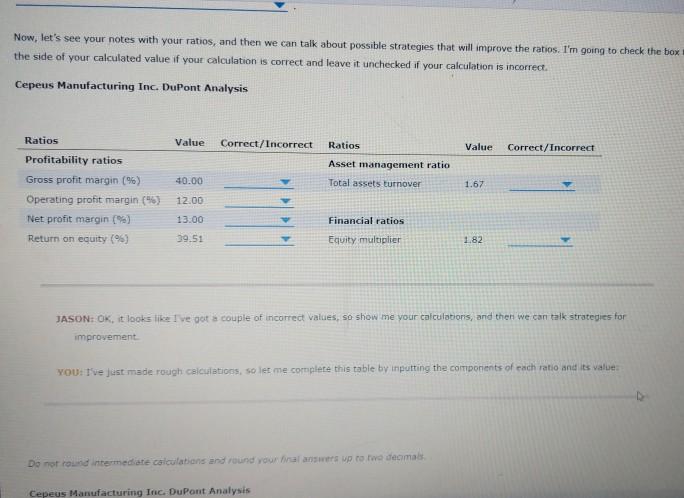
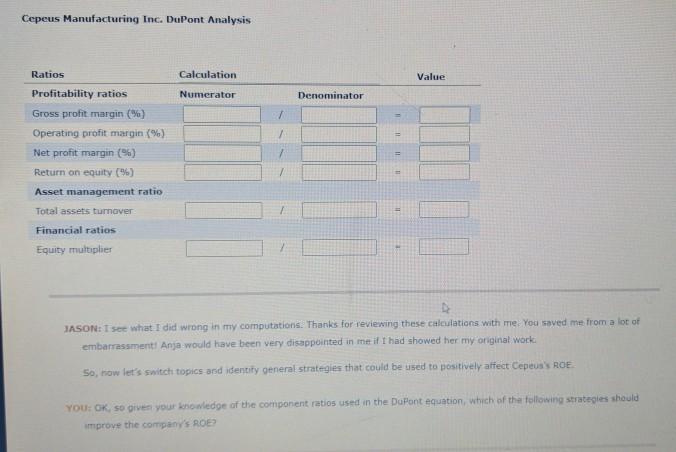
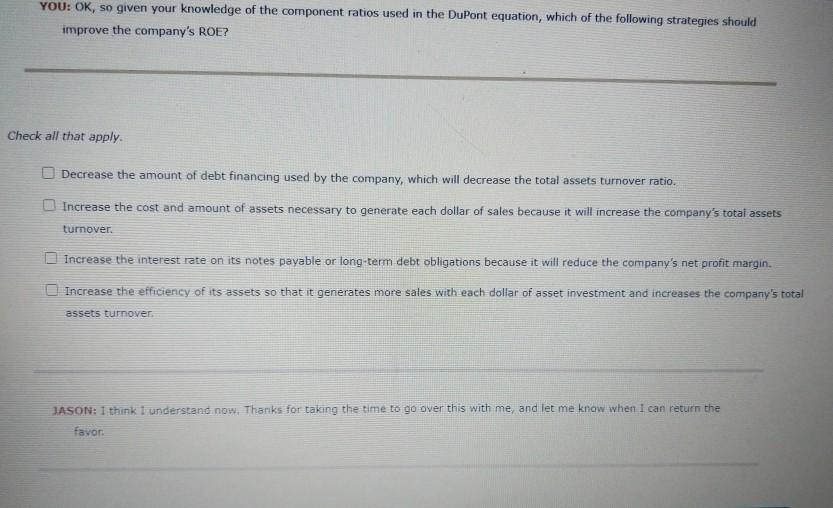
A sheaf of papers in his hand, your friend and colleague, Jason, steps into your office and asked the following. JASON: Do you have 10 or 15 minutes that you can spare? YOU: Sure, I've got a meeting in an hour, but I don't want to start something new and then be interrupted by the meeting, so how can I help? JASON: I've been reviewing the company's financial statements and looking for ways to improve our performance, in general, and the company's return on equity, or ROE, in particular. Anja, my new team leader, suggested that I start by using a DuPont analysis, and I'd like to run my numbers and conclusions by you to see whether I've missed anything. Here are the balance sheet and income statement data that Anja gave me, and here are my notes with my calculations. Could you start by making sure that my numbers are correct? YOU: Give me a minute to look at these financial statements and to remember what I know about the DuPont analysis. Balance Sheet Data Cash $800,000 Accounts receivable 1,600,000 2,400,000 4.800,000 Accounts payable Accruals Notes payable Current liabilities nehr $960,000 320,000 1,280,000 2,560,000 Inventory Current assets Income Statement Data Sales $15,000,000 Cost of goods sold 9,600,000 Gross profit 6,400.000 Operating expenses 4,000,000 EBIT 2.400,000 2.720.000 Balance Sheet Data Income Statement Data Cash Accounts payable Sales $800,000 1,600,000 Accounts receivable $960,000 320,000 Accruals $16,000,000 9,600,000 6,400,000 Inventory 2,400,000 4,800,000 Notes payable Current liabilities Cost of goods sold Gross profit Operating expenses EBIT Current assets 1,280,000 2,560,000 2,720,000 5,280,000 4,000,000 Long-term debt 2,400,000 Total liabilities Interest expense 480,000 Common stock 1,080,000 1,920,000 Net fixed assets 4,800,000 Retained earnings Taxes 3,240,000 4,320,000 59,600,000 672,000 $1,248,000 Total equity Net income Total assets $9,600,000 Total debt and equity the total asset If I remember correctly, the DuPont equation breaks down our ROE into three component ratios, the turnover ratio, and the And, according to my understanding of the DuPont equation and its calculation of ROE, the three ratios provide insights into the company's effectiveness in using the company s assets, and Now, let's see vour notes with your ratios, and then we can talk about possible strategies that will improve the ratio. I'm going to check the box to the side of your calculated value if your calculation is correct and leave it unchecked if your calculation is incorrect Cepeus Manufacturing Inc. DuPont Analysis Now, let's see your notes with your ratios, and then we can talk about possible strategies that will improve the ratios. I'm going to check the box the side of your calculated value if your calculation is correct and leave it unchecked if your calculation is incorrect Cepeus Manufacturing Inc. DuPont Analysis Value Correct/Incorrect Ratios Value Correct/Incorrect 40.00 Ratios Profitability ratios Gross profit margin (96) Operating profit margin (%) Net profit margin (%) Return on equity (95) Asset management ratio Total assets turnover 1.67 12.00 13:00 Financial ratios 39.51 Equity multiplier 1.82 JASON: OK, it looks like I've got a couple of incorrect values, so show me your calculations, and then we can talk strategies for improvement YOU: I've just made rough calculations, so let me complete this table by inputting the components of each ratio and its value Do not round Intermediate calculations and round your flaws up to two decimals Cepeus Manufacturing Inc. DuPont Analysis Cepeus Manufacturing Inc. DuPont Analysis Calculation Value Numerator Denominator Ratios Profitability ratios Gross profit margin (%) Operating profit margin (%) Net profit margin () Return on equity (%) Asset management ratio Total assets turnover Financial ratios Equity multiplier JASON: I see what I did wrong in my computations. Thanks for reviewing these calculations with me. You saved me from a lot of embarrassment Anja would have been very disappointed in me if I had showed her my original work So, now let's switch topics and identity general strategies that could be used to positively affect Cepeus' ROE YOU: OK, so given your knowledge of the component ratios used in the DuPont equation, which of the following strategies should improve the company's ROE YOU: OK, so given your knowledge of the component ratios used in the DuPont equation, which of the following strategies should improve the company's ROE? Check all that apply. Decrease the amount of debt financing used by the company, which will decrease the total assets turnover ratio. Increase the cost and amount of assets necessary to generate each dollar of sales because it will increase the company's total assets turnover. Increase the interest rate on its notes payable or long-term debt obligations because it will reduce the company's net profit margin. Increase the efficiency of its assets so that it generates more sales with each dollar of asset investment and increases the company's total assets turnover. JASON: I think I understand now. Thanks for taking the time to go over this with me, and let me know when I can return the favor
Step by Step Solution
There are 3 Steps involved in it

Get step-by-step solutions from verified subject matter experts
 Study Help